
Mai Tai
Aged rum, orange curaçao, orgeat and lime, shaken briefly and poured ice and all over crushed ice.
The same four spirits, built and swizzled straight in the glass rather than shaken.
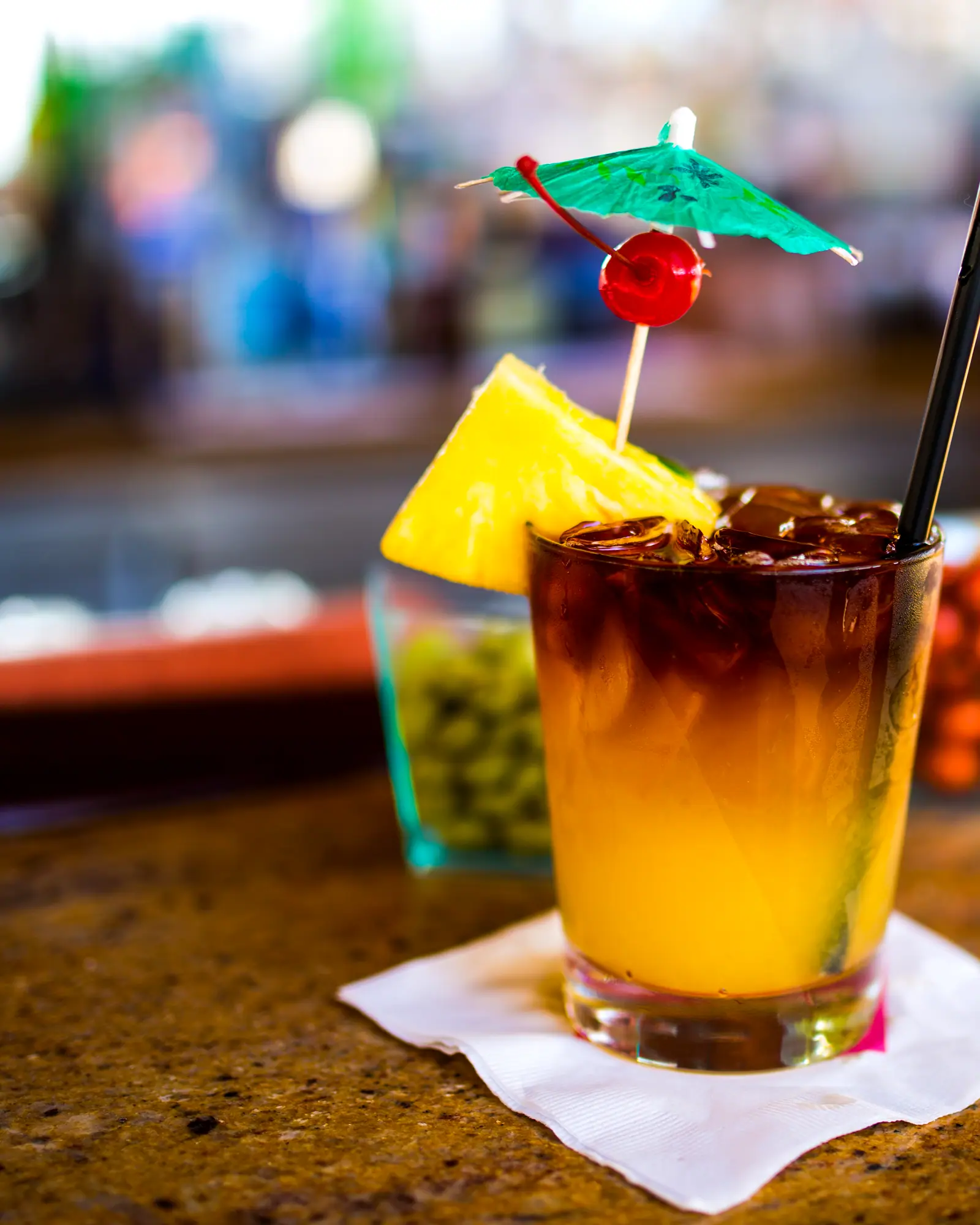

CC BY-SA 2.0 · Cropped, white-balanced, graded and re-encoded to WebP by eXir.
A Mai Tai in a rocks glass over crushed ice, dark rum floated over orange, garnished with a pineapple wedge, cherry and paper umbrella
Serving
Drink spec, per drink
Every figure above is per drink and does not move with the count, which is what makes the two service modes comparable. Sugar per litre, strength and standard drinks stay in the units their own authorities publish, because they are figures for comparing rather than for pouring. Dilution is modelled rather than measured, as a fraction of the poured volume before any ice; dotted figures descend from that estimate.
Diet and allergen labels are computed from the ingredients listed on this page and nothing else. They cannot account for cross-contamination or for the particular product you buy, and they are not medical or safety guidance.
Ingredients
 30 ml fresh lime juice
 60 ml dark rumInterchangeable by volume and at the same strength, so the arithmetic barely moves. The drink loses the molasses and oak notes the orgeat and curaçao are built to sit against and reads considerably thinner.flavour: significant change · strength: no change · sweetness: no change
 15 ml orange curaçao
 15 ml orgeat
- 7.5 ml rich syrup
 2 g mint
Glass
Vessel
128 ml of liquid plus 187 ml of crushed ice occupies about 315 ml, inside the 400 ml the glass holds. The build fails if a recipe ever exceeds its stated vessel.
A batch needs a vessel that closes and fits a fridge shelf.
Drink spec, per drink
Every figure above is per drink and does not move with the count, which is what makes the two service modes comparable. Sugar per litre, strength and standard drinks stay in the units their own authorities publish, because they are figures for comparing rather than for pouring. Dilution is modelled rather than measured, as a fraction of the poured volume before any ice; dotted figures descend from that estimate.
Diet and allergen labels are computed from the ingredients listed on this page and nothing else. They cannot account for cross-contamination or for the particular product you buy, and they are not medical or safety guidance.
Ingredients
- 30 ml fresh lime juice
- 60 ml dark rumInterchangeable by volume and at the same strength, so the arithmetic barely moves. The drink loses the molasses and oak notes the orgeat and curaçao are built to sit against and reads considerably thinner.flavour: significant change · strength: no change · sweetness: no change
- 15 ml orange curaçao
- 15 ml orgeat
- 2 g mint
- 30 ml fresh lime juice
- 60 ml dark rum
- 15 ml orange curaçao
- 15 ml orgeat
- 2 g mint
- ~108 ml water
Glass
Vessel
120 ml of liquid plus 187 ml of crushed ice occupies about 307 ml, inside the 400 ml the glass holds. The build fails if a recipe ever exceeds its stated vessel.
A batch needs a vessel that closes and fits a fridge shelf.
Method
5 steps · 1m 42sSqueeze the 30 ml fresh lime juice and strain out the pips and pulp.
Combine the 60 ml dark rum, the 30 ml fresh lime juice, the 15 ml orange curaçao, the 15 ml orgeat and the 7.5 ml rich syrup in a shaker with a scoop of crushed ice.
Shake hard but briefly for 12s, just long enough to chill the drink without fully melting the ice it was shaken with.
Shaken briefly with crushed rather than cubed ice and poured out unstrained, so the ice that did the chilling stays in the glass and keeps working on the drink as it is drunk. A cube would do the same job more slowly and melt into a puddle instead of a texture.
Pour the whole contents, ice and all, into a double old fashioned glass packed with fresh crushed ice.
Set the 2 g mint beside the straw so its aroma reaches the drinker on every sip.
Common pitfallOrgeat separates and thickens in the fridge, and a bottle poured straight from cold measures short and sweetens the drink unevenly. It needs a shake of its own before it goes anywhere near the jigger.
Keeping and make-ahead
Batched ahead, this keeps sealed and cold. The water line the engine adds is the dilution figure from the spec panel, not a rule of thumb.
Method
4 steps · 1m 40sSqueeze the 30 ml fresh lime juice and strain out the pips and pulp.
Pack a double old fashioned glass with crushed ice, then pour in the 60 ml dark rum, the 30 ml fresh lime juice, the 15 ml orange curaçao and the 15 ml orgeat straight over it.
Plunge a swizzle stick to the bottom of the glass and spin it between the palms for 20s, working up and down through the ice until the outside of the glass frosts over.
Built straight into the glass and worked with a swizzle stick rather than shaken in a tin. Spinning the stick between the palms drags crushed ice up through the liquid instead of the liquid down through the ice, so the glass frosts on the outside as the drink comes together.
Set the 2 g mint beside the straw so its aroma reaches the drinker on every sip.
Common pitfallSkimping on the ice is the way this technique goes wrong: a glass that is not packed full before swizzling has nothing for the stick to drag through, and the drink chills unevenly and never frosts the glass.
Keeping and make-ahead
Batched ahead, this keeps sealed and cold. The water line the engine adds is the dilution figure from the spec panel, not a rule of thumb.
About
A tiki drink whose invention is claimed by two rival Californian restaurateurs, settled in court on naming rights rather than history, and named, by its own inventor's account, for a Tahitian exclamation of approval.
Victor Bergeron, known as Trader Vic, said he invented the drink in 1944 at his restaurant in Oakland, California, from aged Jamaican rum, orange curaçao, orgeat, rock candy syrup and fresh lime 1. By his own account, Tahitian friends visiting the bar tasted it and said "Mai Tai — roa ae," meaning roughly "out of this world, the best," which he took as the name 2 1.
Ernest Beaumont-Gantt, known as Don the Beachcomber, disputed this. He had served a drink called the Q.B. Cooler at his own competing Los Angeles bar as early as 1933, and later argued the Mai Tai was built on it 2. The two drinks are not identical (Beach's recipe is generally described as the more complex of the pair), and accounts differ on how closely the two actually taste alike 2. The case for Beach's priority rests substantially on an account from his widow, Phoebe, rather than on a contemporary written record, while Bergeron's own claim is undercut by the absence of any Mai Tai in his own bar guides published in 1946 and 1947 1.
The dispute reached a courtroom only indirectly. In 1970, a citrus company that had licensed the Don the Beachcomber name attempted to trademark a Mai Tai mix, and Trader Vic's sued over the right to the name; the case settled that year in Bergeron's favour, backed by a signed affidavit from Carrie Guild, one of the Tahitian guests he credited with naming the drink 2 1. The settlement fixed who could sell a Mai Tai commercially. It did not, and does not, settle who mixed the first one.
- 1History of the Mai Taiultimatemaitai.com
- 2Mai Taien.wikipedia.org