
Kombucha
Sweet black tea fermented for a week with a live SCOBY into a tart, lightly sour drink.
Primary kombucha flavoured with ginger and bottled sealed for a few days to build real carbonation.

Public domain · Cropped, white-balanced, graded and re-encoded to WebP by eXir.
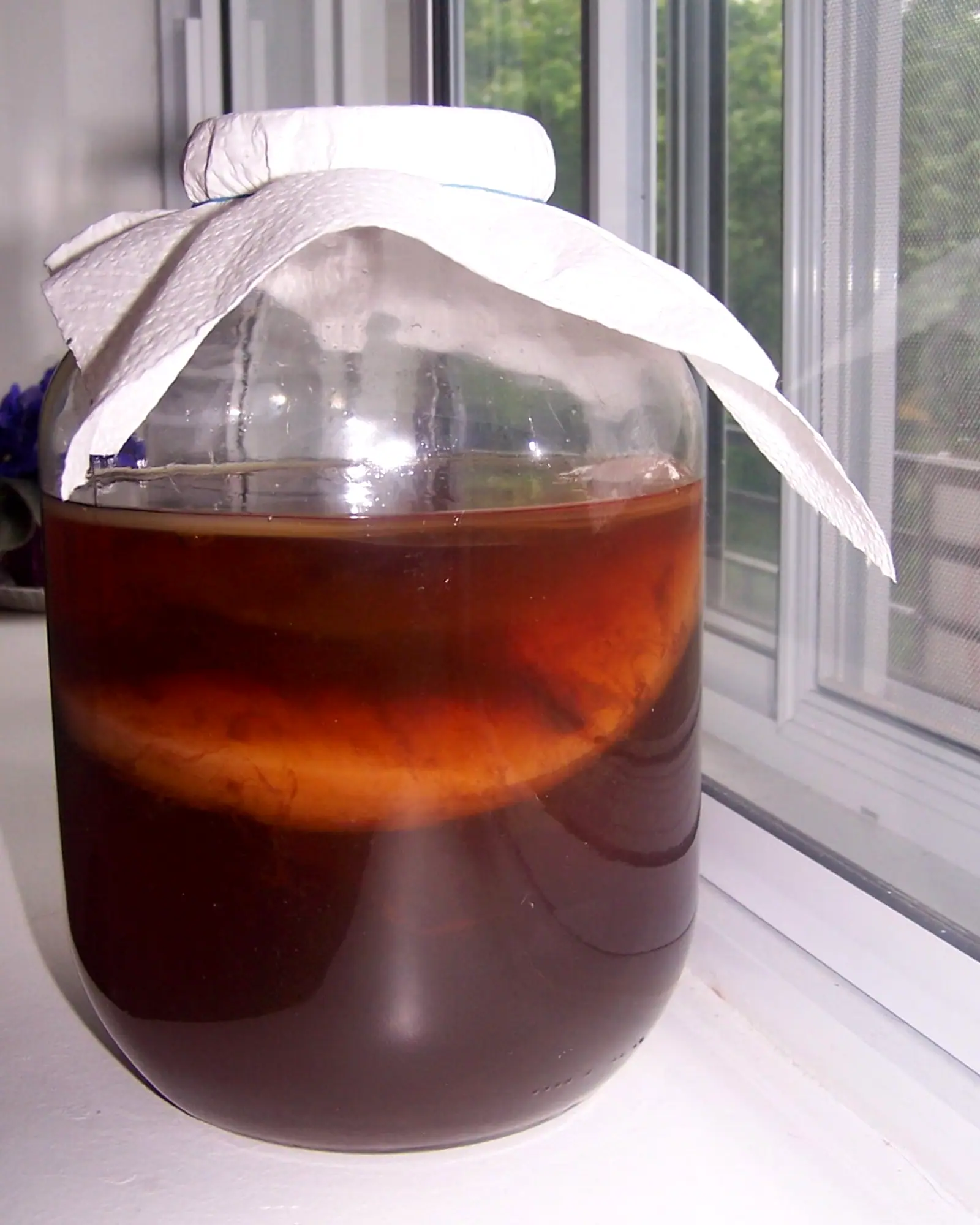
A jar of dark amber kombucha with a SCOBY layer floating in it, covered with a paper towel
Serving
Drink spec, per drink
Every figure above is per drink and does not move with the count, which is what makes the two service modes comparable. Sugar per litre, strength and standard drinks stay in the units their own authorities publish, because they are figures for comparing rather than for pouring.
Diet and allergen labels are computed from the ingredients listed on this page and nothing else. They cannot account for cross-contamination or for the particular product you buy, and they are not medical or safety guidance.
Ingredients
 12 g black tea
 1 800 ml water
 150 g granulated sugar
 1 g a SCOBY
- 12 g black tea
- 1 800 ml water
- 150 g granulated sugar
- 1 g a SCOBY
Glass
Vessel
379 ml of liquid, served without ice, inside the 400 ml the glass holds. The build fails if a recipe ever exceeds its stated vessel.
A batch needs a vessel that closes and fits a fridge shelf.
Drink spec, per drink
Every figure above is per drink and does not move with the count, which is what makes the two service modes comparable. Sugar per litre, strength and standard drinks stay in the units their own authorities publish, because they are figures for comparing rather than for pouring.
Diet and allergen labels are computed from the ingredients listed on this page and nothing else. They cannot account for cross-contamination or for the particular product you buy, and they are not medical or safety guidance.
Ingredients
- 12 g black tea
- 1 800 ml water
- 190 g granulated sugar
- 1 g a SCOBY
 25 g fresh ginger
- 12 g black tea
- 1 800 ml water
- 190 g granulated sugar
- 1 g a SCOBY
- 25 g fresh ginger
Glass
Vessel
384 ml of liquid, served without ice, inside the 400 ml the glass holds. The build fails if a recipe ever exceeds its stated vessel.
A batch needs a vessel that closes and fits a fridge shelf.
Method
5 steps · 8d 1hSteep the 12 g black tea in freshly boiled 1 800 ml water for 10m, then strain the leaves out.
Stir the 150 g granulated sugar into the hot tea until it is completely dissolved.
Leave the sweet tea to cool fully to room temperature before the next step.
The sweet tea has to come all the way down to room temperature before the SCOBY goes in, since tea still warm enough to feel hot on the wrist is hot enough to kill the culture outright.
Pour the cooled tea into a clean jar, lower in the 1 g a SCOBY, cover with a breathable cloth secured with a band, and leave at room temperature for 8d, away from direct light.
Lift out the SCOBY, reserving it for the next batch, and strain the kombucha into bottles for the refrigerator.
Common pitfallA week is a starting point rather than a fixed point: a warmer kitchen ferments faster and a cooler one slower, so the only reliable test is tasting a little each day past the sixth until the sweetness has dropped to a level that still tastes pleasant rather than merely sour.
SafetyThe jar is covered with a breathable cloth rather than a lid, both to let the ferment vent and to keep insects and dust out. A batch that smells sharply of nail polish remover, or grows fuzzy or coloured patches rather than a smooth, pale new layer on the SCOBY, has gone wrong and should be discarded rather than tasted.
Keeping and make-ahead
Batched ahead, this keeps sealed and cold. The water line the engine adds is the dilution figure from the spec panel, not a rule of thumb.
Method
7 steps · 11d 1hSteep the 12 g black tea in freshly boiled 1 800 ml water for 10m, then strain the leaves out.
Stir the 150 g granulated sugar into the hot tea until it is completely dissolved.
Leave the sweet tea to cool fully to room temperature before the next step.
Pour the cooled tea into a clean jar, lower in the 1 g a SCOBY, cover with a breathable cloth, and leave at room temperature for 8d.
Lift out the SCOBY, then divide the kombucha among carbonation-rated bottles, dropping the 40 g granulated sugar and the thinly sliced 25 g fresh ginger into each before capping tightly.
Leave the sealed bottles at room temperature for 3d, burping each once a day to release the building gas.
The sugar and ginger added at bottling give the culture still living in the kombucha something fresh to ferment inside the sealed bottle, which is what produces real carbonation rather than the faint fizz of an open ferment.
Strain out the ginger as you pour, over ice or straight into a chilled glass.
Common pitfallA warm room speeds the second ferment up considerably, and a bottle checked only after several days in summer heat can already be dangerously over-pressured by the time it is opened; burping daily is not optional at that point, it is how you find out before the glass does.
SafetyThe second ferment is sealed on purpose, to trap the carbon dioxide that carbonates it, and that is exactly what makes it a real pressure hazard: use bottles actually rated for carbonation, leave headspace at the top, and "burp" each bottle once a day by cracking the cap briefly to release building gas. Left sealed and unchecked in a warm spot, a bottle can build enough pressure to burst.
Keeping and make-ahead
Batched ahead, this keeps sealed and cold. The water line the engine adds is the dilution figure from the spec panel, not a rule of thumb.
About
Sweet tea fermented with a symbiotic culture of bacteria and yeast into a tart, lightly effervescent drink, whose supposed two-thousand-year Chinese imperial pedigree is a much later marketing invention.
Kombucha's own early history is genuinely thin, and the version most often repeated is not well supported. A popular account traces it to China's Qin dynasty around 220 BC, sometimes tied directly to the emperor Qin Shi Huang, and the same story is widely repeated in marketing copy for the drink 1. It does not hold up: no contemporary record supports it, and stories linking the drink to Korea or Japan before the twentieth century are similarly unfounded, both flagged as promotional myth rather than documented history 2. What can be said with more confidence is that a fermented tea of this kind was known in China's Bohai Sea region, where some practitioners of traditional medicine used it for stomach and lung complaints, without ever becoming a widely known drink across the country 2.
Its clearer documented path runs through Russia, where it appears in print by 1852 and became known there as "tea kvass," and from there into Eastern and Central Europe and Germany, largely as a homemade product rather than a commercial one 12. It reached the United States only in the late twentieth century, and its American uptake was tangled up with the AIDS epidemic of the 1980s and 1990s, when some patients took it up on unproven health claims; that momentum stalled after a 1995 report tied several cases of metabolic acidosis to home-fermented kombucha 2. Its wider popularity today, built on commercial bottling rather than the kitchen jar, is a recent development, and by some estimates the drink is now better known in the West than in the country most often credited as its source 2.
The culture responsible for all of this, a rubbery mat commonly called a SCOBY, is not a single organism but a working community of yeasts and acid-producing bacteria living together in a cellulose matrix, and it is this community, not any one microbe, that turns sweet tea sour and lightly carbonated over the course of a week 1.
- 1Kombucha: An Old Tradition into a New Concept of a Beneficial, Health-Promoting Beveragepmc.ncbi.nlm.nih.gov
- 2Kombuchaen.wikipedia.org