
French 75
Gin, lemon and sugar shaken, strained up and topped with sparkling wine.

CC BY-SA 2.0 · Cropped, white-balanced, graded and re-encoded to WebP by eXir.
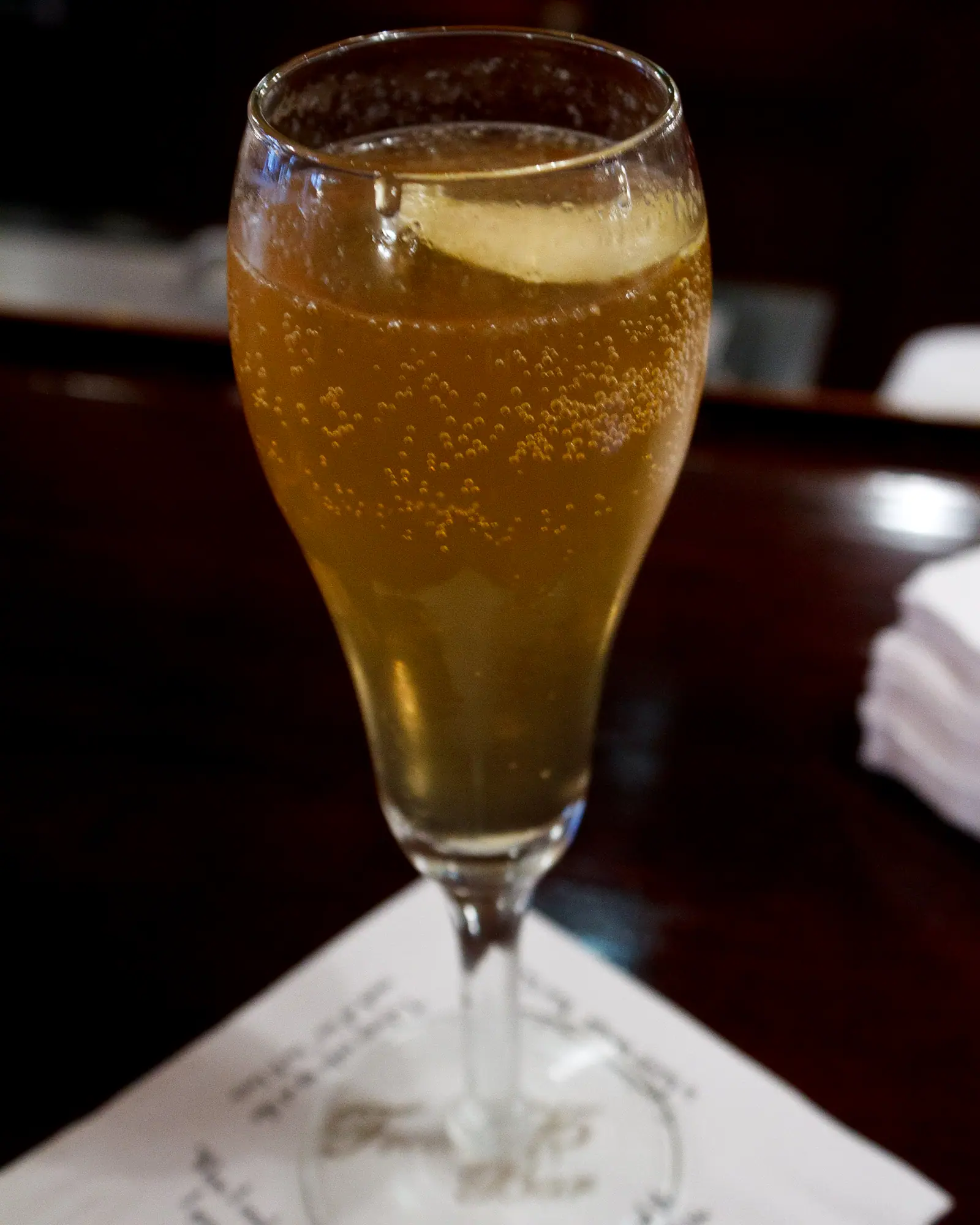
A French 75 served in a champagne flute, pale gold and effervescent, with a lemon twist
Serving
Drink spec, per drink
Every figure above is per drink and does not move with the count, which is what makes the two service modes comparable. Sugar per litre, strength and standard drinks stay in the units their own authorities publish, because they are figures for comparing rather than for pouring. Dilution is modelled rather than measured, as a fraction of the poured volume before any ice; dotted figures descend from that estimate.
Wine is routinely fined with isinglass, gelatine or casein, and a producer rarely states whether a given bottle was.
Diet and allergen labels are computed from the ingredients listed on this page and nothing else. They cannot account for cross-contamination or for the particular product you buy, and they are not medical or safety guidance.
Ingredients
 15 ml fresh lemon juice
 23 ml London dry gin
 7.5 ml simple syrup
 65 ml brut sparkling wine
 1 lemon (58 g)
- 15 ml fresh lemon juice
- 23 ml London dry gin
- 7.5 ml simple syrup
- 65 ml brut sparkling wine
- 1 lemon (58 g)
- ~23 ml water
Glass
Vessel
133 ml of liquid, served without ice, inside the 180 ml the glass holds. The build fails if a recipe ever exceeds its stated vessel.
A batch needs a vessel that closes and fits a fridge shelf.
Method
6 steps · 2m 12sSqueeze the 15 ml fresh lemon juice and strain out the pips and pulp.
Combine the 23 ml London dry gin, the 15 ml fresh lemon juice and the 7.5 ml simple syrup in a shaker and fill it with cubed ice.
Shake hard for 12s to chill and aerate the drink before any wine reaches it.
Strain up into a chilled flute, with no ice in the glass itself.
Top with the 65 ml brut sparkling wine, poured gently down the side of the glass so the foam it raises has somewhere to go.
The sparkling wine is never shaken with the rest. It goes in last, poured gently down the side of the glass, so the bead it carries survives to the drink instead of being beaten out of it in the tin.
Twist a strip of lemon peel over the surface to release its oil, then drop it in.
Common pitfallA gin poured too generously against the sparkling wine turns this into a fizzed-up shaken sour rather than the long drink it is meant to be; the wine is meant to carry the drink's length, not just top it up.
Keeping and make-ahead
Batched ahead, this keeps sealed and cold. The water line the engine adds is the dilution figure from the spec panel, not a rule of thumb.
About
A gin sour lengthened with sparkling wine, named for a WWI-era field gun and documented in conflicting versions from its earliest years, with a cognac-based variant that never displaced gin as the drink's usual base.
The name refers to the French 75-millimetre field gun of the First World War, and the drink is first recorded close to the war itself, though the earliest sources disagree on its inventor. The Washington Herald described a version in 1915 built from gin, grenadine, applejack and a dash of lemon juice, with no champagne in it at all 1. Robert Vermeire's 1922 cocktail book credited a bartender at Henry's Bar in Paris as the drink's originator 1, while Harry MacElhone's own 1919 guide credited a different bartender, MacGarry of Buck's Club in London, and described a build closer to a Tom Collins with champagne standing in for the soda 2. The gin, lemon, sugar and champagne form familiar today is first set out in Judge Jr.'s 1927 Here's How 1.
The drink was served long, over ice in a tall glass, well into the twentieth century: Harry Craddock's Savoy Cocktail Book of 1930 still calls for it that way 1. The short pour into a champagne flute with no ice, now the drink's most common serving, is a later habit rather than the original one.
A cognac-based version has its own advocates: David Embury argued in 1948 that cognac, not gin, was the only base that should carry the name, and cognac French 75s are still served in some American bars 1. The claim did not carry the wider trade; gin remained, and remains, the version most bartenders and guides mean by the name.
- 1French 75 Cocktail Historydiffordsguide.com
- 2The Complicated History of the French 75jeffreymorgenthaler.com