
Es Cendol
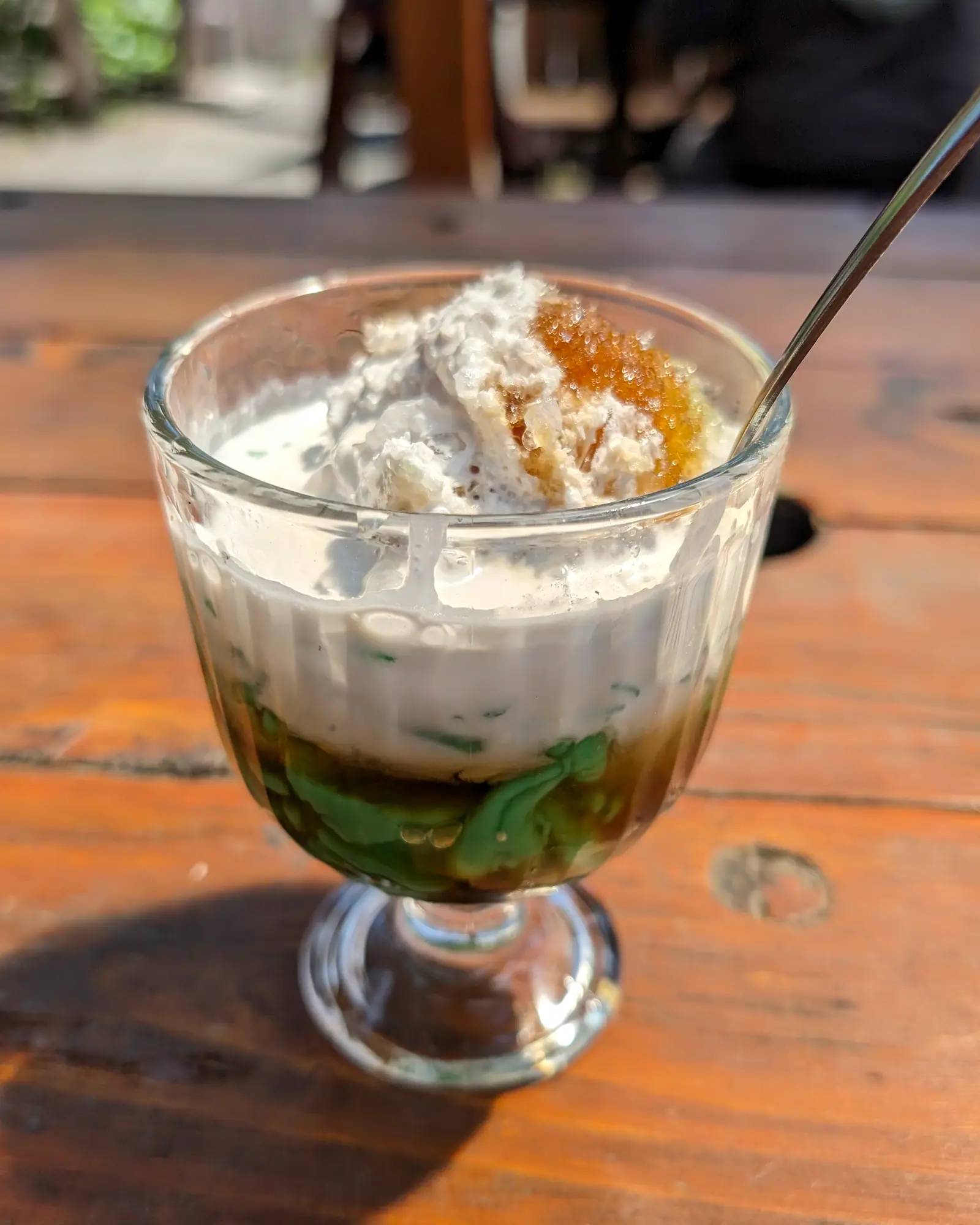
Coconut milk and palm sugar syrup poured over shaved ice and green rice-flour jelly.

CC BY-SA 4.0 · Cropped, white-balanced, graded and re-encoded to WebP by eXir.
Es cendol in a footed glass, green rice-flour jelly and dark palm sugar syrup layered under coconut milk
Serving
Drink spec, per drink
Every figure above is per drink and does not move with the count, which is what makes the two service modes comparable. Sugar per litre, strength and standard drinks stay in the units their own authorities publish, because they are figures for comparing rather than for pouring. Dilution is modelled rather than measured, as a fraction of the poured volume before any ice; dotted figures descend from that estimate.
Diet and allergen labels are computed from the ingredients listed on this page and nothing else. They cannot account for cross-contamination or for the particular product you buy, and they are not medical or safety guidance.
Ingredients
 30 g palm sugar
 30 ml water
 70 g cendol
 70 ml coconut milk
- 30 g palm sugar
- 30 ml water
- 70 g cendol
- 70 ml coconut milk
- ~45 ml water
Glass
Vessel
180 ml of liquid plus 289 ml of crushed ice occupies about 469 ml, inside the 470 ml the glass holds. The build fails if a recipe ever exceeds its stated vessel.
A batch needs a vessel that closes and fits a fridge shelf.
Method
3 steps · 5mSimmer the 30 g palm sugar with the 30 ml water for 5m, until it forms a thin syrup, then cool.
Fill a glass with crushed ice, spoon in the 70 g cendol, and pour the cooled palm sugar syrup over it.
Pour the 70 ml coconut milk over the back of a spoon on top, and serve with a long spoon to stir it all together.
The syrup, the jelly and the coconut milk are layered in rather than stirred together, so the drink arrives looking like three distinct bands and is stirred by the person drinking it, not by whoever built it.
Common pitfallPalm sugar scorches more readily than white sugar once most of the water has boiled off; it wants a low simmer and a watchful eye near the end rather than a hard boil throughout.
Keeping and make-ahead
Batched ahead, this keeps sealed and cold. The water line the engine adds is the dilution figure from the spec panel, not a rule of thumb.
About
A shaved-ice dessert drink built on green rice-flour jelly, coconut milk and palm sugar, with a Javanese origin now well documented against competing modern claims from Malaysia and Singapore.
A sweet rice-flour drink resembling cendol appears in the Kakawin Kresnayana, a twelfth-century Javanese manuscript written by Mpu Triguna in the Kediri Kingdom of East Java, which is the earliest documentary trace historians point to for the drink 12. The Indonesian historian Fadly Rahman has pointed to that manuscript specifically in response to a 2018 international list that credited Singapore as cendol's origin, and a chef and food writer, William Wongso, has separately described dawet, the drink's closest Javanese relative, as having existed for three to four centuries under that name 2. The earliest written recipe in a colonial source appears later still, in an 1866 Dutch-language East Indies cookbook, and an 1859 Makassarese-Dutch dictionary already glosses a version of the word for the rice or sago paste pressed through a mould to make the jelly strands 1.
The word cendol itself is generally traced to the Malay jendol, meaning a bump or bulge, describing the look of the short jelly strands rather than any place name 1. That the drink and its close relatives are documented not only among Javanese and Sundanese cooks but also among Malay, Minangkabau, Bugis, Vietnamese, Khmer, Thai and Burmese communities suggests a shared regional food tradition that predates any one country's modern borders, which is part of why the drink is now claimed by several Southeast Asian nations at once 1. Each has since developed its own version (Malaysia's typically adds sweetened red beans, for instance) while agreeing on the same core of rice-flour jelly, coconut milk and palm sugar over ice 21.
- 1Cendolen.wikipedia.org
- 2Claimed by Malaysia and Singapore, Historian Confirms that Cendol is from Indonesiaseasia.co