
Champurrado
Atole thickened further with chocolate, whisked until it turns glossy.

CC BY 2.0 · Cropped, white-balanced, graded and re-encoded to WebP by eXir.
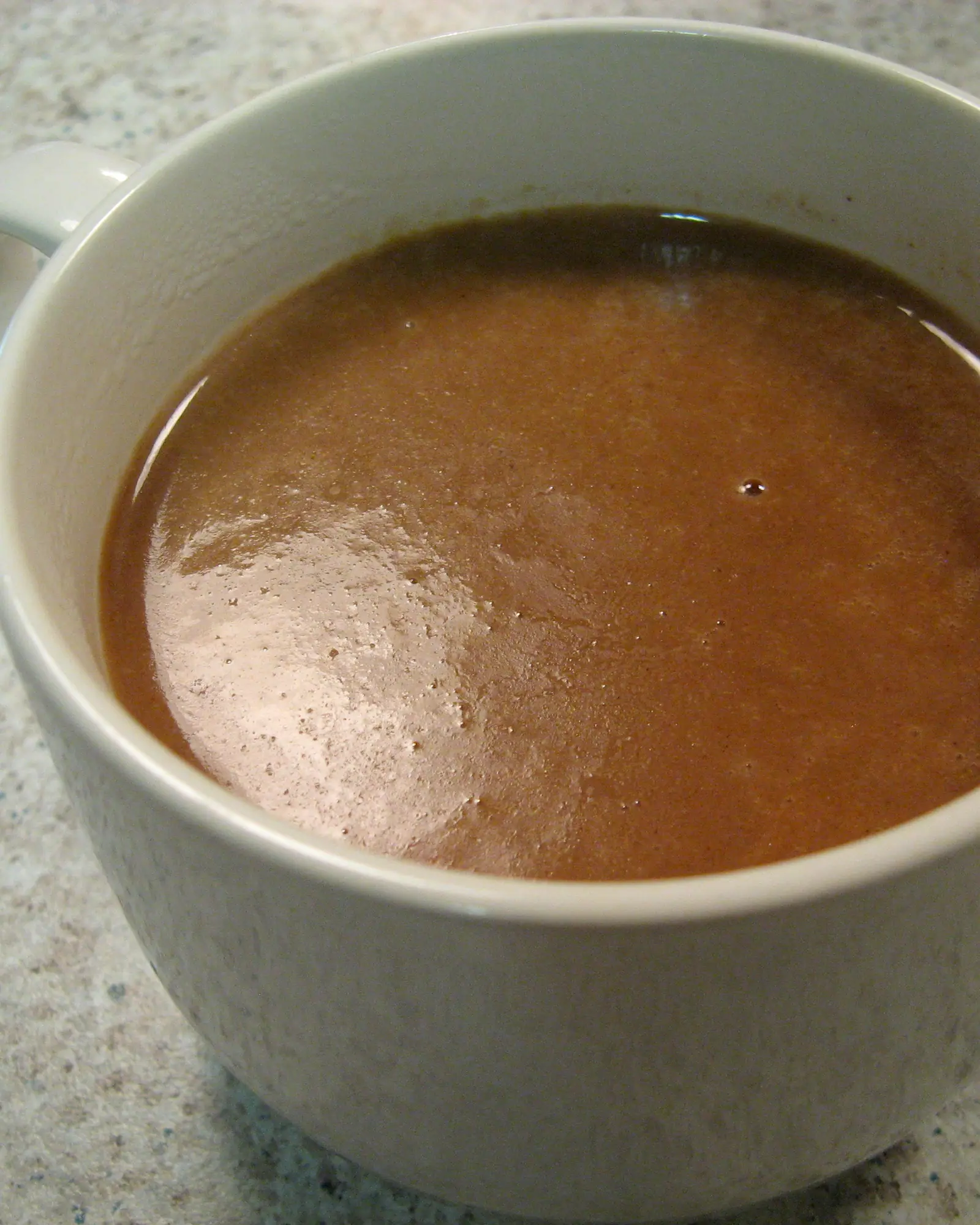
Thick chocolate-brown champurrado filling a white mug
Serving
Drink spec, per drink
Every figure above is per drink and does not move with the count, which is what makes the two service modes comparable. Sugar per litre, strength and standard drinks stay in the units their own authorities publish, because they are figures for comparing rather than for pouring.
Diet and allergen labels are computed from the ingredients listed on this page and nothing else. They cannot account for cross-contamination or for the particular product you buy, and they are not medical or safety guidance.
Ingredients
 25 g masa harina
 150 ml water
 150 ml whole milk
 30 g piloncillo
 3 g cinnamon bark
 15 g cocoa powder
- 25 g masa harina
- 150 ml water
- 150 ml whole milk
- 30 g piloncillo
- 3 g cinnamon bark
- 15 g cocoa powder
Glass
Vessel
333 ml of liquid, served without ice, inside the 350 ml the glass holds. The build fails if a recipe ever exceeds its stated vessel.
A batch needs a vessel that closes and fits a fridge shelf.
Method
4 steps · 7mWhisk the 25 g masa harina into the 150 ml water until completely smooth, with no dry lumps left.
Combine the masa slurry with the 150 ml whole milk, 30 g piloncillo and 3 g cinnamon bark in a pot and simmer over 5m, whisking constantly, until visibly thickened.
Whisk in the 15 g cocoa powder with a molinillo for 1m, until glossy and lightly foamed.
A molinillo spun between the palms works air into the drink as the cocoa dissolves, which is what raises a thin foam on top rather than leaving the chocolate sitting as a separate layer.
Remove the cinnamon stick and pour hot into the serving mug.
Common pitfallSimmering without stirring lets the thickened base catch and scorch on the bottom of the pot, and a scorched champurrado tastes of the pot rather than of the corn and chocolate.
Keeping and make-ahead
Cooked and thickened to order. Reheating keeps drawing more starch out of the masa and the drink turns gluey rather than staying pourable.
About
Atole with chocolate whisked in, joining two ingredients Mesoamerica already drank together long before Spanish colonisation.
Champurrado is, by its own definition, a variety of atole rather than a separate invention: the same corn-masa base, with chocolate as the one ingredient that distinguishes it 1. Neither half of that combination is new, and neither is the combination. In pre-Hispanic Mexico cacao was roasted and ground, then thickened with a small quantity of washed, cooked and ground maize, alongside flavourings such as vanilla, ear flower and annatto 2. Corn and cacao were being drunk together, in other words, several centuries before the drink acquired its present name. That makes champurrado less a single invention than the settling of a very old pairing into one fixed form.
What is specifically colonial about champurrado is the sweetness and the dairy. The Spanish gave the name chocolate to the cacao paste and to the drink made by diluting it in boiling water, taken either on its own or stirred into the maize-flour beverage already called atole, and it is that second preparation, cacao carried in atole rather than in water, that is known in Mexico as champurrado 2. Cane sugar, brought into the Spanish trade network from Southeast Asia, allowed sweeter chocolate drinks than cacao alone had called for, and one early colonial version (chocolate, vanilla and spices, served cold) sits closer to a Spanish adaptation of a Mexican ingredient than to the hot, corn-thickened drink served today 1. The finished champurrado is a hybrid in the same sense: an indigenous base and an indigenous technique carried into a European idea of how a chocolate drink should be sweetened and served.
The technique is the part that did not change. The molinillo, the carved wooden whisk spun between the palms to raise the foam, travelled with champurrado and with plain hot chocolate into other former Spanish colonies, and remains the tool most associated with both 1.
- 1Champurradoen.wikipedia.org
- 2A Culture of Cacao and Chocolate (Laura Caso Barrera)revista.drclas.harvard.edu