
Brandy Alexander
Cognac, brown creme de cacao and cream, shaken to a pale froth.
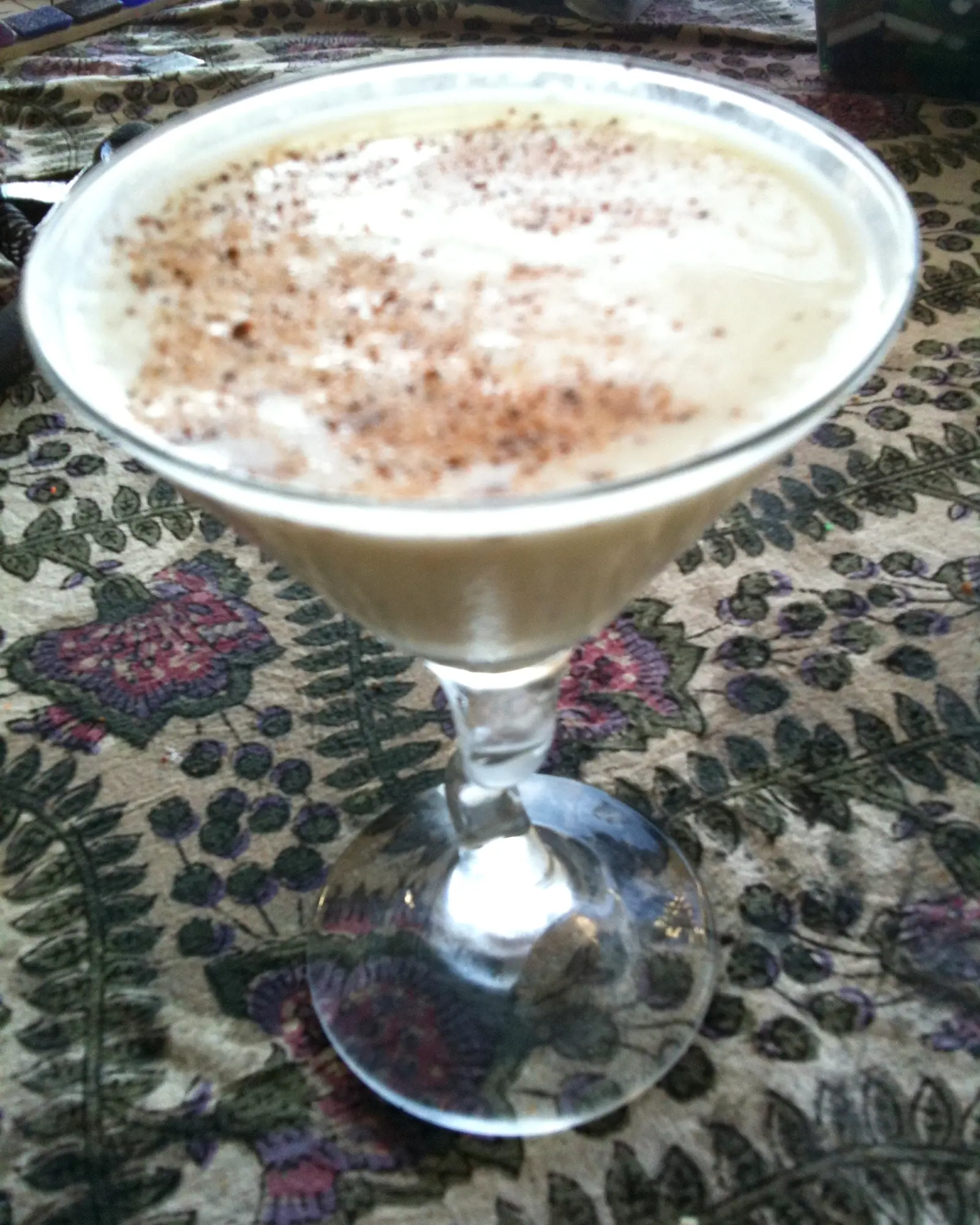

CC BY-SA 2.0 · Cropped, white-balanced, graded and re-encoded to WebP by eXir.
A pale cream cocktail dusted with grated nutmeg, served in a coupe glass
Serving
Drink spec, per drink
Every figure above is per drink and does not move with the count, which is what makes the two service modes comparable. Sugar per litre, strength and standard drinks stay in the units their own authorities publish, because they are figures for comparing rather than for pouring. Dilution is modelled rather than measured, as a fraction of the poured volume before any ice; dotted figures descend from that estimate.
Diet and allergen labels are computed from the ingredients listed on this page and nothing else. They cannot account for cross-contamination or for the particular product you buy, and they are not medical or safety guidance.
Ingredients
 30 ml cognacInterchangeable by volume and at a similar strength, so the arithmetic barely moves. This is the older Alexander the brandy version was named after, and it reads sharper and more juniper-forward against the chocolate than the round, fruity cognac does.flavour: significant change · strength: no change · sweetness: no change
 30 ml brown creme de cacao
 30 ml heavy cream
 0.3 g freshly grated nutmeg
- 30 ml cognac
- 30 ml brown creme de cacao
- 30 ml heavy cream
- 0.3 g freshly grated nutmeg
- ~50 ml water
Glass
Vessel
140 ml of liquid, served without ice, inside the 180 ml the glass holds. The build fails if a recipe ever exceeds its stated vessel.
A batch needs a vessel that closes and fits a fridge shelf.
Method
4 steps · 59sCombine the 30 ml cognac, the 30 ml brown creme de cacao and the 30 ml heavy cream in a shaker with ice.
Shake hard for 14s, longer than a citrus sour needs, so the cream takes on a full head of air.
Cream needs a longer, harder shake than a citrus sour to take on enough air to sit as a pale froth on top rather than a flat, oily surface; a chilling shake alone leaves it looking thin.
Double strain into a chilled coupe.
Grate the 0.3 g freshly grated nutmeg over the surface.
Common pitfallCognac and creme de cacao are close in weight and colour once shaken with cream, so an unbalanced pour is easy to miss by eye. Measuring rather than free-pouring is what keeps the drink from tipping into a chocolate milkshake.
Keeping and make-ahead
Batched ahead, this keeps sealed and cold. The water line the engine adds is the dilution figure from the spec panel, not a rule of thumb.
About
A cream cocktail that began as a gin drink called simply the Alexander, reassigned to brandy within a decade of its first print appearance for reasons no source fully settles.
An equal-parts drink of gin, creme de cacao and cream appears in print as the Alexander Cocktail in Hugo Ensslin's 1915 guide Recipes for Mixed Drinks 1. An earlier drink under the same name, made instead of rye whiskey and Benedictine, had already been printed by Jacob Grohusko in his 1910 Jack's Manual. That drink was an unrelated recipe that happens to share only the name 1.
The switch from gin to brandy is usually credited to the bartender Harry MacElhone, whose 1923 book ABC of Mixing Cocktails carries the brandy version, still labelled simply "Alexander" rather than "Brandy Alexander" 2. A competing, earlier claim complicates that credit: the cocktail historian Michael Crespin has traced an identical brandy, cacao and cream recipe printed in 1913 under the name "Bach Chor Club" in a German reference book, Lexikon der Getränke, a year before the earliest known gin version reached print 2. Crespin does not treat this as an independent German invention, reasoning that the German recipe more likely drew on an Alexander already circulating elsewhere, but the earlier date means the print record cannot currently settle which spirit came first 2.
The name itself has no single documented source. Several explanations circulate (a New York bartender named Troy Alexander, the Russian tsar Alexander II, the drama critic Alexander Woollcott), but none of them is tied to a contemporary written record, and the point is generally treated as unresolved rather than decided 2. Today's standard recipe, including the version set by the International Bartenders Association, calls for brandy rather than the original gin 1.
- 1Alexander (cocktail)en.wikipedia.org
- 2Alexander Cocktail History — Gin or Brandy?mixohistorian.com