
Bloody Mary
Vodka and tomato juice seasoned with Worcestershire, hot sauce and celery salt, thrown rather than shaken.
The same tomato-juice build made with gin, under the name the St. Regis used to keep the drink off its own menu unspoken.
The same tomato-and-spice build with the vodka left out rather than replaced.
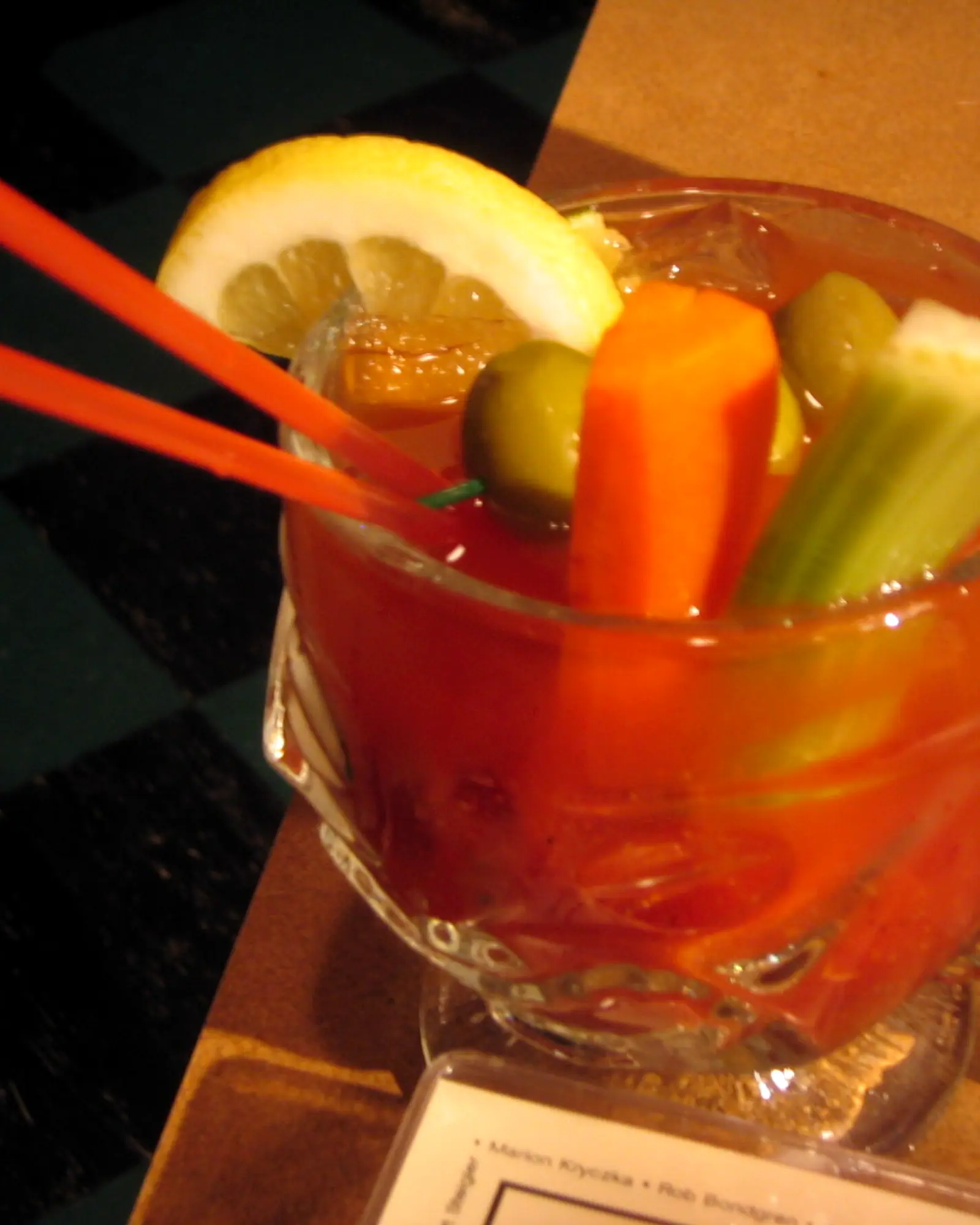

CC BY 2.0 · Cropped, white-balanced, graded and re-encoded to WebP by eXir.
A Bloody Mary garnished with a lemon wheel, green olives, a carrot stick and celery, with red straws
Serving
Drink spec, per drink
Every figure above is per drink and does not move with the count, which is what makes the two service modes comparable. Sugar per litre, strength and standard drinks stay in the units their own authorities publish, because they are figures for comparing rather than for pouring. Dilution is modelled rather than measured, as a fraction of the poured volume before any ice; dotted figures descend from that estimate.
Fermented anchovies are a named ingredient of the standard recipe and are what give it its savoury depth; there is no fish-free version of the reference bottle.
Diet and allergen labels are computed from the ingredients listed on this page and nothing else. They cannot account for cross-contamination or for the particular product you buy, and they are not medical or safety guidance.
Ingredients
 45 ml vodka
 90 ml tomato juice
 15 ml fresh lemon juice
 4 dashes Worcestershire sauce (3.6 ml)Proprietary
 3 dashes hot sauce (2.7 ml)Proprietary
 1 g celery salt
 0.3 g cracked black pepper
 1 lemon (58 g)
- 45 ml vodka
- 90 ml tomato juice
- 15 ml fresh lemon juice
- 4 dashes Worcestershire sauce (3.6 ml)Proprietary
- 3 dashes hot sauce (2.7 ml)Proprietary
- 1 g celery salt
- 0.3 g cracked black pepper
- 1 lemon (58 g)
- ~39 ml water
Glass
Vessel
156 ml of liquid plus 230 ml of cubed ice occupies about 386 ml, inside the 400 ml the glass holds. The build fails if a recipe ever exceeds its stated vessel.
A batch needs a vessel that closes and fits a fridge shelf.
Drink spec, per drink
Every figure above is per drink and does not move with the count, which is what makes the two service modes comparable. Sugar per litre, strength and standard drinks stay in the units their own authorities publish, because they are figures for comparing rather than for pouring. Dilution is modelled rather than measured, as a fraction of the poured volume before any ice; dotted figures descend from that estimate.
Fermented anchovies are a named ingredient of the standard recipe and are what give it its savoury depth; there is no fish-free version of the reference bottle.
Diet and allergen labels are computed from the ingredients listed on this page and nothing else. They cannot account for cross-contamination or for the particular product you buy, and they are not medical or safety guidance.
Ingredients
 45 ml London dry ginSwaps the drink back to the plain Bloody Mary it is built from, losing gin's botanical edge for a neutral spirit that lets the tomato and seasoning carry the whole drink.flavour: moderate change · strength: no change · sweetness: no change
- 90 ml tomato juice
- 15 ml fresh lemon juice
- 4 dashes Worcestershire sauce (3.6 ml)Proprietary
- 3 dashes hot sauce (2.7 ml)Proprietary
- 1 g celery salt
- 0.3 g cracked black pepper
- 1 lemon (58 g)
- 45 ml London dry gin
- 90 ml tomato juice
- 15 ml fresh lemon juice
- 4 dashes Worcestershire sauce (3.6 ml)Proprietary
- 3 dashes hot sauce (2.7 ml)Proprietary
- 1 g celery salt
- 0.3 g cracked black pepper
- 1 lemon (58 g)
- ~39 ml water
Glass
Vessel
156 ml of liquid plus 230 ml of cubed ice occupies about 386 ml, inside the 400 ml the glass holds. The build fails if a recipe ever exceeds its stated vessel.
A batch needs a vessel that closes and fits a fridge shelf.
Drink spec, per drink
Every figure above is per drink and does not move with the count, which is what makes the two service modes comparable. Sugar per litre, strength and standard drinks stay in the units their own authorities publish, because they are figures for comparing rather than for pouring. Dilution is modelled rather than measured, as a fraction of the poured volume before any ice; dotted figures descend from that estimate.
Fermented anchovies are a named ingredient of the standard recipe and are what give it its savoury depth; there is no fish-free version of the reference bottle.
Diet and allergen labels are computed from the ingredients listed on this page and nothing else. They cannot account for cross-contamination or for the particular product you buy, and they are not medical or safety guidance.
Ingredients
- 120 ml tomato juice
- 15 ml fresh lemon juice
- 4 dashes Worcestershire sauce (3.6 ml)Proprietary
- 3 dashes hot sauce (2.7 ml)Proprietary
- 1 g celery salt
- 0.3 g cracked black pepper
- 1 lemon (58 g)
- 120 ml tomato juice
- 15 ml fresh lemon juice
- 4 dashes Worcestershire sauce (3.6 ml)Proprietary
- 3 dashes hot sauce (2.7 ml)Proprietary
- 1 g celery salt
- 0.3 g cracked black pepper
- 1 lemon (58 g)
- ~35 ml water
Glass
Vessel
141 ml of liquid plus 230 ml of cubed ice occupies about 371 ml, inside the 400 ml the glass holds. The build fails if a recipe ever exceeds its stated vessel.
A batch needs a vessel that closes and fits a fridge shelf.
Method
4 steps · 1m 15sCombine the 45 ml vodka, the 90 ml tomato juice, the 15 ml fresh lemon juice, the 4 dashes Worcestershire sauce (3.6 ml), the 3 dashes hot sauce (2.7 ml), the 1 g celery salt and the 0.3 g cracked black pepper in a mixing tin with cubed ice.
Throw the drink: pour it into a second tin held low, then back into the first, repeating for 15s. The stream of liquid does the mixing, not the ice knocking against the tin.
Tomato juice foams and turns cloudy if it is shaken, so the drink is thrown instead (poured back and forth between two vessels over ice), which chills and combines it without beating air in.
Strain into a highball filled with fresh cubed ice.
Cut a wedge from the 1 lemon (58 g) and set it on the rim.
Common pitfallThe 4 dashes Worcestershire sauce (3.6 ml) carries fermented anchovy, which is easy to miss on a bottle that reads as a spice blend rather than a fish product; a Bloody Mary made for a guest who avoids fish is not automatically safe.
Keeping and make-ahead
Batched ahead, this keeps sealed and cold. The water line the engine adds is the dilution figure from the spec panel, not a rule of thumb.
Method
4 steps · 1m 15sCombine the 45 ml London dry gin, the 90 ml tomato juice, the 15 ml fresh lemon juice, the 4 dashes Worcestershire sauce (3.6 ml), the 3 dashes hot sauce (2.7 ml), the 1 g celery salt and the 0.3 g cracked black pepper in a mixing tin with cubed ice.
Gin's own botanicals sit under the tomato and hot sauce rather than over them, so the drink reads drier and slightly more bitter than the vodka version rather than announcing the swap outright.
Throw the drink: pour it into a second tin held low, then back into the first, repeating for 15s.
Strain into a highball filled with fresh cubed ice.
Cut a wedge from the 1 lemon (58 g) and set it on the rim.
Keeping and make-ahead
Batched ahead, this keeps sealed and cold. The water line the engine adds is the dilution figure from the spec panel, not a rule of thumb.
Method
4 steps · 1m 15sCombine the 120 ml tomato juice, the 15 ml fresh lemon juice, the 4 dashes Worcestershire sauce (3.6 ml), the 3 dashes hot sauce (2.7 ml), the 1 g celery salt and the 0.3 g cracked black pepper in a mixing tin with cubed ice.
Without the vodka's volume, the tomato juice is topped up to fill the same glass, so the seasoning stays at the same strength against the base rather than reading diluted.
Throw the drink: pour it into a second tin held low, then back into the first, repeating for 15s.
Strain into a highball filled with fresh cubed ice.
Cut a wedge from the 1 lemon (58 g) and set it on the rim.
Common pitfallThe 4 dashes Worcestershire sauce (3.6 ml) still carries fermented anchovy, which the word "zero-proof" says nothing about; a guest avoiding fish is not covered by this version being alcohol-free.
Keeping and make-ahead
Batched ahead, this keeps sealed and cold. The water line the engine adds is the dilution figure from the spec panel, not a rule of thumb.
About
A vodka-and-tomato-juice cocktail seasoned with Worcestershire and hot sauce, its invention contested between a Paris barman and a Hollywood comedian and its early name softened to Red Snapper at the St. Regis.
Credit for the drink is genuinely contested. Fernand Petiot, a bartender at Harry's New York Bar in Paris, is said by his own account and his family's records to have made a vodka-and-tomato-juice drink there from 1921 1, though a separate account concludes the comedian George Jessel made the same combination in Palm Beach in 1927 after a heavy night out 2. Petiot himself, interviewed by The New Yorker in 1964, allowed Jessel the claim while dismissing what it amounted to: "Jessel said he created it, but it was really nothing but vodka and tomato juice when I took it over" 1. What both accounts agree on is that Petiot did the later work: at the King Cole Room of New York's St. Regis Hotel from 1934, he added salt, pepper, cayenne, Worcestershire and lemon juice to what had been a two-ingredient drink, fixing the template still used today 1.
The Red Snapper name dates to around 1935, when the hotel's owner is said to have objected to "Bloody Mary" as too coarse for the room 2. Which spirit the renamed drink actually used is itself disputed: one account holds that it switched to gin, since vodka was still hard to find in America at the time 1, while another argues the base stayed vodka throughout and the name change was cosmetic only 2. Tabasco's own place in the recipe is dated later still, first documented in print in 1946 and formalised in David Embury's 1952 revision of The Fine Art of Mixing Drinks 2.
The name itself has no settled origin. Proposed sources include a Chicago waitress named Mary, the actress Mary Pickford, a mangled pronunciation of "Vladimir," and England's Queen Mary I, remembered for the executions of her reign 1. None is confirmed, and the drink is served under a name nobody can trace with certainty to its first use.
- 1Bloody Mary (cocktail)en.wikipedia.org
- 2The History of the Bloody Marydiffordsguide.com