Chinese · Breakfast
Youtiao
A wheat dough leavened with baking powder and ammonium bicarbonate, twisted into a pair and deep-fried until it puffs into a hollow, golden-brown stick.
Also known asChinese oil stickYou char kway · Southeast Asia
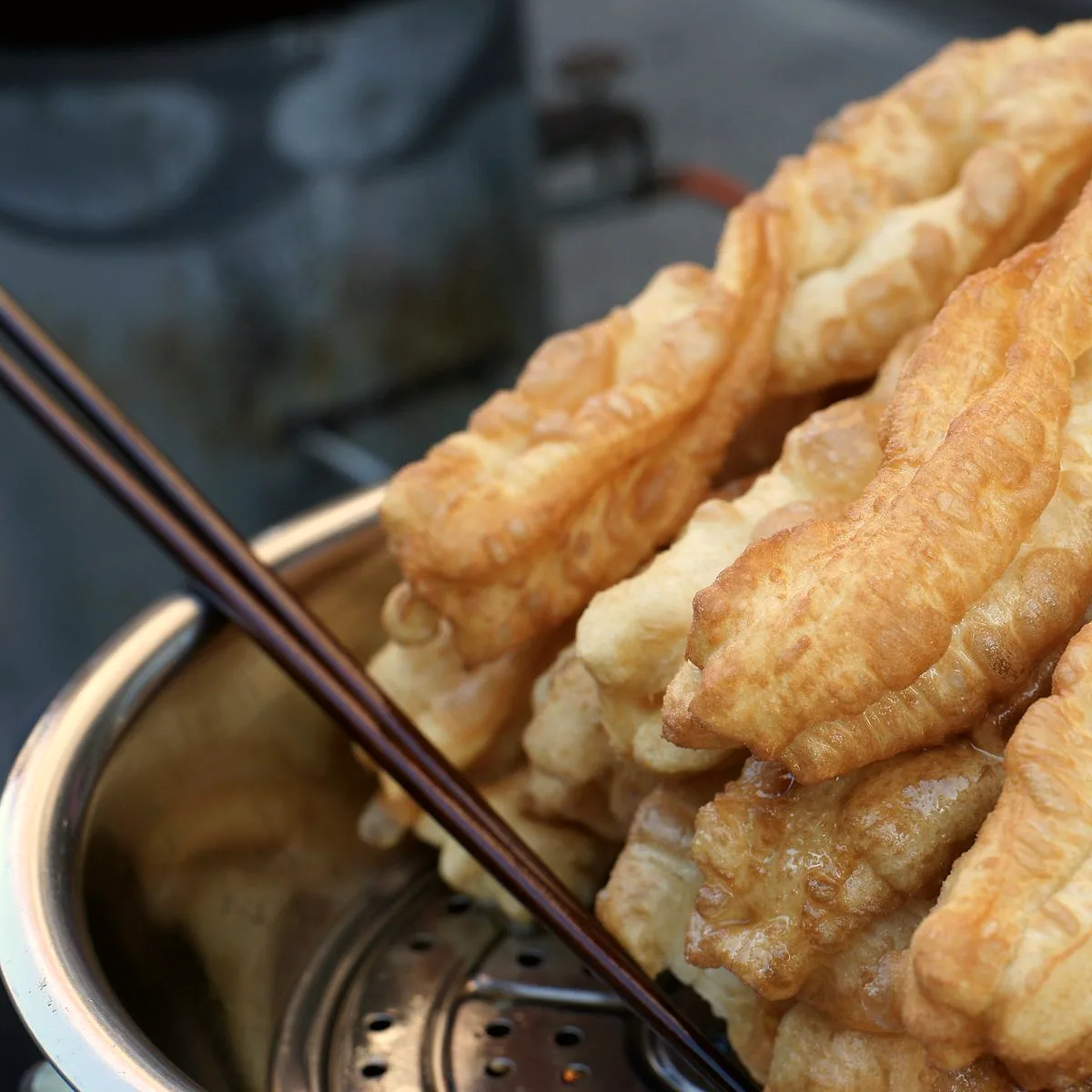

CC0. Cropped and colour-adjusted for this site.
Method
Combine the 400 g plain flour, 6 g baking powder, 3 g ammonium bicarbonate, 6 g fine sea salt and 8 g caster sugar in a bowl. Add the 240 ml water and bring together into a soft, wet dough, mixing rather than kneading, until no dry flour remains.
Cover the dough and leave it to rest at room temperature for 4h, until visibly relaxed and slightly puffed.
The long, slack rest is what lets the two raising agents work without kneading strength back into the dough; a firmer, well-developed dough resists puffing and fries dense rather than hollow.
Turn the dough out onto an oiled surface without kneading it, and pat it into a rectangle. Cut into even strips, stack two strips together and press a chopstick along the length of the top strip to seal the pair, then stretch each pair gently as you go.
Heat the 1.2 L vegetable oil until shimmering, then lower each pair in gently, stretching slightly as it enters the oil. Fry for 3m, turning constantly, until puffed, hollow and deep golden all over. Lift out and drain.
Common pitfallOil that is not hot enough lets the dough absorb fat before it has a chance to puff, giving a heavy, greasy result instead of a light, hollow one. The oil needs to be at full frying temperature before the first pair goes in.
Youtiao's two names describe two different things about it. In Mandarin it is simply yóutiáo, "oil strip", a plain description of a stick of dough fried in oil. In Cantonese it is yàuh ja gwái, "oil-fried devil," a name that carries a story rather than a description [1] [2].
The story is set in the Southern Song dynasty and centres on the general Yue Fei, a celebrated defender against the invading Jurchens, and the chancellor Qin Hui, who is said to have had Yue Fei falsely accused of treason and executed [2]. According to the legend, popular anger at the execution found an outlet in a street snack: two strips of dough, representing Qin Hui and his wife, pressed together and dropped into boiling oil to be punished in effigy every morning [1] [2]. It is a satisfying story and, on the historical record, a contested one: even Qin Hui's own reputation as a traitor rather than a pragmatic peacemaker is a matter scholars still argue over, which makes a specific popular protest against him harder still to pin to a date or a place [2].
Whatever its origin, the shape the legend explains (two strips joined along one edge before frying) is the same shape that makes the dish work. The seam is what lets the two pieces puff apart from each other in the hot oil rather than separately, giving youtiao its characteristic hollow centre and long, airy crumb. It is eaten today mostly at breakfast, torn and dipped into congee or soy milk rather than on its own.
Sources
- Youtiao, WikipediaGives the Mandarin and Cantonese names, the paired-dough shape, and how youtiao is eaten with congee, soy milk or dipping soups.
- The Snack of Song Dynasty Protests, Snack StackSets out the Qin Hui and Yue Fei legend and explicitly flags the historical dispute over Qin Hui's reputation.