American · Dessert
Vanilla Ice Cream
Cream and milk thickened with an egg-yolk custard before churning, in the French style. One serving is one generous scoop.
Not the same asPhiladelphia-style vanilla ice cream (Made from cream, milk and sugar alone, with no egg yolks or cooked custard. See the second version of this page.)
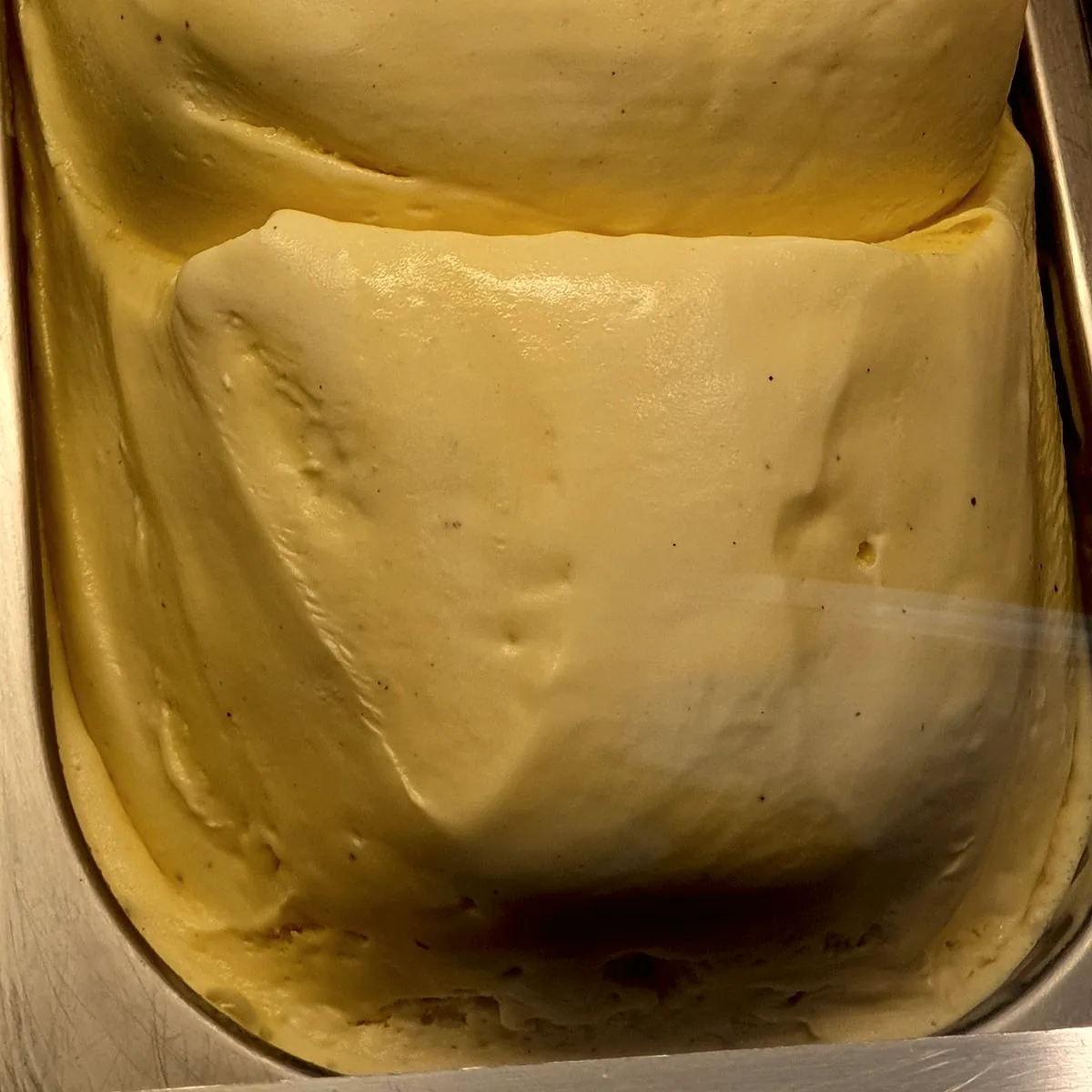

CC BY-SA 4.0. Cropped and colour-adjusted for this site.
The same dish, adapted. Every quantity, time and figure below changes with the version.
Method
Warm the 350 ml milk and the 350 ml double cream together with half of the 130 g caster sugar in a pan over a medium heat until steaming, over 6m, without letting it boil.
Whisk the 5 ½ egg yolks (90 g) with the remaining sugar until pale, then whisk in a ladleful of the hot cream at a time to bring the yolks up to temperature gradually, over 5m.
Whisking warm cream into the yolks gradually, rather than the reverse, raises their temperature slowly enough that they thicken the custard instead of scrambling in it.
Pour the tempered yolks back into the pan and cook over a low heat, stirring constantly, for 6m, until the custard thickens enough to coat the back of a spoon. Strain immediately into a clean bowl and stir in the 15 ml vanilla extract.
Common pitfallA custard taken above a bare simmer curdles almost instantly. It is ready once it coats the back of a spoon and holds a line drawn through it with a finger, which happens well below boiling point.
Cover and chill the custard for 4h, until thoroughly cold.
Churn the chilled custard in an ice cream machine for 25m, until it holds a soft, spoonable shape.
Transfer to a container and freeze for 4h, until firm enough to scoop.
Method
Whisk the 500 ml double cream, the 250 ml milk, the 150 g caster sugar and the 15 ml vanilla extract together until the sugar has dissolved, over 5m.
With no egg yolks to cook, the whole base is simply whisked cold rather than heated, which is what makes this style faster and lighter than a custard base; nothing here needs to thicken before it is chilled.
Cover and chill the base for 2h, until thoroughly cold.
Churn the chilled base in an ice cream machine for 25m, until it holds a soft, spoonable shape.
Transfer to a container and freeze for 4h, until firm enough to scoop.
Ice cream thickened with an egg-yolk custard, sometimes called French-style, is the older and more widespread of the two traditions, and it is the one that travelled through Europe and into most classic recipes. Philadelphia developed a distinct alternative during the nineteenth century: a base made from nothing but cream, milk and sugar, with no eggs at all [1].
The Philadelphia style is not simply a simplification. Leaving out the egg yolks removes the fat and emulsifiers that give custard-based ice cream its characteristically dense, rich mouthfeel, producing something lighter and cleaner-tasting instead, a difference that particularly suits a delicate flavour like vanilla, which a heavy custard can otherwise mute [1]. The city's ice cream trade, driven by brands such as Breyers and Bassett's, both founded in Philadelphia in the nineteenth century, is generally credited with popularising the format and giving it the city's name [2].
Despite its name, the Philadelphia style is not confined to Philadelphia: it is also sold and described elsewhere in the United States as "American-style" ice cream, in contrast to the custard-based style associated with France. Both approaches are treated here as two legitimate versions of the same drink, rather than one being a simplification of the other.
Sources
- Philadelphia-style ice cream: What it is and the history behind it, Today (NBC)On the nineteenth-century Philadelphia tradition of egg-free ice cream.
- 10 Unforgettable Moments in Philadelphia Ice-Cream History, Philadelphia MagazineOn the city's ice cream trade and the brands that popularised its egg-free style.