British · Dessert
Shortbread
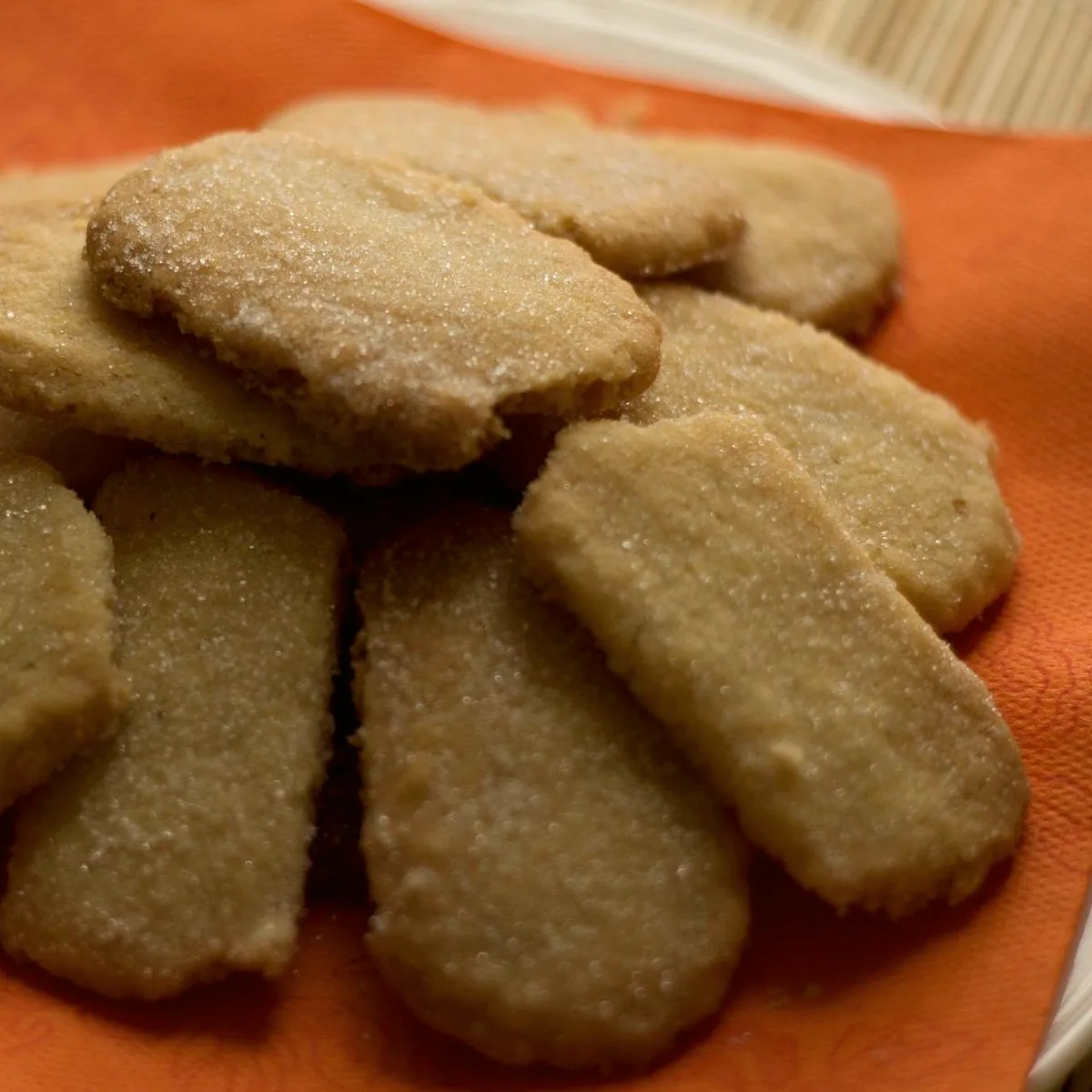
Butter, sugar and flour in a three-two-one ratio, worked to a short dough and baked slowly until pale gold.
Also known asPetticoat tails · Scotland
.jpg)
CC BY 2.0. Cropped and colour-adjusted for this site.
Method
Beat the 200 g unsalted butter and the 100 g caster sugar together until smooth and pale, without beating in excess air.
Add the 300 g plain flour and the 2 g fine sea salt and work them in with a wooden spoon and then by hand, just until the mixture comes together into a smooth, short dough.
Common pitfallWorking the flour in too vigorously develops gluten, which toughens what should be a crumbly, short dough. It is brought together only until it holds, never kneaded.
Press the dough evenly into a lined tin, prick all over with a fork, and score into fingers without cutting all the way through.
Chill for 20m, to firm the butter before it meets the oven.
Bake at 150 °C for 40m, until pale gold and firm at the edges but still soft in the centre.
A low, slow oven is what keeps shortbread pale rather than browned; the point is a short, sandy crumb from the fat and slow-cooked starch, not colour from the Maillard reaction a hotter bake would bring.
Recut along the scored lines while still warm, then leave in the tin to cool completely for 15m before turning out.
Shortbread did not start as a biscuit. Its origins are traced to medieval "biscuit bread": ordinary bread dough left over from baking, sweetened and dried out a second time into a hard rusk, a practice recorded across the British Isles from around the twelfth century [2]. What turned it into shortbread was the gradual replacement of yeast with butter, which made it rich enough to become an occasional luxury rather than a way of using up dough; it was something baked for Christmas, Hogmanay and weddings rather than every week [2].
The dish is popularly tied to Mary, Queen of Scots, credited in the mid sixteenth century with a fondness for a thin, caraway-flavoured round called petticoat tails, and the association is repeated everywhere shortbread is written about. It should be treated with some caution: the documentary evidence connecting her specifically to its origin is thin [1][2], and the earliest source the caraway story usually traces to treats it more as an aside than an established fact [2]. The name "petticoat tails" itself is unsettled, variously explained as a corruption of the French petites galettes, "little cakes", or as a reference to the frilled, petticoat-like edges left by cutting a round into wedges [3].
What can be dated with more confidence is the recipe. The first printed version appeared in 1736, from a Scotswoman named Mrs McLintock [1][3], and eighteenth- and nineteenth-century versions were considerably more elaborate than today's: an eighteenth-century recipe attributed to a Mrs Frazer calls for a peck of flour, citrus peel, blanched almonds and yeast, and an 1854 version from George Read's baking manual adds egg and lemon essence [2]. The plain three-ingredient formula treated as classic today (butter, sugar and flour, in that descending order of weight) is a later simplification of a dough that started out considerably busier.
Sources
- Shortbread, WikipediaOn the medieval origins, the disputed Mary, Queen of Scots association, and the 1736 Mrs McLintock recipe.
- Shortbread, British Food: A HistoryOn the "biscuit bread" origin and two dated historical recipes, from the eighteenth century and from 1854.
- Shortbread and Scotch — An Inimitable Match, Scotch Whisky (scotchwhisky.com)On the two competing theories for the "petticoat tails" name, and on Mrs McLintock's 1736 recipe.