British · Side
Roast Potatoes
Potatoes parboiled, roughed up at the edges and roasted hard in hot fat until the outside shatters.
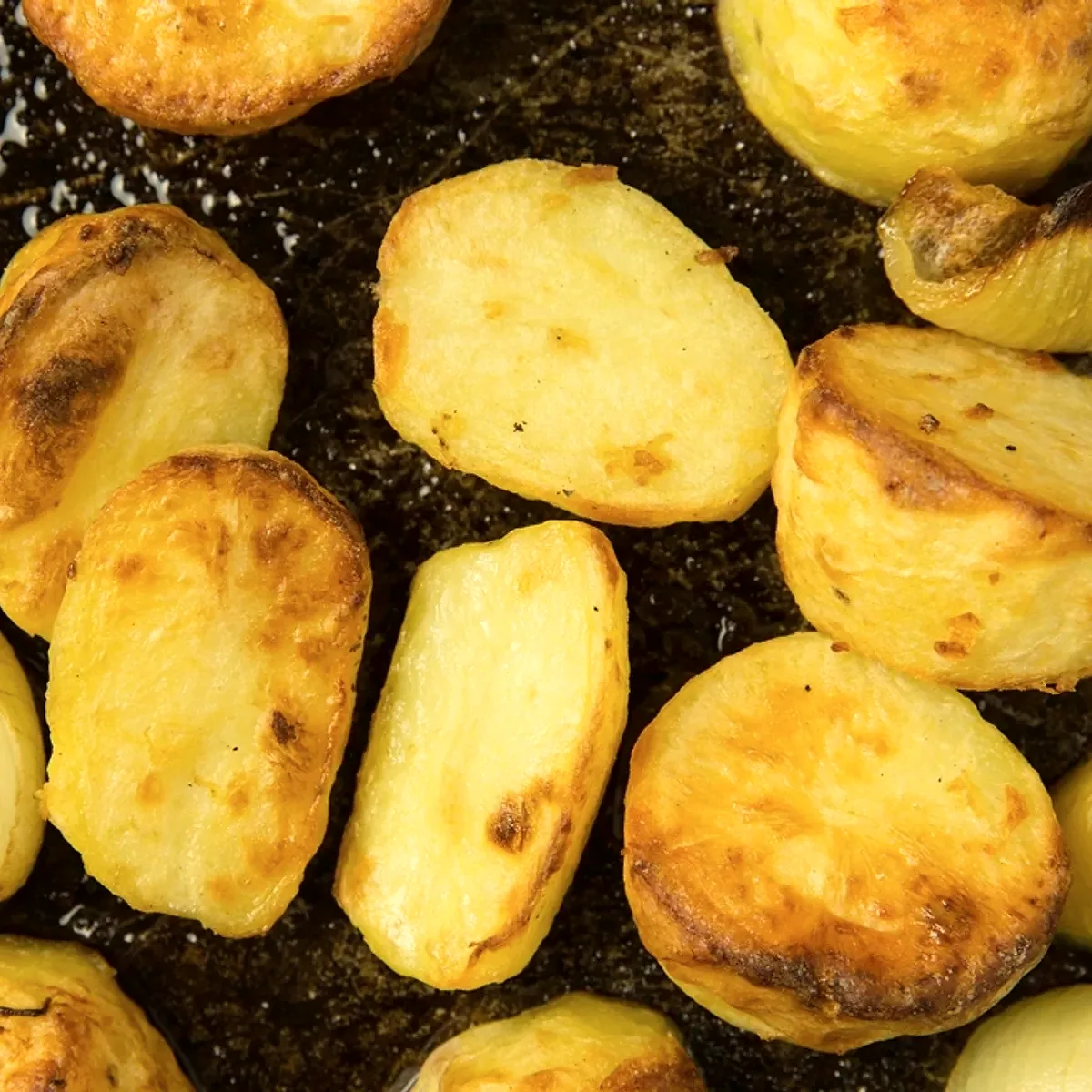
CC0 1.0. Cropped and colour-adjusted for this site.
Method
Cover the 1.2 kg potato with cold water, add the 5 g fine sea salt, bring to the boil and cook for 12m, until the edges are just starting to soften.
Put the 80 g goose fat into a large roasting tin and heat in the oven at 220 °C for 10m, until shimmering hot.
Drain the potatoes well, return them to the dry pan, sprinkle over the 15 g plain flour, and shake hard with the lid on to rough up and coat the edges.
Shaking the drained potatoes in the pan roughs up the surface into a mass of small starchy ridges, which is what catches and crisps in the hot fat; a smooth-edged potato browns evenly but never shatters.
Tip the potatoes carefully into the hot fat, turning to coat, and roast at 220 °C for 45m, turning once or twice, until deep golden and crisp all over. Season with the 3 g fine sea salt and serve at once.
Common pitfallAdding the potatoes to fat that is not yet properly hot lets them sit and steam instead of searing on contact, and they never fully crisp afterwards. The fat needs to be visibly shimmering before they go in.
Roast potatoes have surprisingly little documented history of their own; what can be dated is the cookery-writing tradition that fixed the method still used today. Isabella Beeton's Book of Household Management, published in 1861 after first appearing as a magazine column from 1857, gives an instruction that would be recognised in any British kitchen now: peel and halve or quarter the potatoes, parboil them, strain and dry them over a low heat, then put them into hot dripping in a roasting tin, either on their own or in the tin already holding the joint [1]. Beeton's book followed Eliza Acton's Modern Cookery, published in 1845, which had already introduced the now-standard format of listing ingredients and timings ahead of method: the template Beeton's own roast potato instruction still takes [2][1].
Dripping itself was not a luxury ingredient in this period but an ordinary one; a simple working diet in Victorian Britain ran on little more than bread, dripping, vegetables and tea [2], which makes Beeton's roasting method less an invention than a written-down version of something already common practice in kitchens that rendered their own fat from every joint they cooked.
What the record does not settle is when parboiling before roasting became standard, or who first roughened the surface deliberately for a craggier crust; both are simply present, fully formed, by the time the method is written down [1]. The dish's core technique (a first cook in water, a second in screaming-hot fat) has not needed to change since.
Sources
- Mrs. Beeton's Book of Household Management, Chapter XXX, WikisourceThe primary 1861 text, instructing that potatoes be parboiled, dried, then put into hot dripping in a roasting tin or the tin holding the joint.
- A Brief History of Food: Victorian Innovation, Tastes of HistoryA heritage-education organisation's account of Eliza Acton's 1845 and Mrs Beeton's 1857–61 cookery writing, and dripping's place in the ordinary Victorian diet.