Japanese · Soup · Starter
Miso Soup
Dashi with miso stirred through it off the heat, holding silken tofu and wakame.
Also known asMisoshiru · Japan
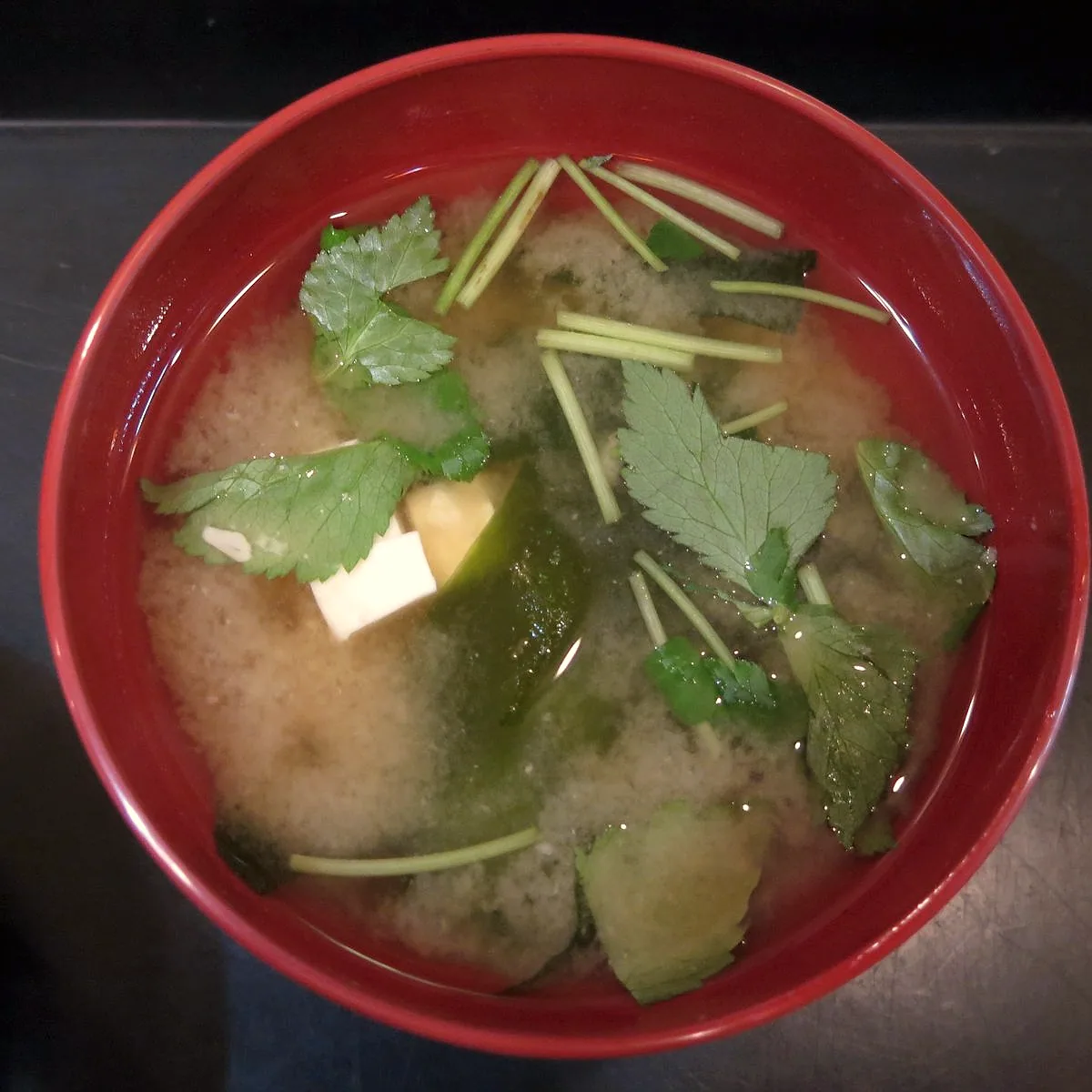

CC0. Cropped and colour-adjusted for this site.
Method
Wipe the 8 g kombu over with a dry cloth, leaving the white bloom on the surface: that is where much of its flavour sits. Put it into a pan with the 500 ml water and leave it to steep for 30m.
Bring the pan up very slowly over 10m, aiming to hold it around 60 °C. Lift the kombu out as soon as the first fine bubbles climb the sides and well before the water simmers: kelp held at the boil turns the stock slippery and faintly bitter.
Bring the liquid to a boil, take the pan straight off the heat and scatter in the 15 g katsuobushi. Leave it for 4m, until the flakes have all sunk.
Pour it through a sieve lined with muslin and let it drip for 3m. Do not press or squeeze the flakes: that forces bitterness and cloudiness into a stock whose entire point is clarity.
While the kombu steeps, cover the 4 g wakame with cold water and leave it for 10m. It will swell to many times its dry size. Drain it and cut any long fronds into short lengths.
Wakame swells to many times its dry volume, which is why the weight here looks improbably small. Judging it by eye from the packet is the reliable way to end up with a bowl of seaweed.
Bring the strained dashi back to just under a simmer, then slide in the 150 g silken tofu and the drained wakame and give them 3m to heat through. The surface should barely tremble; silken tofu breaks up if the pan is stirred or allowed to boil.
Take the pan off the heat. Put the 36 g miso into a ladle, dip the ladle into the hot stock and work the paste apart against the metal with chopsticks until it has gone completely, then tip it back into the pan and turn it through gently over 2m. Scatter the 1 ½ spring onions (20 g) over and serve at once, without letting it near the heat again.
The miso goes in off the heat and is never boiled. Boiling drives off the volatile aromatics that make it worth using and kills the live cultures in unpasteurised paste, leaving a soup that tastes only of salt.
Common pitfallSpooning the paste straight into the pan leaves lumps that never break up and grains of koji in the bottom of the bowl. It is worked apart in a ladle of hot stock first, every time.
Miso is not originally Japanese. Its ancestor is a Chinese fermented soy preparation recorded from the third century BC, which arrived in Japan alongside Buddhism in the sixth century AD; by the Nara period the name had shifted towards the modern one [1]. The active agent throughout is koji, the mould Aspergillus oryzae, whose enzymes break the soy protein down into the amino acids the paste tastes of [1].
The soup is the Japanese part. Miso began as an expensive food for the elite, and what turned it into a daily one was a meal structure: ichiju issai, one soup and one dish, the eating custom that took hold among the samurai in the Kamakura period between 1185 and 1333 [2]. Buddhist monks of the Muromachi period ground the whole soybeans into a paste, which is what made miso dissolve rather than sit in the bowl, and home brewing spread with it; industrial production followed in the Edo period [1][2].
The result is that the soup is now the overwhelming use of the ingredient. More than eighty per cent of Japan's annual miso production goes into miso soup, and around three-quarters of Japanese people drink it at least once a day [3].
What is fixed about it is thin: a dashi, a miso and a small number of solid things suspended in it. The stock is most often kombu with katsuobushi, though dried sardines or dried shiitake do the same job, and the paste may be white, red or a blend of the two [3]. Almost everything else is regional or seasonal, which is why a dish this standardised in structure is never quite the same bowl twice.
Sources
- Miso, WikipediaOn the Chinese antecedents, the arrival of fermented soy foods with Buddhism, the Nara-period shift to mishō, the Muromachi grinding of the beans to a paste, and koji.
- Miso, Umami Information CenterOn miso as an elite import, the Kamakura samurai custom of ichiju issai, and the spread of home brewing in the Muromachi period and industrial production in the Edo.
- Miso soup, WikipediaOn the standard dashi and miso types and on how much of Japan's miso ends up in soup.