Filipino · Dessert
Leche Flan
An egg-yolk custard set over a layer of hard caramel, steamed rather than baked, and unmolded to show off its glossy amber top.
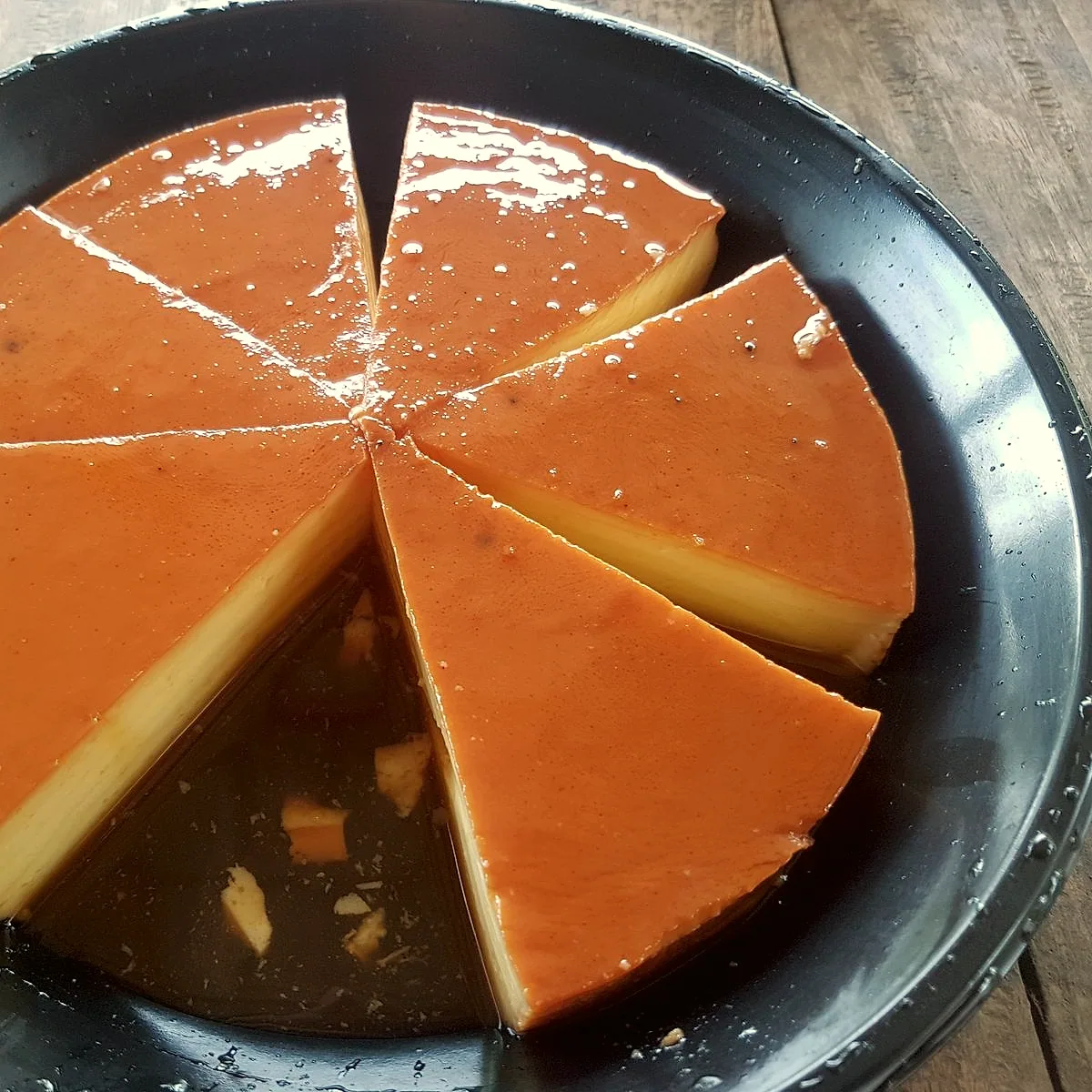
_02.jpg)
CC0. Cropped and colour-adjusted for this site.
Method
Melt the 150 g caster sugar in a dry pan over a medium heat, swirling rather than stirring, for 8m, until deep amber. Pour immediately into the base of the mould or moulds, tilting to coat, and set aside to harden.
Gently whisk the 10 ½ egg yolks (180 g) with the 300 g condensed milk, 250 ml evaporated milk and 5 ml vanilla extract for 10m, until just combined, then strain through a fine sieve into the caramel-lined mould.
Common pitfallWhisking the yolks too vigorously beats air into the mixture, and that air shows up as small holes in the finished custard. Stirring gently, just enough to combine, keeps the texture smooth.
Cover the mould with foil and steam over gently simmering water for 40m, until the custard is set but still faintly wobbly at the centre.
Steaming rather than baking in a water bath keeps the custard at a gentler, more even temperature throughout, which is what gives leche flan its dense, silky set without the small air bubbles a hotter oven bake can leave behind.
Cool, then refrigerate for 4h. Run a knife around the edge and invert onto a plate to unmould, letting the caramel run down over the custard.
Leche flan belongs to a family of caramel-topped custards that Spanish colonisation carried around the world. It is a denser, sweeter descendant of the Spanish dish, made with condensed milk and more egg yolk than a crème caramel takes, using canned milk that reached Filipino kitchens with American wartime supplies rather than the whole eggs and plain milk of its European relatives [2] [3].
The dessert's popular origin story is architectural rather than culinary. Spanish-era builders mixed egg whites with lime and other binders as mortar for church walls and domes: the sealing of Manila Cathedral's dome in 1780 and expense records for duck eggs at the Bacoor, Cavite church in the 1820s are both documented instances of the practice [1]. That construction method left enormous quantities of egg yolks with no stated use, and oral tradition holds that convent and household cooks began working them into rich custards and candies rather than discard them, with leche flan, yema and tocino del cielo all credited to the same surplus [1] [2].
That story is repeated constantly and confirmed by nobody with documentary evidence. The Philippine food historian Felice Prudente Sta. Maria has said directly that the yolk-surplus account "hasn't yet found written evidence," even as she allows that a culinary legend told this consistently may eventually be borne out [1]. The mortar-building itself is well documented; the leap from surplus yolks to a specific dessert is a plausible, widely told story rather than a proven one.
Sources
- Separation of church and eggs: The surprising history of yolks and whites in the Philippines, SBS FoodBy Nikki Alfonso-Gregorio; documents the egg-white church mortar with dated records, and quotes food historian Felice Prudente Sta. Maria on the lack of written evidence for the yolk-to-dessert link.
- Crème caramel, WikipediaPlaces leche flan within the wider Iberian and Portuguese-colonial family of caramel custards and describes its denser, condensed-milk-and-yolk formulation.
- Leche flan, The Nosey ChefBy Ann Marie Eastmond; explains leche flan's denser, more egg-heavy, condensed-milk formulation against crème caramel, and dates condensed milk's arrival in the Philippines to American supplies during the Second World War.