Persian · Side
Chelo ba Tahdig
Basmati rinsed, parboiled and steamed loose-grained under a cloth-wrapped lid, over a bottom layer of saffron-stained potato pressed to a golden, crisp crust.
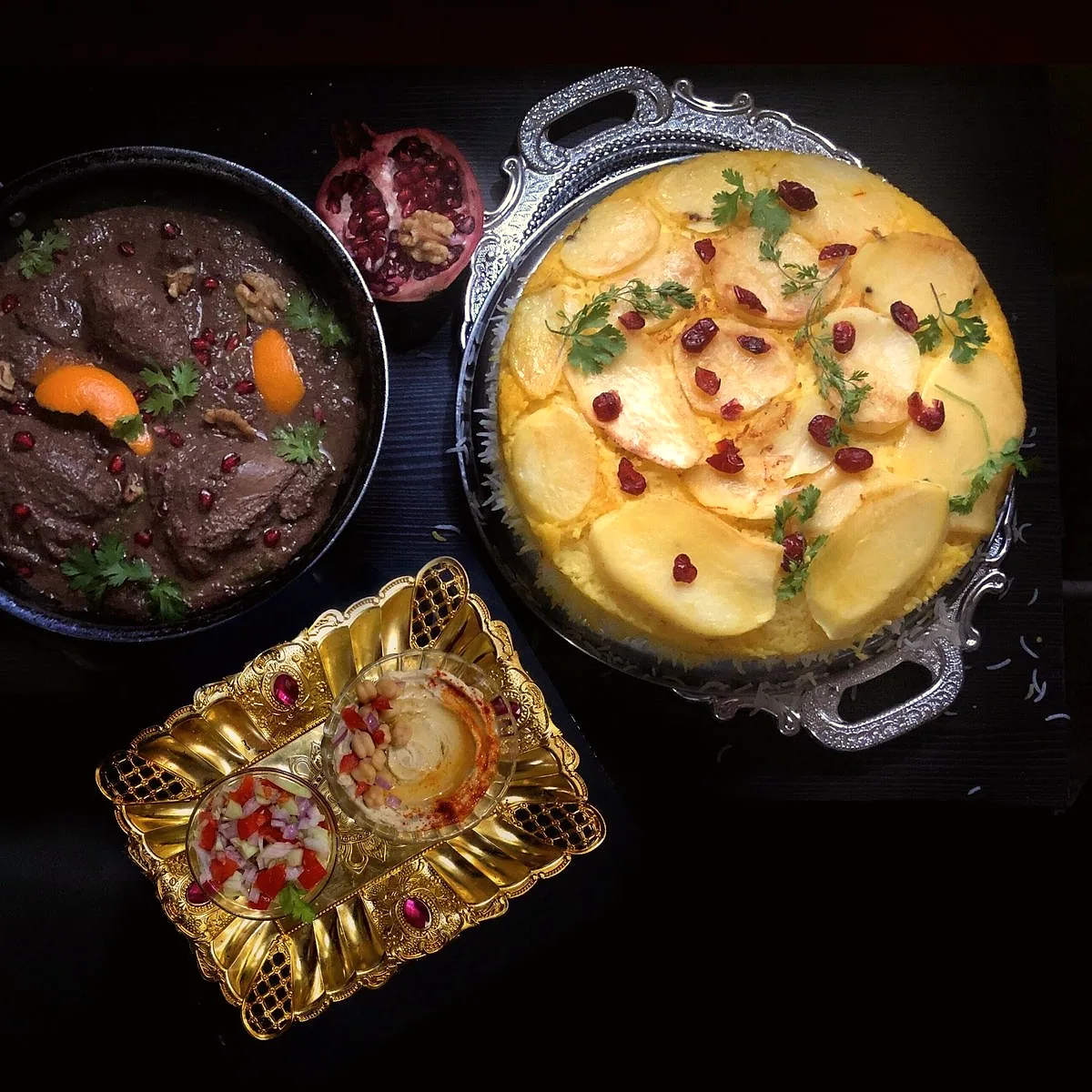

CC BY-SA 4.0. Cropped and colour-adjusted for this site.
Method
Rinse the 500 g basmati rice in several changes of cold water, swirling and draining each time, for 6m, until the water runs clear of surface starch.
Cover the rinsed rice with the 2.5 L water and the 25 g fine sea salt and leave it to soak for 45m.
Grind the 0.3 g saffron and stir it into the 30 ml water, hot but not boiling, and set it aside to steep for 5m while the rice soaks.
Bring the rice in its soaking water to the boil and cook for 7m, until the grains have softened at the edge but are still firm at the core. Drain immediately in a fine sieve.
The rice is only ever parboiled, never cooked through in the water; it finishes by steam alone, which is what keeps the grains whole and separate rather than starchy and clumped.
Melt half of the 70 g ghee in the base of a heavy, non-stick pot. Arrange the 300 g potato over the base in a single, overlapping layer. Mound the drained rice over the potato in a low pyramid, taking care to keep the layer of potato undisturbed underneath. Drizzle over the remaining ghee and the bloomed saffron water, then use the handle of a spoon to poke a few holes down through the mound to let steam escape. Spend 15m building the layers evenly.
Wrap the pot lid in a clean cloth, secure it on tightly, and set the pot over a low heat for 50m, until the potato at the base has set into a firm, golden crust and the rice on top is tender and separate.
Common pitfallA lid left bare lets condensation drip back onto the rice and turns the top layer soggy. Wrapping it in a cloth lets the steam vent while the water stays out.
Take the pot off the heat and let it stand briefly, then invert it over a serving platter in one confident motion so the crust of potato lifts free on top. This takes 5m.
Rice reached Iran from South and Southeast Asia, and for centuries it stayed a food of the elite, grown and eaten mainly under Safavid patronage before it spread more widely through Iranian society over the seventh to thirteenth centuries [1]. Chelo, plain steamed white rice cooked and served on its own rather than mixed through with other ingredients as in a polo, became the everyday form that rice took once it was no longer restricted to court kitchens.
The crust at the bottom of the pot has its own name, tahdig ("bottom of the pot") and its own telling of how it came to be prized rather than scraped out and discarded. A widely repeated account, set in the nineteenth-century Qajar court, has palace servants fighting loudly over the crisp rice left in the royal cooking pot until the commotion reached the king himself, who tried it, approved, and had it served to him every night after. That story is presented even by the sources that repeat it as a popular legend rather than a documented event, with no contemporary record behind it [2].
Whatever the truth of its telling, tahdig's spread through Persian society was well under way by the end of the nineteenth century, judged by how widely home cooks were already known to attempt it [2]. It later travelled with Persian Jewish communities as they left Iran across the twentieth century, following the 1948 founding of Israel and later waves of emigration, becoming for many a dish that carried the memory of home as much as it fed a table [2].
What tahdig is made from varies by household and region far more than the legend suggests: a layer of potato, of flatbread, of yoghurt-thickened rice, or the rice itself pressed directly against a well-oiled pot, each producing a differently textured crust from the same underlying technique of parboiling the rice and finishing it by steam alone.
Sources
- Chelow With Tahdig: The Mouthwatering Iranian Rice That Takes Time To Master, Tasting TableTraces rice's arrival in Iran from South and Southeast Asia, its early restriction to Safavid elites, and its spread through Iranian society between the seventh and thirteenth centuries.
- The Crispy, Golden Crust of Tahdig — A Dish That Connects Persian Jews to Their Roots, AishNames and explicitly frames as a popular urban legend the Qajar-era palace story of tahdig's discovery, and traces the dish's later importance to Persian Jewish communities after the twentieth-century emigration from Iran.