Italian · Main Course
Cacio e Pepe
Sheep's cheese and black pepper worked into a sauce with nothing but the starch of the water the pasta cooked in.
Not the same asPasta alla gricia (The same Pecorino and pepper with rendered guanciale added. Gricia is, in effect, cacio e pepe with cured pork in it.)
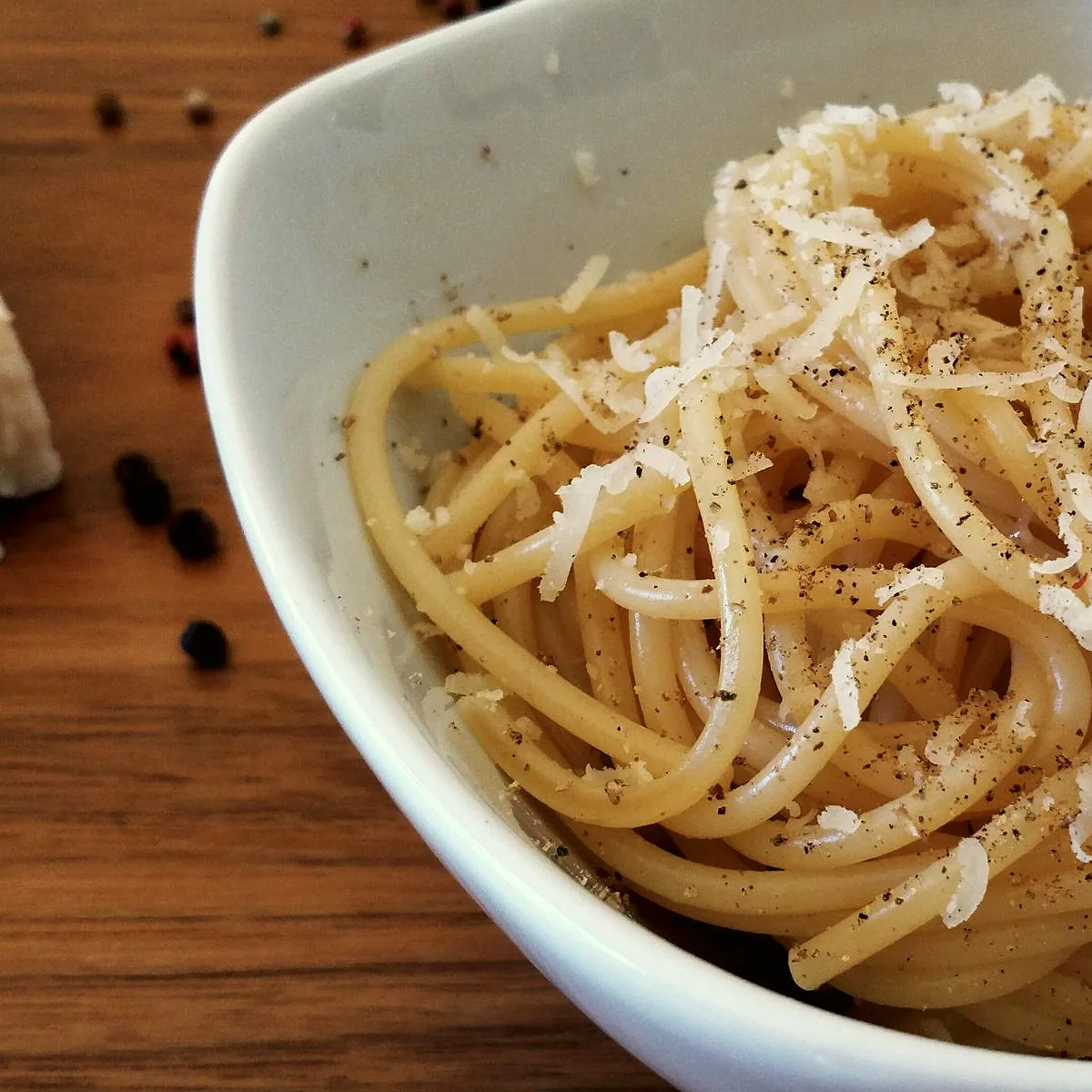

CC BY-SA 3.0. Cropped and colour-adjusted for this site.
Method
Bring the 2 L water to a rolling boil in the widest pan you have, then add the 20 g fine sea salt and let it dissolve.
Add the 180 g dried spaghetti and cook for 9m, or two minutes short of whatever the packet claims. Before draining, lift out a mugful of the cooking water: the starch it carries is what will let the sauce bind. Drain the pasta while the centre still resists a bite.
While the water heats, tip the 4 g ground black pepper into a wide, dry pan over a moderate flame and toast it for 2m, shaking it about, until it turns fragrant and resinous rather than dusty. Take the pan off the heat and leave the pepper in it.
Once the pasta is in the water, put the 85 g Pecorino Romano in a bowl and beat in a ladleful of the starchy cooking water a little at a time, working it for 4m until it becomes a slack, entirely smooth paste with no grain left in it. Leave it to lose its heat while the pasta finishes.
The cheese is loosened with cooking water rather than plain water because the dissolved starch is what holds the melted proteins apart. Without it they draw together into strings and the sauce splits.
Drain the pasta, keeping plenty of the water back, and tip it into the pepper pan with a splash of that water, tossing over the pan's residual warmth until every strand is slick and coated. Now, off the heat and well below 65 °C, add the cheese paste and toss hard for 3m, loosening with more cooking water until the sauce turns glossy and moves as one mass. Serve at once under the 15 g Pecorino Romano.
Common pitfallCheese meeting a pan still on the flame is the single way this dish fails. It seizes into rubbery clots that no amount of tossing will bring back, and the only remedy is to start the sauce again.
Cacio e pepe is cheese and pepper, and the phrase is dialect for exactly the two things in it [1]. Pasta, salt and the water the pasta cooked in are the whole of the rest.
The received account gives the dish to the shepherds of Lazio, Abruzzo, Tuscany and Umbria, moving flocks between pastures with hard sheep's cheese, dried pasta and pepper in their bags [1]. It is a good story and the pepper is the hole in it: black pepper was never a cheap commodity, and dried pasta became an everyday staple far more recently than the story needs it to have [1][3]. The likelier reading is that pepper joined an older and plainer cheese-and-pasta dish long after the fact.
The written record shows it Roman and domestic well before it was famous. Ada Boni's La cucina romana of 1929 already lists spaghetti a cacio e pepe, and remarks that its piquancy was valued for the wine it encouraged [2]. Its career as a restaurant dish is much younger, placed by one account in the osterie of Rome in the 1950s and 1960s, and credited by another to the Slow Food movement of the late 1980s [3].
Its reputation for being harder than it looks is deserved, and has now been measured. A group of physicists published a phase diagram of the sauce in Physics of Fluids in 2025 and found that everything turns on starch: below roughly one per cent of starch relative to the mass of the cheese, the proteins aggregate on heating into what the authors named the Mozzarella Phase, clots of cheese suspended in water rather than a sauce [4]. The paper was given an Ig Nobel Prize the same year [5]. It is an unusually exact account of why the traditional instruction is the instruction: the cooking water, never fresh water, and never the flame.
Sources
- Cacio e pepe, WikipediaOn the name, the ingredients, and the shepherd account together with the objection that pepper was too expensive for it.
- Ada Boni, La cucina romana, 1929, Terra di fame e di abbondanza — Istituto Storico Parri, Emilia-RomagnaA survey of the contents of Boni's Roman cookbook, which lists spaghetti a cacio e pepe.
- What is cacio e pepe and how did it take over the world?, Los Angeles Times, 2021Jenn Harris, quoting Elizabeth Minchilli against the shepherd story and dating the dish's restaurant career. Read in the Yahoo syndication of the Los Angeles Times piece.
- Phase behavior of Cacio e Pepe sauce, Physics of Fluids 37, 044122, 2025Bartolucci, Busiello, Ciarchi, Corticelli, Di Terlizzi, Olmeda, Revignas and Schimmenti, on starch concentration and the failure mode they name the Mozzarella Phase.
- 2025 Ig Nobel Prize for Perfect Pasta Sauce, Institute of Science and Technology Austria, 2025Records the award to the authors of the Physics of Fluids paper.