Brazilian · Dessert
Brigadeiro
Condensed milk cooked down with cocoa and butter to a thick fudge, rolled into balls and coated in chocolate sprinkles.
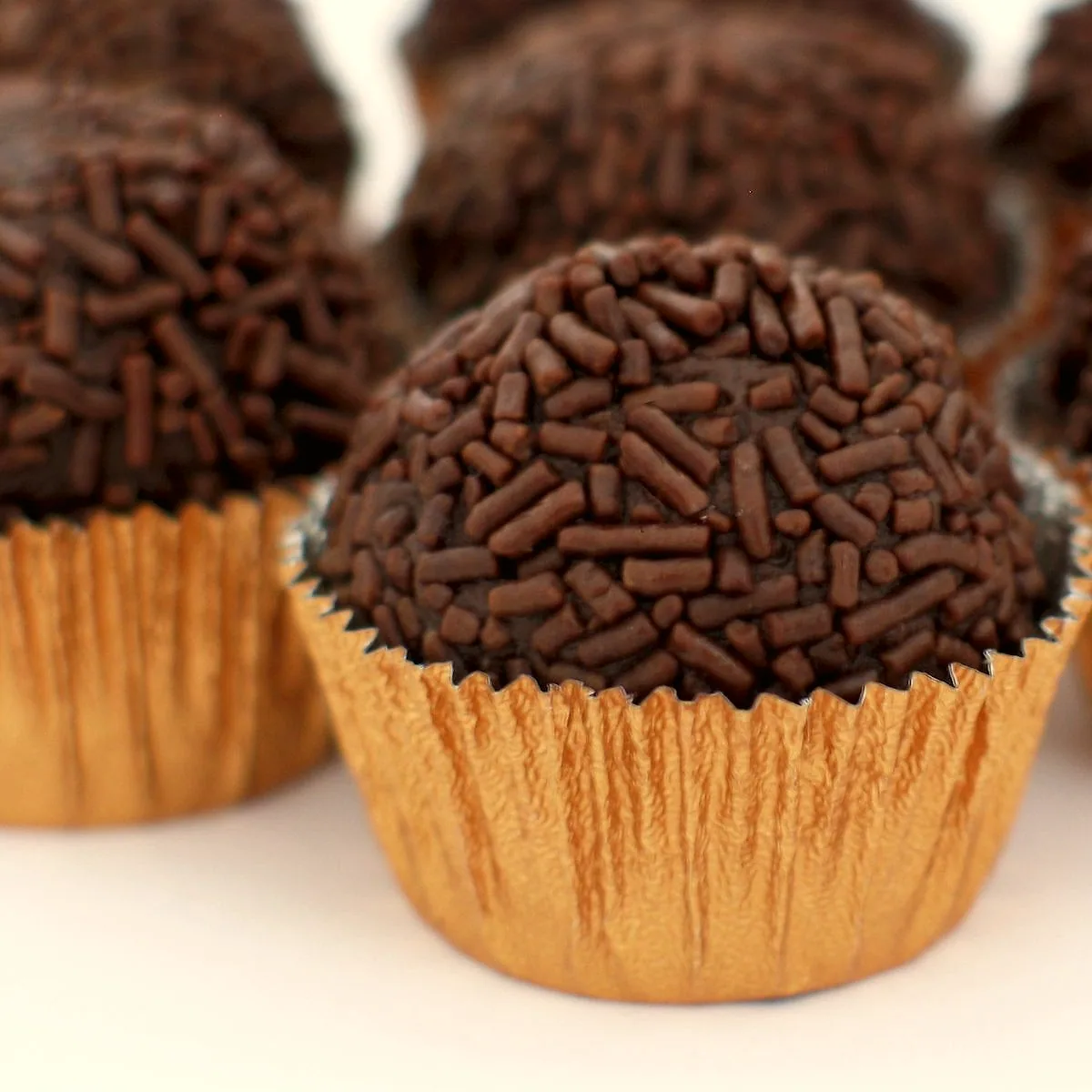

CC BY-SA 2.0. Cropped and colour-adjusted for this site.
Method
Combine the 395 g condensed milk, 30 g cocoa powder and 20 g unsalted butter in a heavy-based saucepan over a low heat. Cook for 15m, stirring constantly, until the mixture thickens enough that a spoon dragged across the bottom of the pan briefly leaves it visible before the fudge flows back together.
The mixture is done when a spoon dragged through it briefly exposes the bottom of the pan before the fudge flows back over. Stopping earlier leaves it too soft to roll once cool; stopping later makes it stiff and hard to shape.
Common pitfallLeaving the pan unstirred for more than a few seconds lets the milk solids catch on the base, and a scorched batch tastes of it right through. It wants a low heat and a spatula moving constantly, scraping the bottom and corners.
Scrape the fudge onto a plate, smooth it out and chill for 1h, until firm enough to roll without sticking to your hands.
Roll the fudge into small balls between lightly buttered palms, then roll each ball in the 120 g chocolate sprinkles to coat completely.
The story told about brigadeiro is specific enough to sound documented: in 1945, supporters of the Air Force brigadier and presidential candidate Eduardo Gomes (many of them women voting in a Brazilian national election for the first time) sold a condensed-milk sweet at campaign rallies and named it after him [2]. Gomes lost to Eurico Gaspar Dutra, but the name outlived the campaign entirely [1][3]. It is a good story, and it is presented by those who tell it as lore rather than as settled history. That is a distinction worth keeping, since the ingredients behind it were already in Brazilian kitchens well before 1945 [2].
Condensed milk had been sold in Brazil since Nestlé began marketing it there in the 1920s, and it became a practical stand-in for scarcer dessert ingredients during the rationing years of the Second World War, the exact conditions the 1945 story assumes rather than invents [2]. A closely related sweet from Rio Grande do Sul, "negrinho," uses the same condensed-milk-and-cocoa base and has been traced by at least one researcher to that same 1920s arrival of tinned condensed milk, and a regional-press account of the sweet's history separately describes "negrinho" as an older name than the brigadeiro story itself, which is evidence that the confection likely predates the 1945 campaign, whatever its name was before Eduardo Gomes became attached to it [1][3].
What survived past the election, either way, is a sweet built for wartime scarcity: condensed milk, cocoa and butter, cooked down to a fudge that needs no oven, no eggs and no ingredient harder to find than a tin from the cupboard. That may explain its staying power rather better than any election slogan does.
Sources
- Brigadeiro, WikipediaGives the 1945 campaign story for Heloísa Nabuco de Oliveira and Brigadier Eduardo Gomes, and notes the related Rio Grande do Sul sweet "negrinho," traced by at least one researcher to the 1920s arrival of Nestlé condensed milk in Brazil.
- The Political Lore of an Iconic Brazilian Sweet, Gastro Obscura (Atlas Obscura)Frames the campaign story explicitly as lore rather than settled fact, and sets it against wartime rationing that made condensed milk an easy substitute for scarcer dessert ingredients.
- A jornada do brigadeiro: de campanha política a símbolo do Brasil, Estado de MinasBrazilian regional newspaper account confirming Gomes's 1945 loss to Eurico Gaspar Dutra and noting that "negrinho," the Rio Grande do Sul name for the same sweet, is of older origin than the election story.