American · Main Course
Texas Brisket
A whole beef brisket, seasoned with nothing but salt and pepper and smoked low over wood for the better part of a day until it shreds under a fork.
Not the same asJewish-style braised brisket (A pot-roasted, oven-braised dish finished in its own liquid rather than smoked. It is a different cooking method on the same cut, and the two traditions are historically related but not interchangeable.)
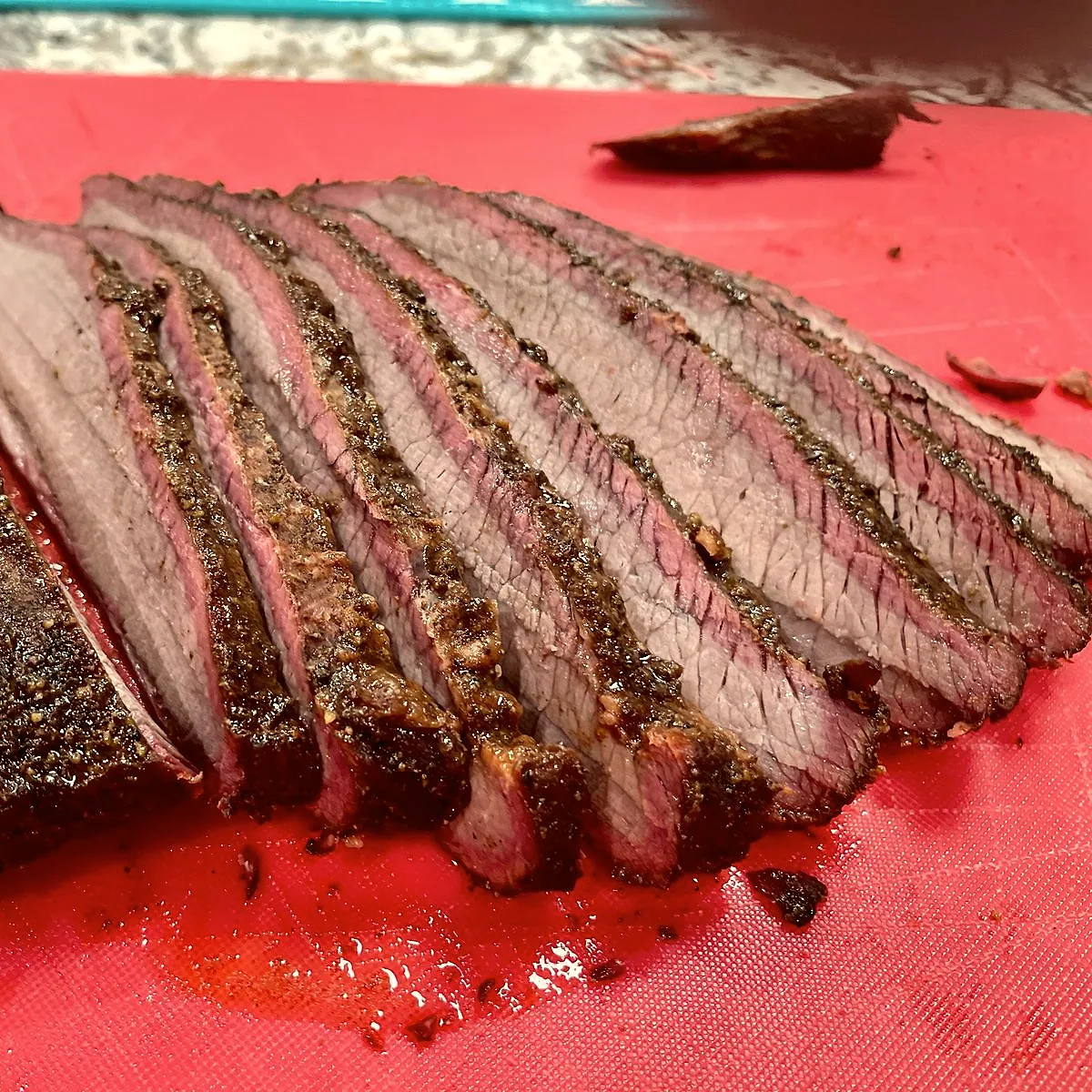

CC BY-SA 4.0. Cropped and colour-adjusted for this site.
Method
Trim the 4.8 kg beef brisket so the fat cap is an even layer rather than removing it, then coat the whole surface with the 55 g fine sea salt and the 40 g ground black pepper, pressing it on so it holds.
Set the brisket fat side up in a smoker running at a steady 110 °C over post oak or another mild hardwood, and leave it undisturbed for 6h, until a dark, firm bark has formed on the surface and the internal temperature has climbed into the stall, where it will hold roughly steady for a long stretch.
Lift the brisket onto a large sheet of butcher paper and wrap it tightly, sealing the seams underneath, to carry it through the rest of the stall without softening the bark.
Wrapping the brisket partway through the cook pushes it through the long temperature stall where evaporative cooling can hold the internal temperature still for hours. Butcher paper does this without steaming the bark soft the way foil does.
Return the wrapped brisket to the smoker at the same temperature for 5h, until a probe pushed into the thickest part of the flat meets no resistance at all and the internal temperature reads close to 95 °C.
Leave the brisket wrapped and rest it in a dry cooler or a switched-off oven for 1h before opening the paper. This is not optional: the meat is far too hot to hold together if it is cut straight away, and it finishes tenderising as it cools.
Unwrap the brisket and separate the point from the flat where the seam of fat runs between them. Slice each piece on its own, cutting straight across its own grain into slices about the width of a pencil, for 15m.
Common pitfallThe point and the flat are two separate muscles running in different directions. Slicing straight across the whole brisket at one angle cuts the flat correctly and the point against its own grain; they are separated and sliced individually instead.
The standard account of Texas brisket credits German and Czech immigrants, who arrived in the Hill Country in the mid-nineteenth century and opened meat markets that smoked the week's unsold cuts to keep them saleable, a habit that by the 1920s and 1930s had hardened into the barbecue joints of towns such as Lockhart and Elgin. That much is well attested. What is less settled is why brisket in particular (a cheap, tough forequarter cut that most of American butchery treated as an afterthought) became the centerpiece.
The documentary trail is thinner than the folklore. The earliest newspaper advertisements for smoked brisket found so far date to 1910, and they were aimed at Texas's Jewish communities rather than the general public [1]. Brisket already held a place in Ashkenazi cooking, where it was prized as an inexpensive cut permitted under dietary law, and Texas butchers appear to have begun offering it smoked specifically to Jewish customers in the early twentieth century [2]. Black's BBQ in Lockhart, which credits itself as the first Central Texas meat market to put brisket on the menu by itself, only did so in the late 1950s, decades after Central Texas's German and Czech butchers were already smoking beef, and mostly because customers had until then simply asked for "beef" and been handed whichever cut, fatty or lean, the counter had on hand [1]. One turning point often cited is Walter Jetton, the caterer who served brisket at Lyndon Johnson's ranch barbecues and helped put it in front of a national audience [2].
So the general immigrant-meat-market story and the specific rise of brisket are two claims of different strength: the markets are documented, but the leap from "German and Czech butchers smoked beef" to "brisket became Texas barbecue's defining cut" runs through a narrower, later, and less-repeated history than the usual telling allows.
What is not in dispute is the technique that resulted: a whole, largely untrimmed cut, seasoned with nothing but salt and coarse pepper, smoked low over post oak for most of a day until the connective tissue running through it has broken down, then rested and sliced against the grain. Sauce is beside the point: in Central Texas barbecue it is served on the side, if at all, and the smoke and the meat are expected to stand on their own.
Sources
- The History of Smoked Brisket, Texas MonthlyBy Texas Monthly's barbecue editor Daniel Vaughn; covers the 1910 Jewish grocery-store newspaper ads for smoked brisket and Black's BBQ in Lockhart being the first to sell it exclusively, in the late 1950s.
- Talk of the Table: A Tale of Two Briskets, Moment MagazineTraces barbecue historian Daniel Vaughn's research connecting early Texas smoked brisket to Jewish butchers and delicatessens.