Skip to content
Markey
Theme: System (currently light)
Volkswagen VW roundel

Generation

Volkswagen Golf Mk1

Volkswagen Golf Mk1 (Typ 17), 1974-1993

Produced
1974–1993
Code
Typ 17
Designer
Giorgetto Giugiaro at Italdesign
Red Volkswagen Golf Mk1 photographed head-on, showing the square headlamps, black grille and upright glasshouse

Image credit

File
File:VW Golf I front 20080208.jpg
Author (attribution required)
Rudolf Stricker
Test Drive this car

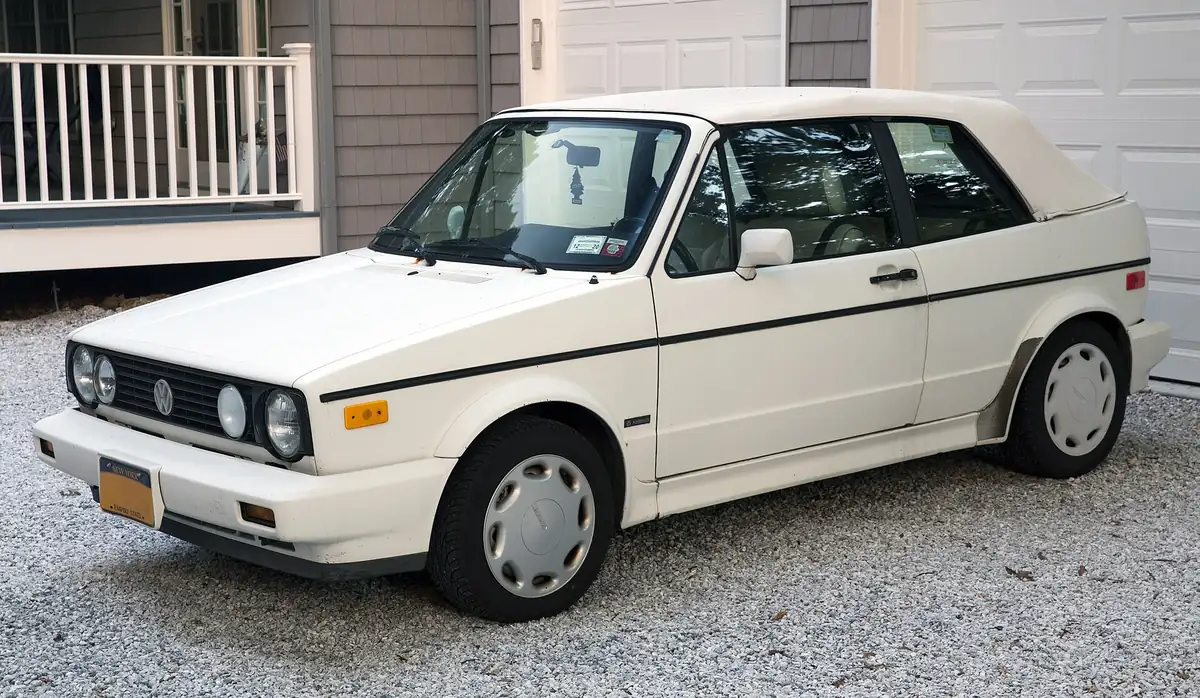
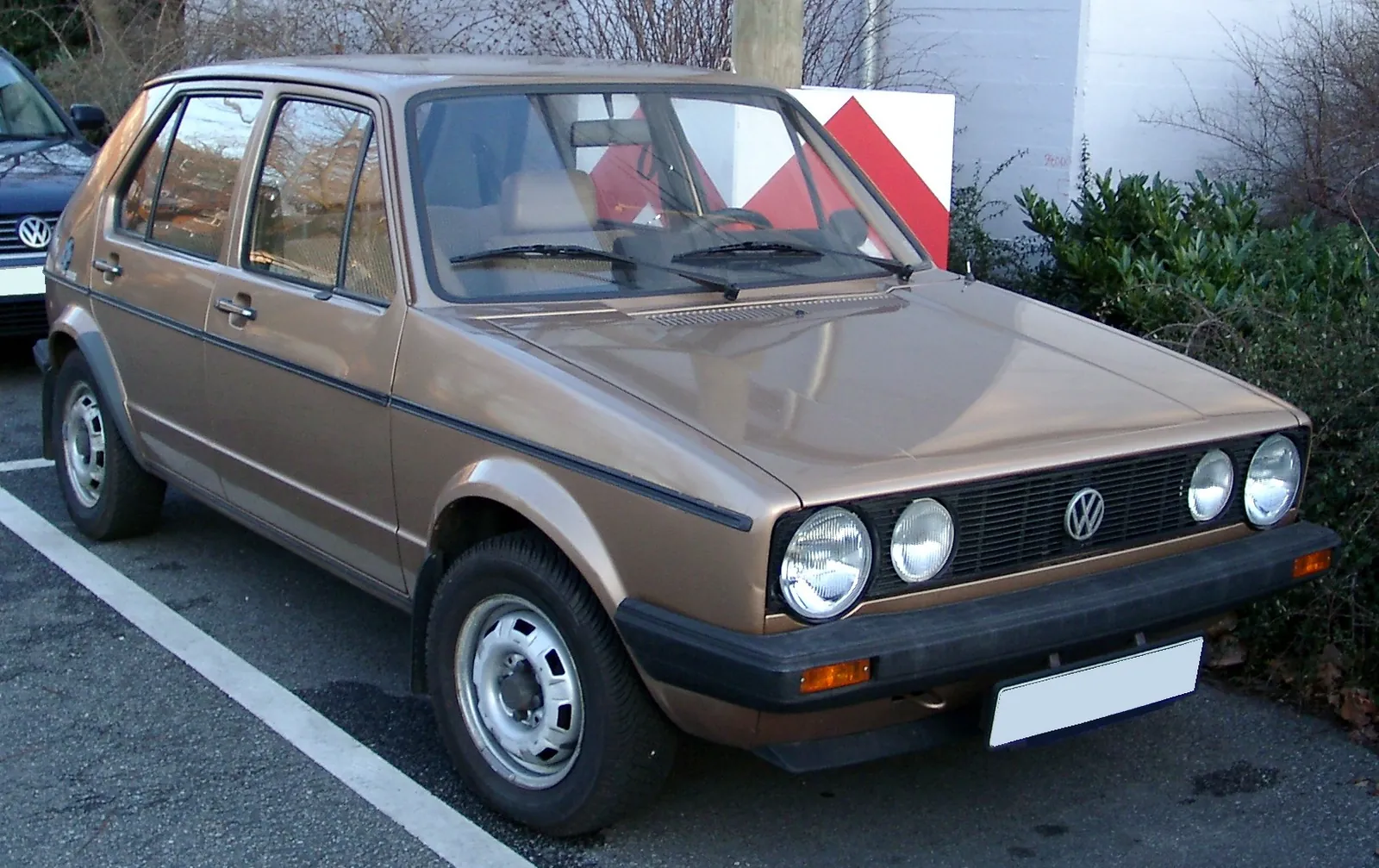
Giugiaro’s two-box shape, in production from May 1974, and still being built as a Cabriolet in 1993, nine years after the hatchback it came from was replaced.[1] That is why this entry’s production years run to 1993 and why it appears under the 1990s as well as the 1970s.

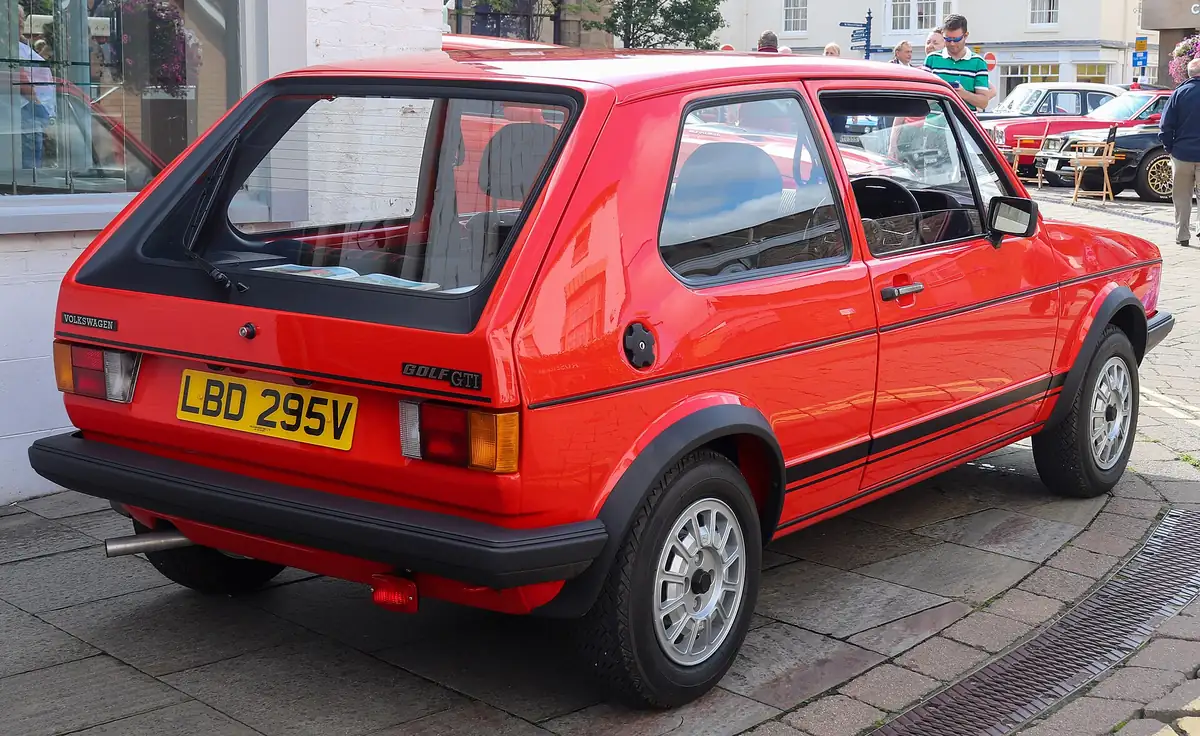
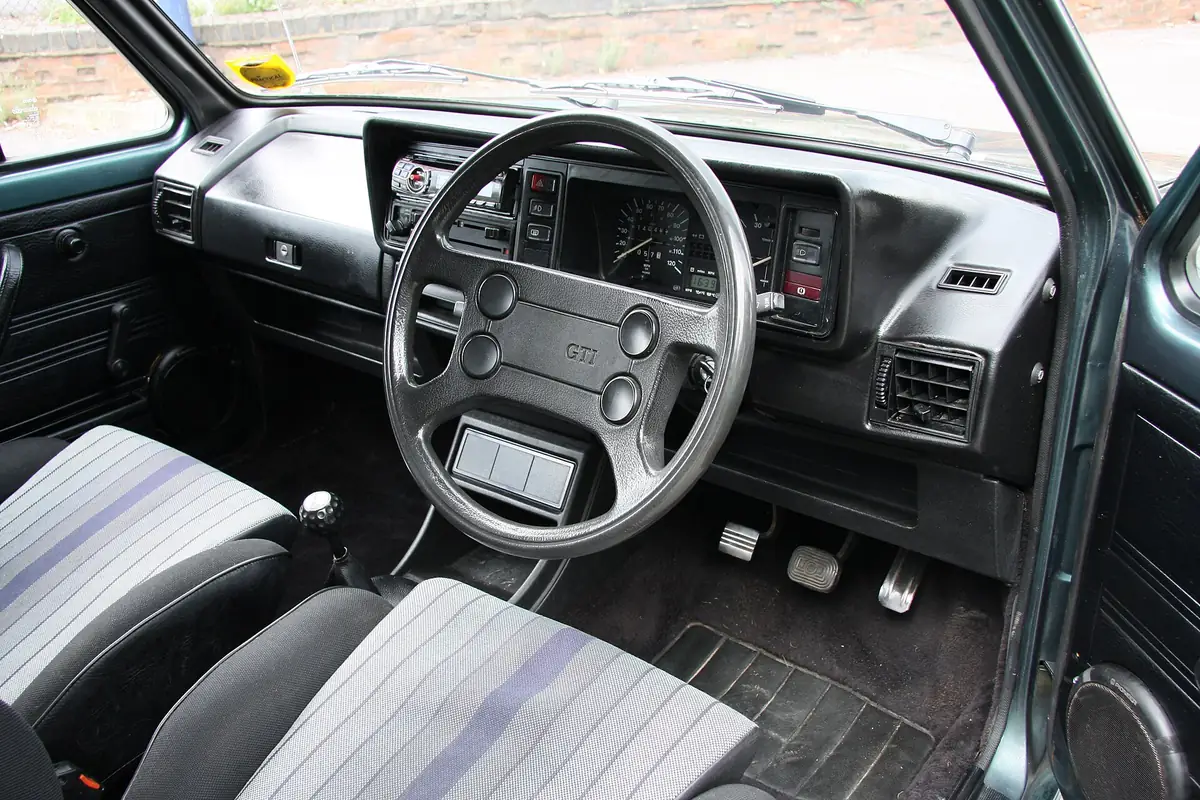
The Golf GTI is the reason most people remember the car, and it is also this batch’s best illustration of a sourcing problem. Its torque, acceleration and top speed are all published twice in the same Wikipedia article, with different figures each time: the prose cites Volkswagen’s own 40-years brochure, the model-range table gives something slightly different. Those three values are marked as having conflicting sources, and both figures are stated on each. Nothing here silently picks a winner.

Only the Cabriolet carries a drag coefficient, because only the Cabriolet has one published.[2] That is also the trim the Test Drive page models, since it is the one with a complete set of physical inputs.
Overview

Manufacturer
Volkswagen
Produced
1974–1993
Model code
Typ 17
Designer
Giorgetto Giugiaro at Italdesign
Segment
C-segment (Europe) / Compact (US)
Positioning
Mainstream
Assembly
  • Wolfsburg, Germany
  • Brussels, Belgium
  • New Stanton, Pennsylvania, United States (Westmoreland Assembly)
  • Uitenhage, South Africa
  • Puebla, Mexico
  • Sarajevo, Yugoslavia (TAS)
  • Clayton, Victoria, Australia

Dimensions

Length
3,705 mm

Cars built to August 1978. Later hatchbacks measured 3,815 mm on deeper bumpers, and the US-market Rabbit was published as 155.3 in.

[1]

Width
1,610 mm

Later cars measured 1,630 mm.

[1]

Height
1,395 mm

Hatchback. The Cabriolet stood 1,412 mm and the Caddy pickup 1,490 mm.

[1]

Wheelbase
2,400 mm

Hatchback and Cabriolet. The Caddy pickup used a 2,625 mm wheelbase.

[1]

Kerb weight
790 kg

Lightest published figure. The generation spans 790-930 kg for the hatchback and 905-970 kg for the Cabriolet, so a single scalar cannot describe it; the per-trim figures below are the real data.

[1]

1.1

Trim · 1974–1983 · FA/GG/HB

Power
37 kW

50 PS at 6,000 rpm, converted at 1 PS = 0.73549875 kW.

[1]

Torque
77 N⋅m

Published as 7.9 kg-m at 3,000 rpm, converted at 9.80665 N-m per kg-m.

[1]

Kerb weight
Not yet available
0–100 km/h
17.0 s

[1]

Top speed
138 km/h

Published as a 138-140 km/h band; the lower bound is recorded. The Cabriolet on this engine managed 133 km/h.

[1]

Fuel economy
9.0 L/100 km

From the article model-range table, which does not name a test cycle. Predates the modern European cycles.

[1]

CO₂
Not yet available
Drag coefficient
Not yet available
Frontal area
Not yet available
Displacement
1,093 cc

[1]

Boot volume
Not yet available
Seats
5
Engine
inline-4 · FA/GG/HB
Drivetrain
Front-wheel drive

1.6 Diesel

Trim · 1980–1983 · CR/JK

Power
40 kW

54 PS at 4,800 rpm, converted at 1 PS = 0.73549875 kW.

[1]

Torque
98 N⋅m

98 N-m at 2,300 rpm.

[1]

Kerb weight
Not yet available
0–100 km/h
17.5 s

Published as a 17.5-21.5 s band across markets and gearing; the quickest figure is recorded.

[1]

Top speed
138 km/h

Published as a 138-142 km/h band; the lower bound is recorded.

[1]

Fuel economy
6.5 L/100 km

From the article model-range table, which does not name a test cycle.

[1]

CO₂
Not yet available
Drag coefficient
Not yet available
Frontal area
Not yet available
Displacement
1,588 cc

[1]

Boot volume
Not yet available
Seats
5
Engine
inline-4 · CR/JK
Drivetrain
Front-wheel drive
US market
Sold as Volkswagen Rabbit Diesel

GTI

Trim · 1976–1982 · EG

Power
81 kW

110 PS at 6,100 rpm, converted at 1 PS = 0.73549875 kW.

[1]

Torque
140 N⋅mSources disagree

The article prose gives 140 N-m at 5,000 rpm, citing Volkswagen’s own 40-years brochure; the model-range table in the same article gives 137 N-m at the same speed. The manufacturer-attributed figure is recorded.

[1]

Kerb weight
810 kg

Kerb weight as published in the article prose, citing Volkswagen’s 40-years brochure.

[1]

0–100 km/h
9.2 sSources disagree

The article prose gives 9.2 s, citing Volkswagen’s 40-years brochure; the model-range table in the same article gives 10 s. The manufacturer-attributed figure is recorded.

[1]

Top speed
182 km/hSources disagree

The article prose gives 182 km/h, citing Volkswagen’s 40-years brochure; the model-range table gives 183 km/h. A 1 km/h difference, recorded rather than quietly reconciled.

[1]

Fuel economy
10.5 L/100 km

From the article model-range table, which does not name a test cycle.

[1]

CO₂
Not yet available
Drag coefficient
Not yet available
Frontal area
Not yet available
Displacement
1,588 cc

79.5 x 80 mm bore and stroke, 9.5:1 compression.

[1]

Boot volume
Not yet available
Seats
5
Engine
inline-4 · EG
Drivetrain
Front-wheel drive

GLI Cabriolet

Trim · 1982–1993 · DX

Power
82 kW

112 PS at 5,800 rpm, converted at 1 PS = 0.73549875 kW.

[1]

Torque
150 N⋅m

150 N-m at 3,500 rpm.

[1]

Kerb weight
905 kg

Lightest published Cabriolet kerb weight; the body spans 905-970 kg.

[1]

0–100 km/h
10.5 s

Cabriolet figure. The equivalent hatchback managed 9 s.

[1]

Top speed
180 km/h

Cabriolet figure. The equivalent hatchback reached 187 km/h.

[1]

Fuel economy
11.0 L/100 km

Cabriolet figure from the article model-range table, which does not name a test cycle.

[1]

CO₂
Not yet available
Drag coefficient
0.48

Listed as the Volkswagen Cabriolet (Rabbit Convertible), 1979-1993. No drag coefficient is published for the Mk1 hatchback, which is why only this trim carries one.

[2]

Frontal area
Not yet available
Displacement
1,781 cc

[1]

Boot volume
Not yet available
Seats
4
Engine
inline-4 · DX
Drivetrain
Front-wheel drive

Sources & confidence

Every figure above carries a status. Nothing on this page is estimated without saying so, and nothing missing has been filled in with a guess.

Last verified
2026-08-18
Review status
Spot-checked by hand

Photography on this page is credited on each image. Tap theion a photograph for its author, licence and source.

References

Every sourced figure and every cited claim on this page, numbered. Wikipedia articles record the revision they were read at, because the article will have changed by the time you check it.

  1. [1]

    Volkswagen Golf Mk1. Wikipedia · revision 1368565284 · read 2026-08-18

    WikipediaCC BY-SA 4.0

    This article disagrees with itself on the GTI: the prose cites Volkswagen’s own 40-years brochure for 140 N⋅m, 9.2 s and 182 km/h, while the model-range table gives 137 N⋅m, 10 s and 183 km/h. Both figures are recorded on the affected values with status ‘conflicting-sources’.

  2. [2]

    List of automobile drag coefficients. Wikipedia · revision 1360737555 · read 2026-08-17

    WikipediaCC BY-SA 4.0

    The aerodynamic source named in several hundred production and concept vehicles, 1921 to 2024.

  3. [3]

    1984 Volkswagen Rabbit 1.6 diesel, 5-speed manual — EPA fuel economy record (vehicle 26787). US EPA / US Department of Energy · read 2026-08-18

    DatasetPublic domain (US Government work)Cited by the specifications

    The US-market Mk1 Golf was sold as the Rabbit. 1984 is the first model year EPA publishes and the last of Rabbit production, so this record covers the very end of the run.