
Skip to content
Markey
Theme: System (currently light)
Toyota emblem

Generation

Toyota Hilux (AN110/120/130)

Toyota Hilux (AN110/120/130), 2015-present

Produced
2015–present
Code
AN110/AN120/AN130
Designer
Ryota Naka, Yukihiro Koide, Takuya Watabe, Eishi Suzuki, Yusuke Fukushima
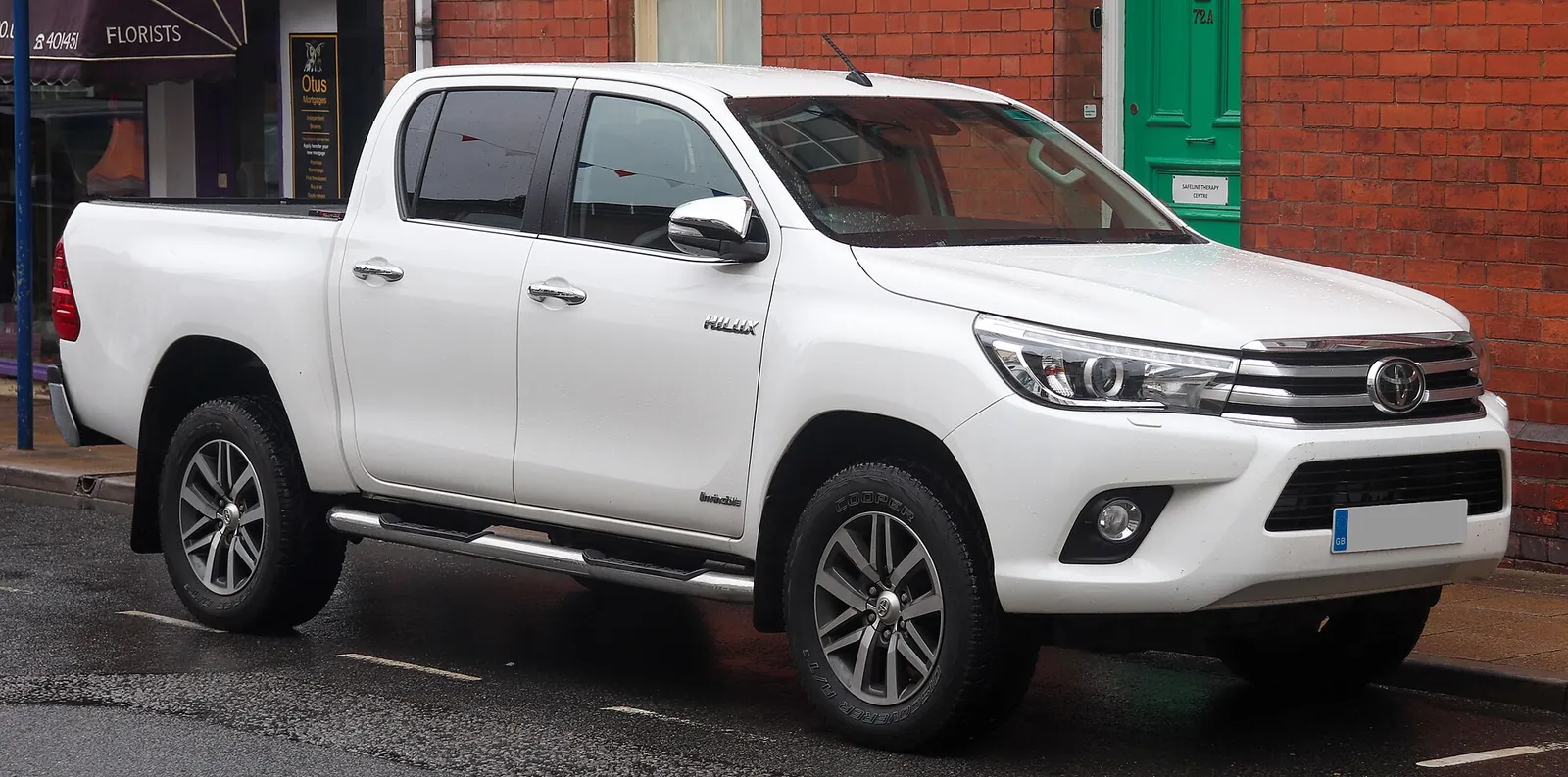
White Toyota Hilux Invincible double-cab pickup photographed from the front three-quarter angle

Image credit

File
File:2016 Toyota HiLux Invincible D-4D 4WD 2.4 Front.jpg
Author (attribution required)
Vauxford

The eighth-generation Hilux, on Toyota’s IMV platform, launched simultaneously in Thailand and Australia in 2015 and has since been revised through three separate facelifts, each raising the 2.8-litre diesel’s output, most notably the 2020 update that took the automatic-transmission 1GD-FTV from 177 hp to 204 PS.[1] It has never been sold in North America, where the Tacoma covers the same role.

As with several long-running trucks and SUVs on this site, only one weight range is published for the whole engine line-up (1,495-2,286 kg) rather than a figure per trim. The lighter rear-wheel-drive petrol and the heavier four-wheel-drive diesel recorded here take the two ends of that range on the same basis used elsewhere: a plausible mapping given which trim is mechanically heavier, not a manufacturer-confirmed figure for those two engines specifically.

Overview

Manufacturer
Toyota
Produced
2015–present
Model code
AN110/AN120/AN130
Designer
Ryota Naka, Yukihiro Koide, Takuya Watabe, Eishi Suzuki, Yusuke Fukushima
Segment
Pickup (Europe) / Pickup truck (US)
Positioning
Mainstream
Assembly
  • Ban Pho / Samrong Tai, Thailand (Toyota Motor Thailand)
  • Prospecton, South Africa (Toyota South Africa Motors)
  • Zárate, Argentina (Toyota Argentina)
  • Shah Alam, Malaysia (UMW Toyota Motor)
  • Karachi, Pakistan (Indus Motor Company)
  • Bidadi, India (Toyota Kirloskar Motors)

Dimensions

Length
4,935 mm

Low end of the Single Cab's 4,935-5,270 mm range. Crew Cab is 5,320-5,325 mm; Smart Cab is 5,320 mm.

[1]

Width
1,800 mm

Low end of a published 1,800-2,020 mm range across body styles and markets.

[1]

Height
1,690 mm

Low end of the Single Cab's 1,690-1,855 mm range.

[1]

Wheelbase
2,750 mm

Short-wheelbase. Long-wheelbase variants are 3,085 mm.

[1]

Kerb weight
1,495 kg

Low end of the generation's published 1,495-2,286 kg weight range.

[1]

2.7 (2TR-FE)

Trim · 2015–present · 2TR-FE

Power
120 kW

At 5,500 rpm.

[1]

Torque
246 N⋅m

At 3,800 rpm.

[1]

Kerb weight
1,495 kgEstimated

Low end of the generation's published weight range, applied here to the lighter rear-wheel-drive petrol trim rather than taken from a per-engine figure.

[1]

0–100 km/h
Not yet available
Top speed
Not yet available
Fuel economy
Not yet available
CO₂
Not yet available
Drag coefficient
Not yet available
Frontal area
Not yet available
Displacement
2,694 ccEstimated

The article describes this engine only as "2.7 L"; 2,694 cc is the well-documented displacement of the Toyota 2TR-FE engine, not a figure stated directly in this article.

Boot volume
Not yet available
Seats
5
Engine
inline-4, Dual VVT-i · 2TR-FE
Drivetrain
Rear-wheel drive

2.8 (1GD-FTV, 2020 facelift)

Trim · 2020–present · 1GD-FTV

Power
150 kW

204 PS at 3,400 rpm, converted at 1 PS = 0.73549875 kW, following the 2020 facelift's power upgrade with the automatic transmission. The pre-facelift automatic made 177 hp; the GR Sport version made 221 hp; neither recorded as separate trims here.

[1]

Torque
500 N⋅m

At 1,400-3,400 rpm, 2020 facelift.

[1]

Kerb weight
2,286 kgEstimated

High end of the generation's published weight range, applied here to the heavier four-wheel-drive diesel trim rather than taken from a per-engine figure.

[1]

0–100 km/h
Not yet available
Top speed
Not yet available
Fuel economy
Not yet available
CO₂
Not yet available
Drag coefficient
Not yet available
Frontal area
Not yet available
Displacement
2,755 ccEstimated

The article describes this engine only as "2.8 L"; 2,755 cc is the well-documented displacement of the Toyota 1GD-FTV engine, not a figure stated directly in this article.

Boot volume
Not yet available
Seats
5
Engine
inline-4, common rail, variable-geometry turbo · 1GD-FTV
Drivetrain
Four-wheel drive

Sources & confidence

Every figure above carries a status. Nothing on this page is estimated without saying so, and nothing missing has been filled in with a guess.

Last verified
2026-09-08
Review status
Compiled from cited sources

Photography on this page is credited on each image. Tap theion a photograph for its author, licence and source.

References

Every sourced figure and every cited claim on this page, numbered. Wikipedia articles record the revision they were read at, because the article will have changed by the time you check it.

  1. [1]

    Toyota Hilux. Wikipedia · revision 1373684850 · read 2026-09-08

    WikipediaCC BY-SA 4.0

    Covers all eight Hilux generations in one article, with per-generation infoboxes and engine tables.