
Skip to content
Markey
Theme: System (currently light)
Toyota emblem

Generation

Toyota Celica (T230)

Toyota Celica (T230), 1999-2006

Produced
1999–2006
Code
T230
Designer
Alan R. Schneider, Yasuhiko Mizuhata, Hiroyuki Metsugi
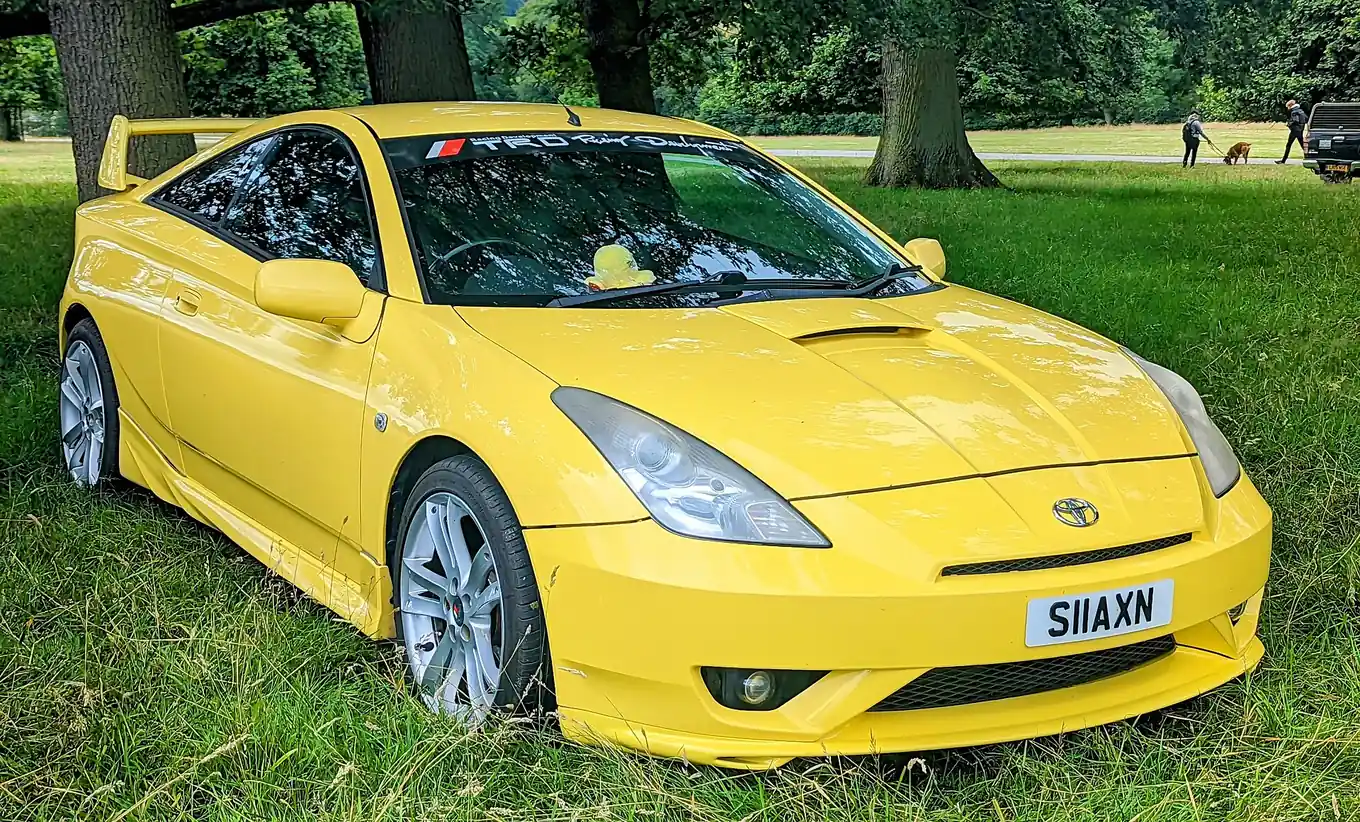
Yellow seventh-generation Toyota Celica GT VVTL-i photographed from the front three-quarter angle

Image credit

File
File:2005 Toyota Celica GT VVTL-i.jpg
Author (attribution required)
Calreyn88

Body style

Powertrain

The seventh and final Celica dropped the notchback coupé body entirely, selling only as a liftback, and, for the first time in the nameplate’s history, offered no all-wheel-drive GT-Four variant.[1] It was part of Toyota’s Project Genesis, an unsuccessful attempt to attract younger buyers to Toyota dealerships in the United States.

The two trims recorded here are the Japanese-market SS-I and SS-II specifications, since the article’s most complete power-and-torque table is for that market; UK and other export versions of the same engines carried slightly different outputs (142 PS rather than 145 PS for the base 1ZZ-FE, for instance), which are not recorded as separate trims here.

Overview

Manufacturer
Toyota
Produced
1999–2006
Model code
T230
Designer
Alan R. Schneider, Yasuhiko Mizuhata, Hiroyuki Metsugi
Segment
S-segment (Europe) / Sports car (US)
Positioning
Mainstream
Assembly
Susono, Shizuoka, Japan (Higashi-Fuji plant, Kanto Auto Works)

Dimensions

Length
4,335 mm

[1]

Width
1,735 mm

[1]

Height
1,305 mm

Published as 51.4 in, converted at 1 in = 25.4 mm.

[1]

Wheelbase
2,600 mm

Published as 102.4 in, converted at 1 in = 25.4 mm.

[1]

Kerb weight
1,090 kg

Infobox gives a 1,090-1,180 kg range across the generation without attributing each figure to a trim. The lower figure is recorded here.

[1]

SS-I (ZZT230)

Trim · 1999–2006 · 1ZZ-FE

Power
107 kW

145 PS at 6,400 rpm, Japanese-market SS-I, converted at 1 PS = 0.73549875 kW.

[1]

Torque
170 N⋅m

At 4,200 rpm.

[1]

Kerb weight
1,090 kgEstimated

Low end of the generation's published weight range, applied here to the lighter four-cylinder base trim.

[1]

0–100 km/h
Not yet available
Top speed
Not yet available
Fuel economy
Not yet available
CO₂
Not yet available
Drag coefficient
Not yet available
Frontal area
Not yet available
Displacement
1,794 ccEstimated

The article describes this engine only as "1.8 L"; 1,794 cc is the well-documented displacement of the Toyota 1ZZ-FE engine, not a figure stated directly in this article.

Boot volume
Not yet available
Seats
4
Engine
inline-4, VVT-i · 1ZZ-FE
Drivetrain
Front-wheel drive

SS-II (ZZT231)

Trim · 1999–2005 · 2ZZ-GE

Power
140 kW

190 PS at 7,600 rpm, Japanese-market SS-II, converted at 1 PS = 0.73549875 kW.

[1]

Torque
180 N⋅m

At 6,800 rpm.

[1]

Kerb weight
1,180 kgEstimated

High end of the generation's published weight range, applied here to the higher-performance trim.

[1]

0–100 km/h
Not yet available
Top speed
Not yet available
Fuel economy
Not yet available
CO₂
Not yet available
Drag coefficient
Not yet available
Frontal area
Not yet available
Displacement
1,794 ccEstimated

The article describes this engine only as "1.8 L"; 1,794 cc is the well-documented displacement of the Toyota 2ZZ-GE engine, not a figure stated directly in this article.

Boot volume
Not yet available
Seats
4
Engine
inline-4, VVTL-i, co-developed with Yamaha · 2ZZ-GE
Drivetrain
Front-wheel drive

Sources & confidence

Every figure above carries a status. Nothing on this page is estimated without saying so, and nothing missing has been filled in with a guess.

Last verified
2026-09-08
Review status
Compiled from cited sources

Photography on this page is credited on each image. Tap theion a photograph for its author, licence and source.

References

Every sourced figure and every cited claim on this page, numbered. Wikipedia articles record the revision they were read at, because the article will have changed by the time you check it.

  1. [1]

    Toyota Celica. Wikipedia · revision 1370550690 · read 2026-09-08

    WikipediaCC BY-SA 4.0

    Covers all seven Celica generations in one article, with per-generation infoboxes and market-specific power/torque tables.