
Skip to content
Markey
Theme: System (currently light)
Peugeot wordmark with the chrome lion emblem

Generation

Peugeot 307

Peugeot 307 (T5), 2001-2008

Produced
2001–2008
Code
T5
Designer
Murat Günak
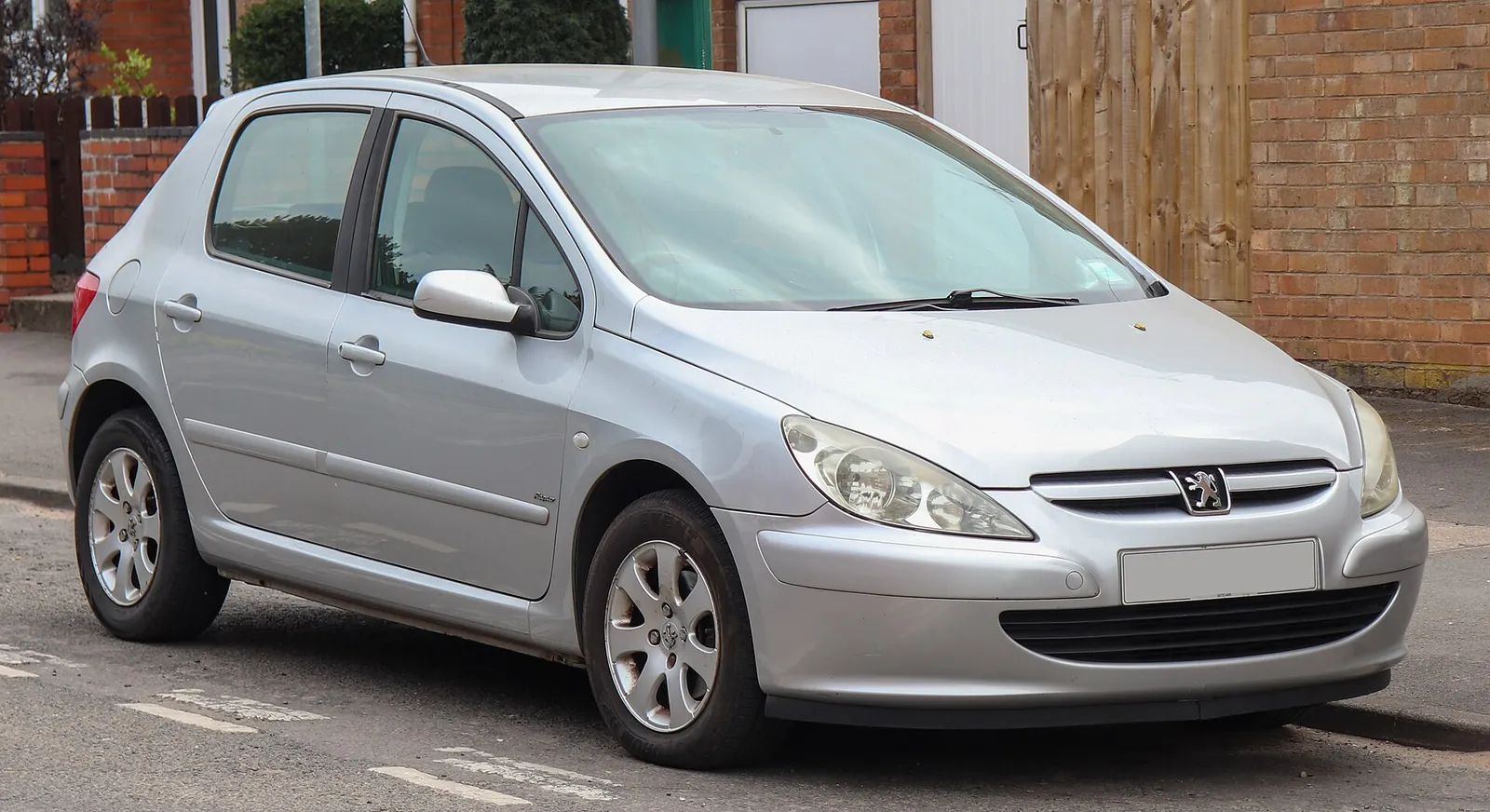
Silver five-door Peugeot 307 hatchback photographed from the front three-quarter angle on a residential street

Image credit

File
File:2002 Peugeot 307 Rapier 16V 1.6 Front.jpg
Author (attribution required)
Vauxford

Designed by Murat Günak on PSA’s PF2 platform, the 307 launched in 2001 with a taller glasshouse and roofline than most C-segment rivals, aimed at outright cabin space rather than a sporting stance.[1] Build quality and reliability drew criticism in its early years (it sat at the bottom of the ADAC’s German breakdown statistics for cars of its age in 2009), though Peugeot’s June 2005 facelift is credited with improving both. A diesel-electric hybrid prototype, claimed to return 83 mpg, was announced in 2006 but never reached production before the 307 itself was replaced.

Three trims are recorded: the mainstream 1.6 16v petrol, the most powerful naturally aspirated 2.0 16v, and the 16-valve 2.0 HDi diesel introduced from model year 2004. Every horsepower figure in the source is explicitly labelled PS, so the conversions here carry no reading ambiguity, unlike several other Peugeots of this era. No top speed, 0-100 km/h time or manufacturer kerb weight is published in the source; a kerb weight is recorded for the 1.6 16v only, sourced from a single Netherlands-registered car rather than a manufacturer specification.
Overview

Manufacturer
Peugeot
Produced
2001–2008
Model code
T5
Designer
Murat Günak
Segment
C-segment (Europe) / Compact (US)
Positioning
Mainstream
Assembly
  • Mulhouse, France
  • Sochaux, France
  • Wuhan, China (DPCA)
  • Villa Bosch, Argentina
  • El Palomar, Argentina
  • Kaduna, Nigeria (PAN)

Dimensions

Length
4,210 mm

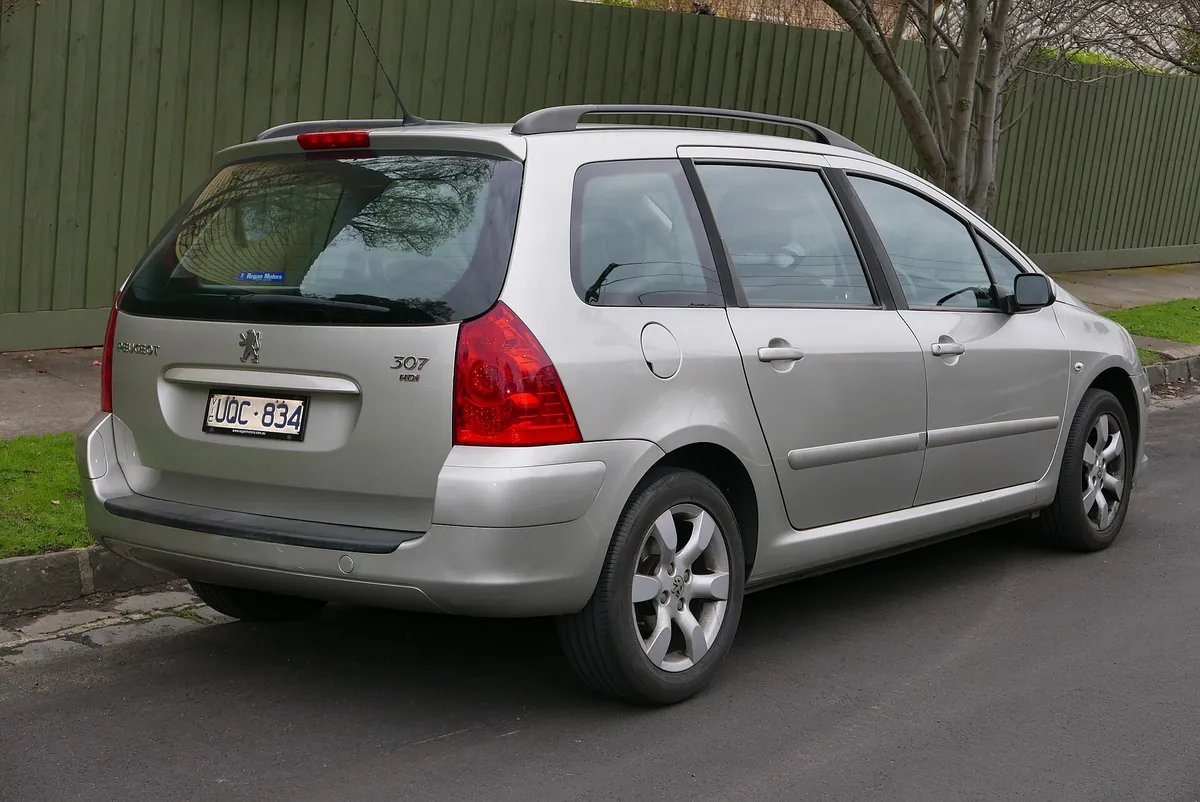
Hatchback body; the coupé-cabriolet is 4350 mm, the estate 4420 mm and the saloon 4470 mm.

[1]

Width
1,730 mm

[1]

Height
1,510 mm

Published for most body styles; the coupé-cabriolet is lower, at 1420 mm.

[1]

Wheelbase
2,608 mm

Hatchback and coupé-cabriolet; the saloon is 2612 mm and the estate 2710 mm.

[1]

Kerb weight
Not yet available

1.6 16v

Trim · 2001–2008 · TU5

Power
81 kW

110 PS, explicitly labelled PS in the source, converted at 1 PS = 0.73549875 kW (80.9 kW, rounded to 81).

[1]

Torque
147 N⋅m

[1]

Kerb weight
1,168 kg

Netherlands RDW register entry for a first-registered 2002 five-door 1587 cc car (an individual registered car, not a manufacturer specification), but matched here on displacement and body to this trim.

[2]

0–100 km/h
Not yet available
Top speed
Not yet available
Fuel economy
Not yet available
CO₂
Not yet available
Drag coefficient
Not yet available
Frontal area
Not yet available
Displacement
1,587 cc

[1]

Boot volume
Not yet available
Seats
5
Engine
inline-4 16v · TU5
Drivetrain
Front-wheel drive

2.0 16v

Trim · 2001–2008 · EW10

Power
130 kW

177 PS, explicitly labelled PS in the source, converted at 1 PS = 0.73549875 kW (130.2 kW, rounded to 130). The most powerful naturally aspirated petrol engine offered; two lower-output 2.0 16v tunes (136 PS and 140 PS) were also sold and are not recorded separately here.

[1]

Torque
202 N⋅m

[1]

Kerb weight
Not yet available
0–100 km/h
Not yet available
Top speed
Not yet available
Fuel economy
Not yet available
CO₂
Not yet available
Drag coefficient
Not yet available
Frontal area
Not yet available
Displacement
1,997 cc

[1]

Boot volume
Not yet available
Seats
5
Engine
inline-4 16v · EW10
Drivetrain
Front-wheel drive

2.0 HDi

Trim · 2004–2008 · DW10TED4

Power
100 kW

136 PS, explicitly labelled PS in the source, converted at 1 PS = 0.73549875 kW (100.0 kW). The 16-valve version of the DW10 diesel, introduced from model year 2004; earlier 8-valve DW10 diesels made 90 PS or 107 PS and are not recorded separately here.

[1]

Torque
320 N⋅m

[1]

Kerb weight
Not yet available
0–100 km/h
Not yet available
Top speed
Not yet available
Fuel economy
Not yet available
CO₂
Not yet available
Drag coefficient
Not yet available
Frontal area
Not yet available
Displacement
1,997 cc

[1]

Boot volume
Not yet available
Seats
5
Engine
inline-4 16v turbocharged common-rail diesel · DW10TED4
Drivetrain
Front-wheel drive

Sources & confidence

Every figure above carries a status. Nothing on this page is estimated without saying so, and nothing missing has been filled in with a guess.

Last verified
2026-09-24
Review status
Compiled from cited sources

Photography on this page is credited on each image. Tap theion a photograph for its author, licence and source.

References

Every sourced figure and every cited claim on this page, numbered. Wikipedia articles record the revision they were read at, because the article will have changed by the time you check it.

  1. [1]

    Peugeot 307. Wikipedia · revision 1373618521 · read 2026-09-24

    WikipediaCC BY-SA 4.0

  2. [2]

    RDW Open Data — Gekentekende Voertuigen (Peugeot 307 registrations). RDW (Dutch vehicle authority) · read 2026-09-24

    DatasetCC0Cited by the specifications

    Netherlands vehicle register; describes one individually registered 1.6 16v car, not a manufacturer specification.