
Skip to content
Markey
Theme: System (currently light)
The Nissan badge: a circular ring around the wordmark, rendered as a flat outline

Generation

Nissan Leaf (Mk1)

Nissan Leaf (Mk1, ZE0), 2010-2017

Produced
2010–2017
Code
ZE0
Designer
Kazuki Yamazaki, Masahide Fujiwara
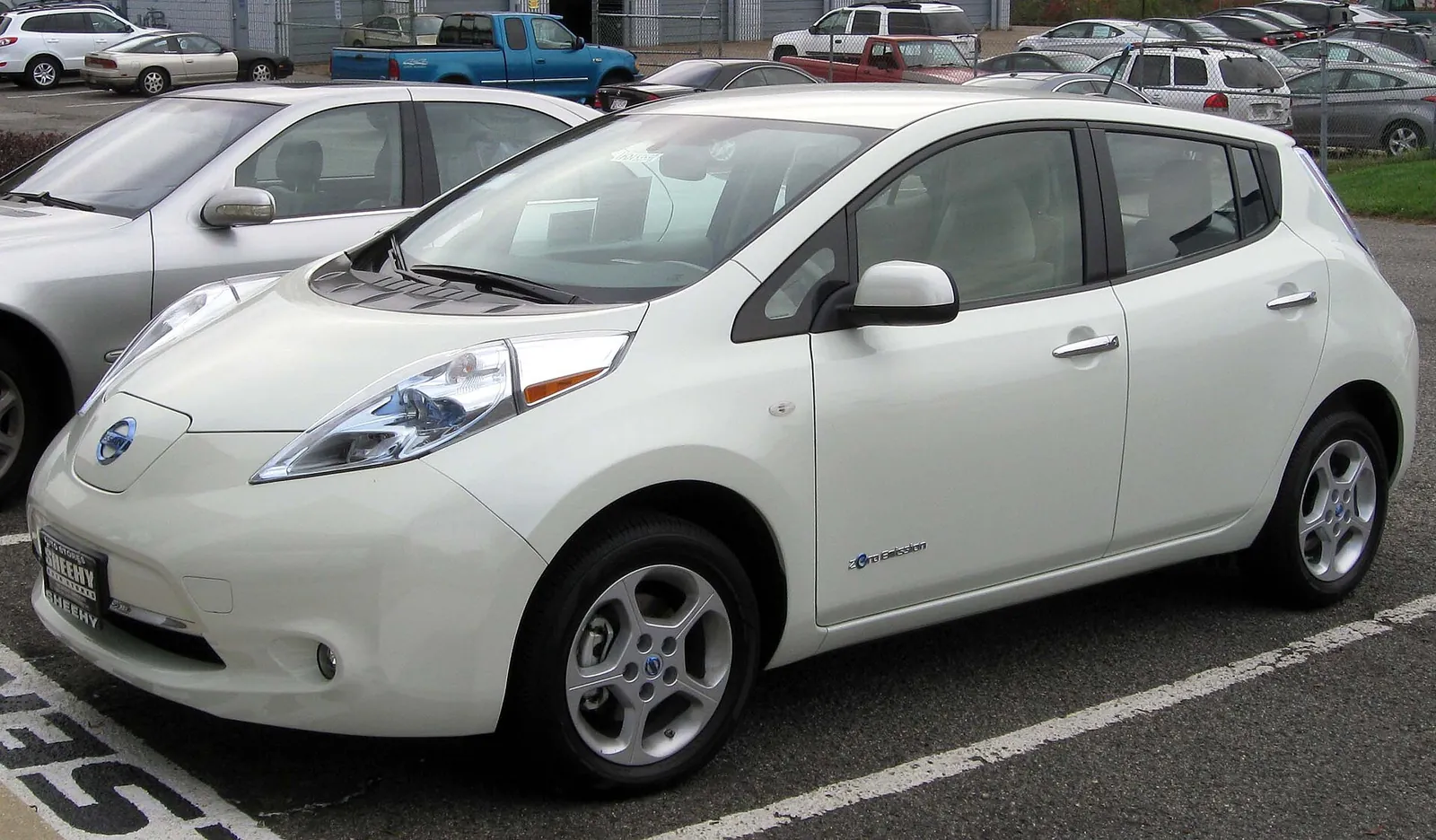
White first-generation Nissan Leaf hatchback photographed from the front three-quarter angle

Image credit

File
File:2011 Nissan Leaf SL -- 10-28-2011.jpg
Author
IFCAR
Licence
Public domain

Body style

Unveiled in August 2009 and built from October 2010 at Nissan’s Oppama plant, the original Leaf grew out of three in-house prototypes (the Cube-based EV-01 and EV-02, and the Tiida-based EV-11) into the first electric car sold at real volume rather than leased to fleets, as Nissan’s earlier Altra and Hypermini had been.[1] US and UK production followed from 2013, at Smyrna, Tennessee and Sunderland respectively.

Its range is the clearest case in this entry of a manufacturer’s own figure diverging from an independent regulator’s: Nissan quoted 160 km on the NEDC cycle, while the EPA’s own five-cycle test, the more rigorous of the two, rated it at 117 km, a gap wide enough that the US Federal Trade Commission publicly challenged the EPA’s own number as still too generous. This entry records the EPA figure, not Nissan’s, as the independently regulated measurement.

Overview

Manufacturer
Nissan
Produced
2010–2017
Model code
ZE0
Designer
Kazuki Yamazaki, Masahide Fujiwara
Segment
C-segment (Europe) / Compact (US)
Positioning
Mainstream
Assembly
  • Yokosuka, Kanagawa, Japan (Oppama Plant)
  • Smyrna, Tennessee, United States
  • Sunderland, United Kingdom (NMUK)

Dimensions

Length
4,445 mm

[1]

Width
1,770 mm

[1]

Height
1,550 mm

[1]

Wheelbase
2,700 mm

[1]

Kerb weight
1,500 kg

Published as a range of 3,307-3,354 lb (1,500-1,521 kg) across trims; lowest value in the range recorded here.

[1]

24 kWh

Trim · 2010–2017 · EM61/EM57

Power
80 kW

Matches the 80 kW figure given by both English Wikipedia articles.

[2]

Torque
Not yet available
Kerb weight
Not yet available
0–100 km/h
Not yet available
Top speed
Not yet available
Electric consumption
21.1 kWh/100 km

EPA five-cycle rating, measured at the wall, 34 kWh/100mi.

[2]

Battery capacity
24.0 kWh

Nominal capacity; a 30 kWh pack became available for the final (2016) model year.

[1]

Electric range
117 km

EPA-rated, 73 mi, for the 2011 model year. Substantially lower than Nissan's own quoted 160 km (NEDC); the US FTC separately disputed the EPA's methodology at the time, arguing for a range of 96-110 mi. This entry records the EPA figure as the independently regulated one.

[2]

Drag coefficient
0.29

Nissan's own figure for the 2011 model year, improved to 0.28 from the 2013 model year. Car and Driver's own wind-tunnel test of a 2012 car measured a higher 0.32.

[1]

Frontal area
Not yet available
Boot volume
651 L

EPA hatchback luggage volume, 23 cu ft, converted at 28.3168 L/cu ft. EPA measures a hatchback to the roof, not comparable with a European VDA seats-up figure.

[2]

Seats
5
Engine
single motor · EM61/EM57
Drivetrain
Front-wheel drive

Sources & confidence

Every figure above carries a status. Nothing on this page is estimated without saying so, and nothing missing has been filled in with a guess.

Last verified
2026-09-04
Review status
Compiled from cited sources

Photography on this page is credited on each image. Tap theion a photograph for its author, licence and source.

References

Every sourced figure and every cited claim on this page, numbered. Wikipedia articles record the revision they were read at, because the article will have changed by the time you check it.

  1. [1]

    Nissan Leaf (first generation). Wikipedia · revision 1366463868 · read 2026-09-04

    WikipediaCC BY-SA 4.0

  2. [2]

    2011 Nissan Leaf — EPA fuel economy. US Environmental Protection Agency · read 2026-09-04

    DatasetPublic domain (US Government work)Cited by the specifications