
Skip to content
Markey
Theme: System (currently light)
The Mazda wordmark in blue lowercase letters

Generation

Mazda RX-7 (FD3S)

Mazda RX-7 (FD3S), 1991-2002

Produced
1991–2002
Code
FD3S
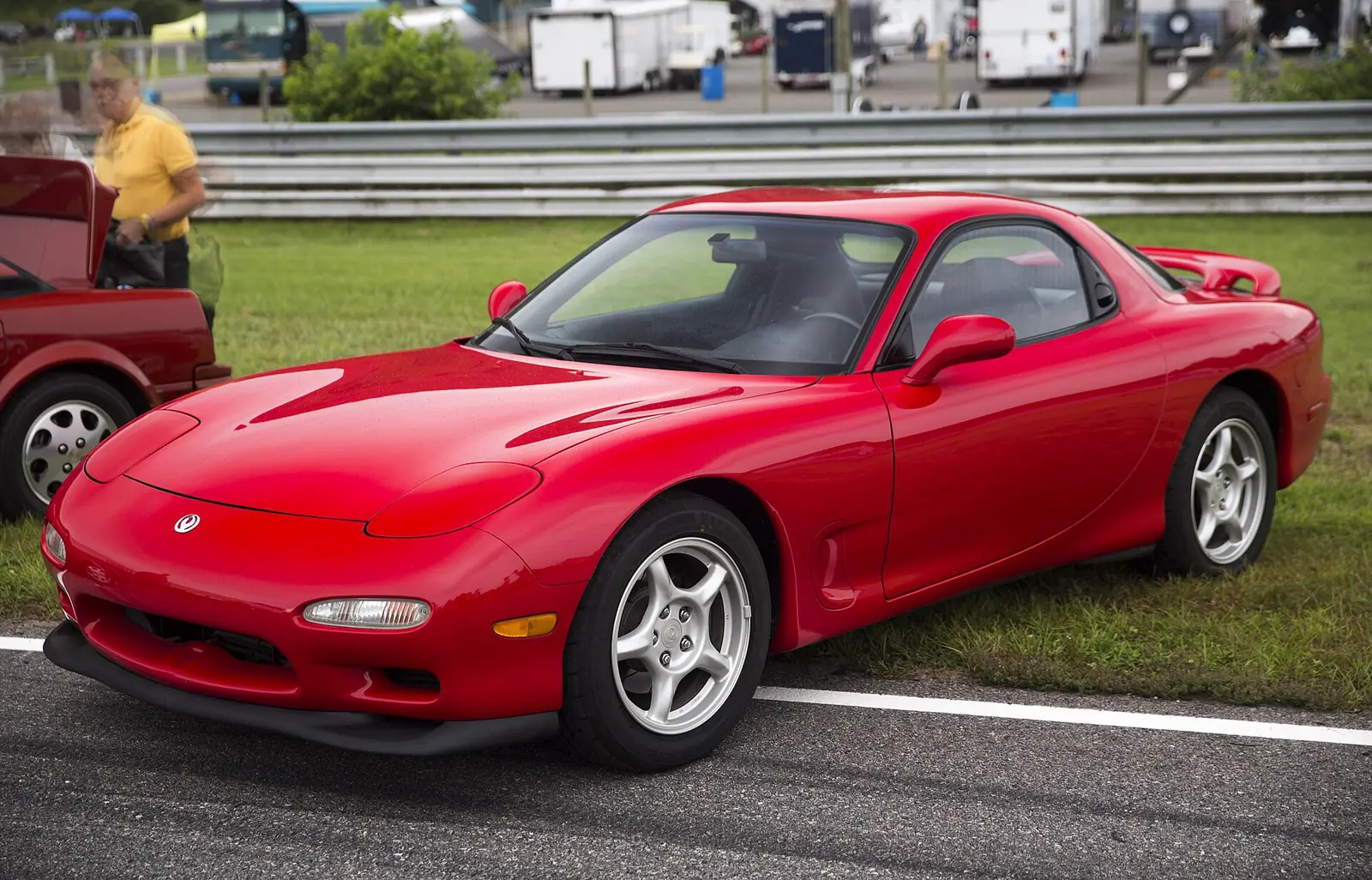
Red third-generation Mazda RX-7 photographed from the front three-quarter angle on a racetrack, showing its smooth pop-up-headlight nose and rounded flanks

Image credit

File
File:1994 Mazda RX-7 R2 in Vintage Red, front left (Lime Rock).jpg
Author (attribution required)
Mr.choppers

Body style

Powertrain

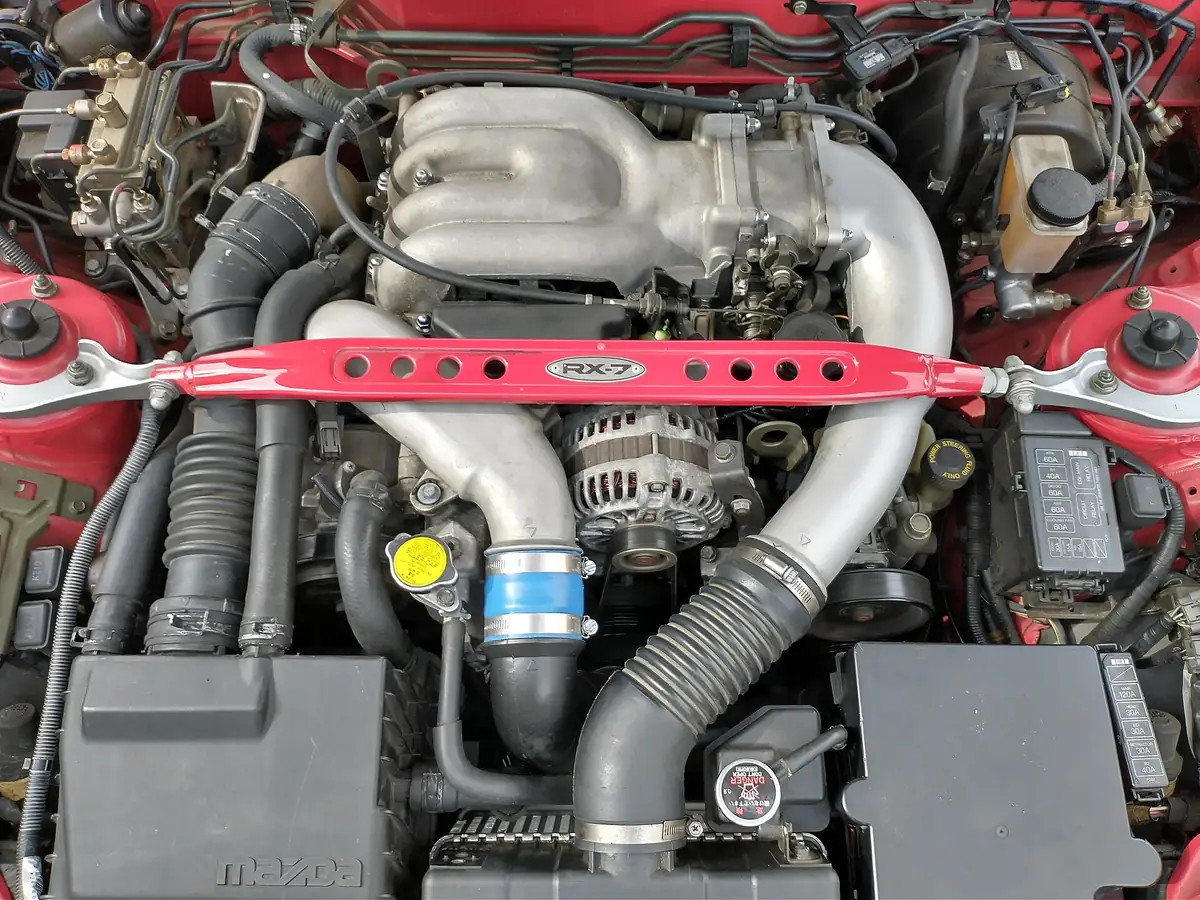
The FD3S is the RX-7 most people picture: a rounded, low, pop-up-headlight coupé launched in October 1991 around the 13B-REW, the first mass-produced sequential twin-turbo engine exported from Japan.[1] Mazda sold it in North America for only four model years, 1993 to 1995, before weak demand and a strong yen ended US imports; production continued in Japan, progressively lighter and more powerful in its final Series 8 Type RS form, until 2002.

Japanese-market output was effectively capped at 280 PS across the industry’s self-imposed 206 kW (280 PS) gentlemen’s agreement, which is why the car’s peak figures barely moved across a decade of otherwise continuous development; later cars got lighter and better cooled instead of outright more powerful. The limited-edition “Spirit R” of 2000–2002, the very last cars built, is not broken out as its own trim here because the source does not give it a separate power figure from the Type RS it was based on.
Overview

Manufacturer
Mazda
Produced
1991–2002
Model code
FD3S
Segment
S-segment (Europe) / Sports car (US)
Positioning
Premium
Assembly
Mazda, Hiroshima, Japan (Hiroshima Assembly)

Dimensions

Length
4,285 mm

[1]

Width
1,760 mm

[1]

Height
1,230 mm

[1]

Wheelbase
2,446 mm

[1]

Kerb weight
Not yet available

13B-REW Twin-Turbo

Trim · 1991–1995 · 13B-REW

Power
188 kW

255 PS (JIS), converted at 1 PS = 0.73549875 kW.

[1]

Torque
294 N⋅m

[1]

Kerb weight
1,260 kg

Weight for the 5-speed manual version of the initial Series 6 twin-turbo spec; the 4-speed automatic version of the same engine tune weighed 1,340 kg.

[1]

0–100 km/h
Not yet available
Top speed
Not yet available
Fuel economy
Not yet available
CO₂
Not yet available
Drag coefficient
Not yet available
Frontal area
Not yet available
Displacement
1,308 cc

Same 13B displacement as the naturally aspirated engine; the REW adds Mazda/Hitachi's sequential twin-turbocharger system.

[1]

Boot volume
Not yet available
Seats
2
Engine
twin-rotor Wankel, sequential twin-turbo · 13B-REW
Drivetrain
Rear-wheel drive

Type RS

Trim · 2000–2002 · 13B-REW

Power
206 kW

280 PS at 6,500 rpm, the maximum output permitted under the Japanese manufacturers' gentlemen's agreement, converted at 1 PS = 0.73549875 kW.

[1]

Torque
314 N⋅m

314 N-m at 5,000 rpm.

[1]

Kerb weight
1,280 kg

Weight reduced to 1,280 kg for the Series 8 Type RS, this generation's final Japan-only high-end specification.

[1]

0–100 km/h
Not yet available
Top speed
Not yet available
Fuel economy
Not yet available
CO₂
Not yet available
Drag coefficient
Not yet available
Frontal area
Not yet available
Displacement
1,308 cc

[1]

Boot volume
Not yet available
Seats
2
Engine
twin-rotor Wankel, sequential twin-turbo · 13B-REW
Drivetrain
Rear-wheel drive

Sources & confidence

Every figure above carries a status. Nothing on this page is estimated without saying so, and nothing missing has been filled in with a guess.

Last verified
2026-09-24
Review status
Compiled from cited sources

Photography on this page is credited on each image. Tap theion a photograph for its author, licence and source.

References

Every sourced figure and every cited claim on this page, numbered. Wikipedia articles record the revision they were read at, because the article will have changed by the time you check it.

  1. [1]

    Mazda RX-7. Wikipedia · revision 1375789154 · read 2026-09-23

    WikipediaCC BY-SA 4.0

    Single article covering all three generations (SA/FB, FC, FD) by section.