
Skip to content
Markey
Theme: System (currently light)
Hyundai badge: a stylised, slanted letter H inside an oval

Generation

Hyundai i30 (FD)

Hyundai i30 (FD), 2007-2012

Produced
2007–2012
Code
FD
Designer
Thomas Burkle
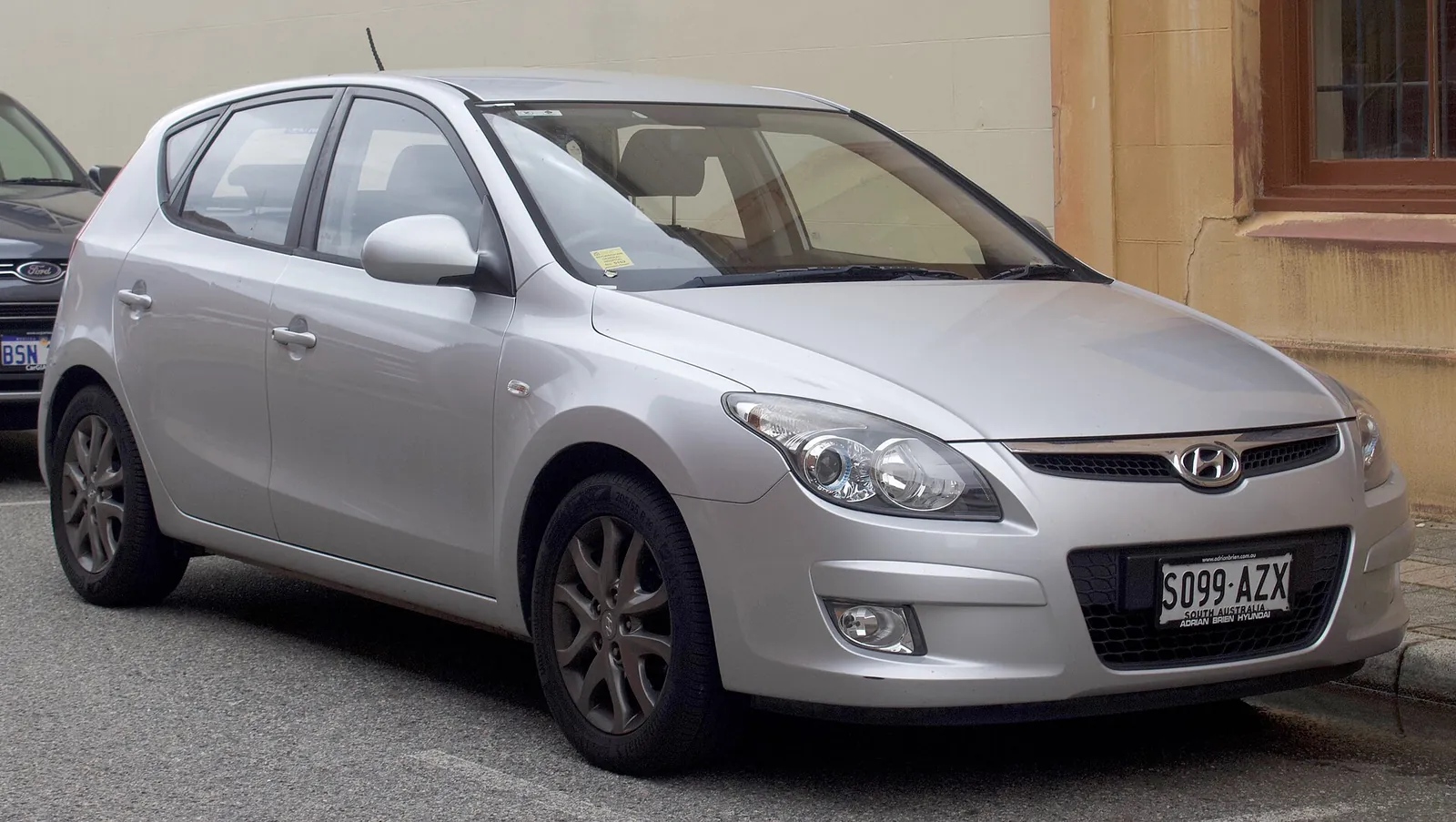
Silver first-generation Hyundai i30 five-door hatchback photographed from the front three-quarter angle

Image credit

File
File:2011 Hyundai i30 (FD) SLX hatchback (2018-10-01) 01.jpg
Author (attribution required)
EurovisionNim

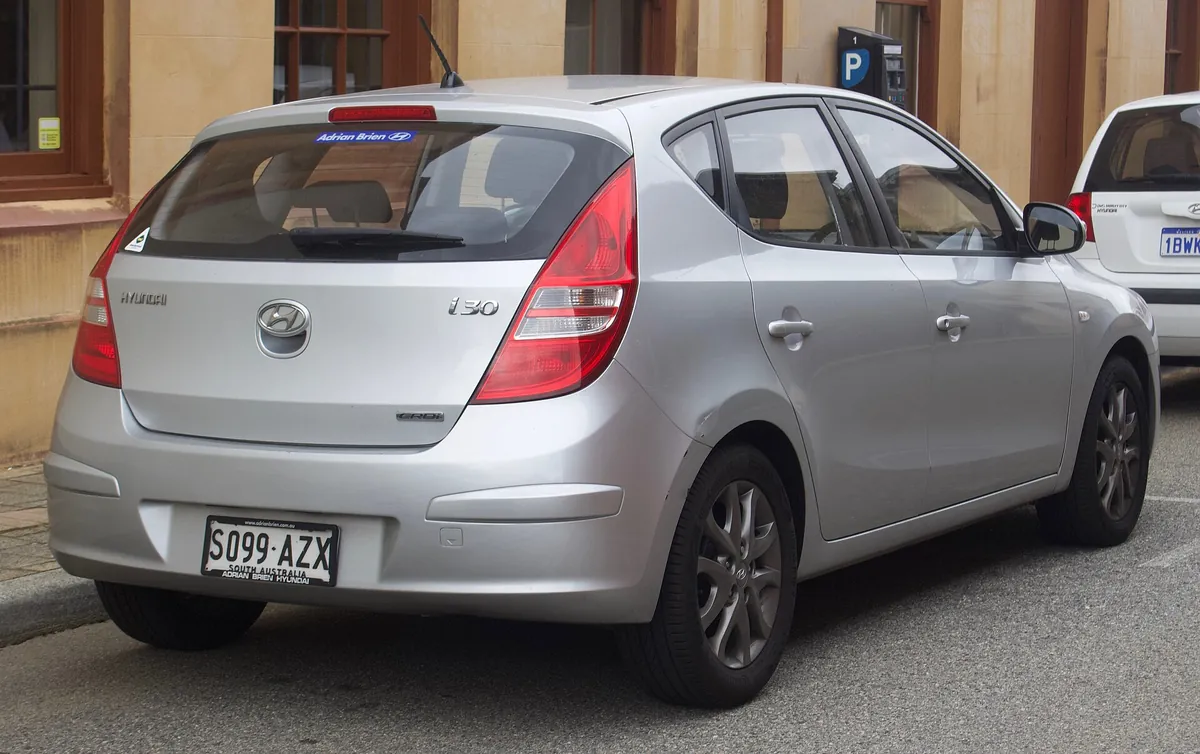
The original i30, announced by the Hyundai Arnejs concept at the 2006 Paris Motor Show and launched for real in mid-2007.[1] It was designed in Rüsselsheim, Germany rather than Korea, and sold as an estate too, the i30cw, which crossed the Atlantic as the Elantra Touring, a name that shared nothing with the regular i30 hatchback badge used everywhere else.

Kerb weight is a genuine gap for this generation: unlike the second and third generations, whose Wikipedia infoboxes both give a weight range, the first generation’s does not give one at all, so the field is left as an explicit placeholder rather than estimated from a later car.
Overview

Manufacturer
Hyundai
Produced
2007–2012
Model code
FD
Designer
Thomas Burkle
Segment
C-segment (Europe) / Compact (US)
Positioning
Mainstream
Assembly
  • Ulsan, South Korea
  • Nosovice, Czech Republic
  • Beijing, China (Beijing Hyundai)
  • Cairo, Egypt (Ghabbour Group)

Dimensions

Length
4,245 mm

Hatchback figure; the i30cw estate is 4,475 mm.

[1]

Width
1,775 mm

[1]

Height
1,480 mm

Hatchback figure; the i30cw estate is 1,565 mm.

[1]

Wheelbase
2,650 mm

Hatchback figure; the i30cw estate is 2,700 mm.

[1]

Kerb weight
Not yet available

Not published in the Wikipedia infobox for this generation, unlike the second and third generations, which both give a weight range.

1.4

Trim · 2007–2012 · G4FA

Power
80 kW

109 PS at 6,200 rpm, converted at 1 PS = 0.73549875 kW (80.2 kW, rounded to 80).

[1]

Torque
137 N⋅m

Published directly as 137.2 N-m at 5,000 rpm.

[1]

Kerb weight
Not yet available
0–100 km/h
12.6 s

[1]

Top speed
187 km/h

[1]

Fuel economy
Not yet available
CO₂
Not yet available
Drag coefficient
Not yet available
Frontal area
Not yet available
Displacement
1,396 cc

[1]

Boot volume
Not yet available
Engine
inline-4, Gamma CVVT DOHC 16v · G4FA
Drivetrain
Front-wheel drive

2.0 CRDi

Trim · 2007–2012 · D4EA

Power
103 kW

140 PS at 3,800 rpm, converted at 1 PS = 0.73549875 kW (103.0 kW).

[1]

Torque
304 N⋅m

Published directly as 304 N-m at 1,900-2,500 rpm.

[1]

Kerb weight
Not yet available
0–100 km/h
10.3 s

[1]

Top speed
205 km/h

[1]

Fuel economy
Not yet available
CO₂
Not yet available
Drag coefficient
Not yet available
Frontal area
Not yet available
Displacement
1,991 cc

[1]

Boot volume
Not yet available
Engine
inline-4 CRDi-VGT SOHC 16v turbo-diesel · D4EA
Drivetrain
Front-wheel drive

Sources & confidence

Every figure above carries a status. Nothing on this page is estimated without saying so, and nothing missing has been filled in with a guess.

Last verified
2026-09-24
Review status
Compiled from cited sources

Photography on this page is credited on each image. Tap theion a photograph for its author, licence and source.

References

Every sourced figure and every cited claim on this page, numbered. Wikipedia articles record the revision they were read at, because the article will have changed by the time you check it.

  1. [1]

    Hyundai i30. Wikipedia · revision 1375363372 · read 2026-09-24

    WikipediaCC BY-SA 4.0

    Single article covering all generations (FD, GD, PD) by section.