
Skip to content
Markey
Theme: System (currently light)
Hyundai badge: a stylised, slanted letter H inside an oval

Generation

Hyundai Accent (BN7)

Hyundai Accent (BN7), 2023-present

Produced
2023–present
Code
BN7
Designer
Min-chul Koo
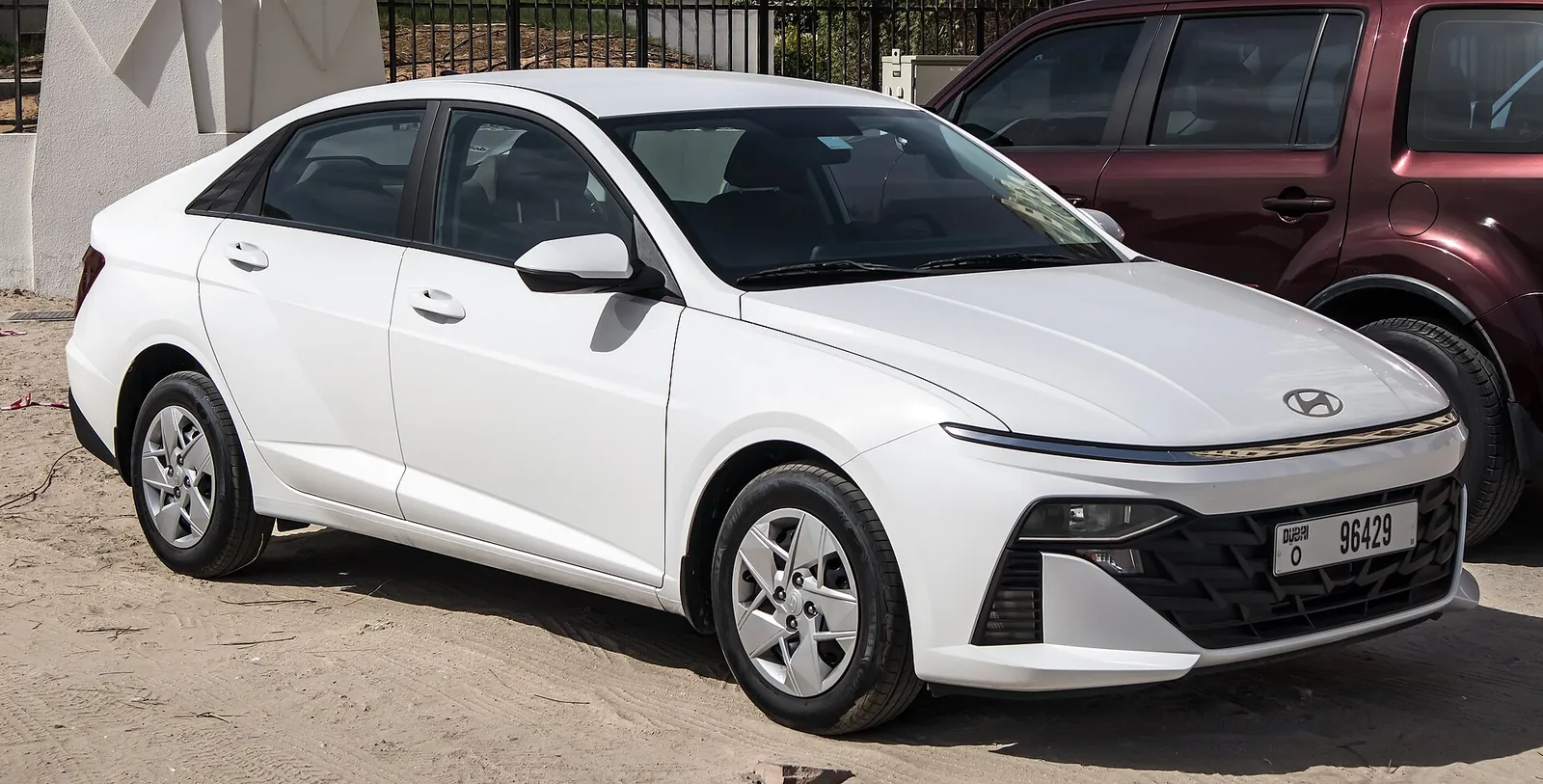
White sixth-generation Hyundai Accent saloon photographed from the front three-quarter angle, showing the connected LED light bar and sharp-edged bumper

Image credit

File
File:Hyundai Accent 1.5 MPI Smart+ (VI) – f 08032025.jpg
Author (attribution required)
M 93

Body style

Powertrain

The sixth and current generation, launched in India in March 2023 as the Verna and progressively rolled out elsewhere as the Accent, continuing the split naming the model has carried for two decades.[1] It is built in India and Vietnam rather than South Korea, reflecting where Hyundai now expects most of its sales to come from.

Two petrol engines are offered: a naturally aspirated 1.5-litre and a 1.5-litre turbo good for a claimed 8.1-second 0-100 km/h with the dual-clutch gearbox. Kerb weight is a genuine gap here rather than an oversight: neither Hyundai’s own specification pages nor the Wikipedia article publish a figure for this generation, so the field is left as an explicit placeholder rather than estimated from the outgoing car.
Overview

Manufacturer
Hyundai
Produced
2023–present
Model code
BN7
Designer
Min-chul Koo
Segment
B-segment (Europe) / Subcompact (US)
Positioning
Economy
Assembly
  • Chennai, India (Hyundai Motor India)
  • Ninh Binh, Vietnam (Hyundai Thanh Cong Manufacturing Vietnam)

Dimensions

Length
4,535 mm

[1]

Width
1,765 mm

[1]

Height
1,475 mm

[1]

Wheelbase
2,670 mm

[1]

Kerb weight
Not yet available

Not published by Hyundai or stated in the Wikipedia article for this generation (the infobox weight field is present but empty).

1.5 Smartstream MPi

Trim · 2023–present · G4FL

Power
85 kW

115 PS at 6,300 rpm, converted at 1 PS = 0.73549875 kW (84.6 kW, rounded to 85).

[1]

Torque
144 N⋅m

Published directly as 144 N-m; the powertrain table separately states 14.7 kgf-m at 4,500 rpm, which converts to 144.2 N-m at 9.80665 N per kgf, consistent with the prose figure.

[1]

Kerb weight
Not yet available
0–100 km/h
Not yet available
Top speed
Not yet available
Fuel economy
Not yet available
CO₂
Not yet available
Drag coefficient
Not yet available
Frontal area
Not yet available
Displacement
Not yet available
Boot volume
Not yet available
Engine
inline-4, Smartstream Smartstream G1.5 MPi · G4FL
Drivetrain
Front-wheel drive

1.5 Smartstream T-GDi

Trim · 2023–present · G4LH

Power
118 kW

160 PS at 5,500 rpm, converted at 1 PS = 0.73549875 kW (117.7 kW, rounded to 118).

[1]

Torque
253 N⋅m

The powertrain table gives 25.8 kgf-m at 1,500-3,500 rpm, converted at 9.80665 N per kgf to 253.0 N-m; the article prose separately states 253 N-m directly.

[1]

Kerb weight
Not yet available
0–100 km/h
8.1 s

Manufacturer-quoted official 0-100 km/h figure for the T-GDi/DCT, from the article's powertrain table.

[1]

Top speed
Not yet available
Fuel economy
Not yet available
CO₂
Not yet available
Drag coefficient
Not yet available
Frontal area
Not yet available
Displacement
Not yet available
Boot volume
Not yet available
Engine
inline-4, Smartstream G1.5 T-GDi · G4LH
Drivetrain
Front-wheel drive

Sources & confidence

Every figure above carries a status. Nothing on this page is estimated without saying so, and nothing missing has been filled in with a guess.

Last verified
2026-09-24
Review status
Compiled from cited sources

Photography on this page is credited on each image. Tap theion a photograph for its author, licence and source.

References

Every sourced figure and every cited claim on this page, numbered. Wikipedia articles record the revision they were read at, because the article will have changed by the time you check it.

  1. [1]

    Hyundai Accent. Wikipedia · revision 1372150513 · read 2026-09-08

    WikipediaCC BY-SA 4.0

    Single article covering all generations (X3, LC, MC, RB, HC, BN7) by section.