
Skip to content
Markey
Theme: System (currently light)
Citroën double-chevron badge

Generation

Citroën 2CV

Citroën 2CV, 1948–1990

Produced
1948–1990
Designer
André Lefèbvre, Flaminio Bertoni, Walter Becchia and Marcel Chinon
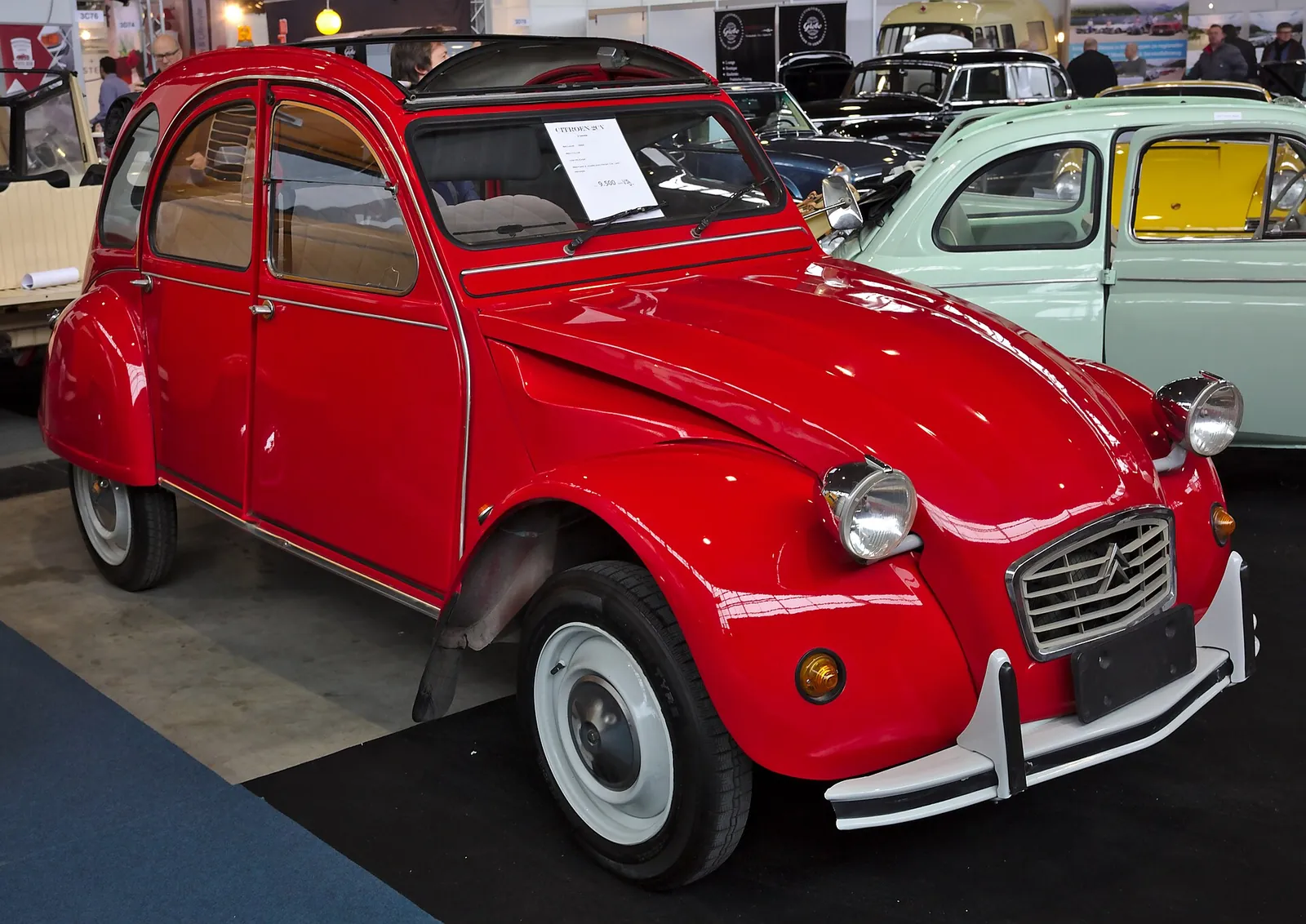
Grey Citroën 2CV photographed from the front three-quarter angle, showing the corrugated bonnet, round headlamps and rolled canvas roof

Image credit

File
File:Citroen 2CV 1X7A7979.jpg
Author (attribution required)
Alexander Migl
Test Drive this car

The 2CV never had a second generation, which is why this entry spans the whole of 1948 to 1990. The engine grew from 375 cc to 602 cc and the power roughly tripled, but the car underneath was the one Citroën showed in 1948, and Wikipedia treats it in a single article rather than a set of generation ones.[1] The evolution lives in the trims below instead.

Two of those trims are worth pausing on. The 1981 Charleston is less powerful than the 1970 car (29 PS against 33 PS) and faster, because a milder camshaft and a different carburettor traded peak power for a longer-legged top speed. And the Sahara had two engines, one per axle, each with its own gearbox and fuel tank, worked by a single lever. Its power cell is empty: each engine is published at 12 PS, but adding two engine ratings together would be arithmetic, not a measurement.

The drag coefficient of 0.51 sits on the earliest trim because that is the year the source gives it.[2]

Overview

Manufacturer
Citroën
Produced
1948–1990
Designer
André Lefèbvre, Flaminio Bertoni, Walter Becchia and Marcel Chinon
Segment
A-segment (Europe) / Minicompact (US)
Positioning
Economy
Assembly
  • Levallois-Perret, France
  • Forest, Belgium
  • Mangualde, Portugal
  • Vigo, Spain
  • Slough, United Kingdom
  • Buenos Aires, Argentina
  • Koper, Yugoslavia (Cimos)

Dimensions

Length
3,860 mm

[1]

Width
1,480 mm

[1]

Height
1,600 mm

[1]

Wheelbase
2,400 mm

[1]

Kerb weight
600 kg

The single figure the article publishes for the model. It does not say which variant or year it describes, and the car gained weight over forty-two years.

[1]

Type A (375 cc)

Trim · 1948–1954

Power
6.6 kW

9 PS (DIN) at 3,500 rpm, converted at 1 PS = 0.73549875 kW. Deliberately under-tuned: the article notes the inlet tract and carburettor were sized to restrict it well below what the components could take.

[1]

Torque
Not yet available
Kerb weight
600 kg

The model-level kerb weight the article publishes; it does not identify a variant, so this is the best available figure rather than a measurement of this trim.

[1]

0–100 km/h
Not yet available
Top speed
64 km/h

The article also records a 0-40 km/h time of 42.4 s for this car. It publishes no 0-100 km/h time, which for a 64 km/h car is not an omission.

[1]

Fuel economy
Not yet available
CO₂
Not yet available
Drag coefficient
0.51

Listed for the Citroën 2CV and dated 1948 in the source, which is why it is recorded against the earliest trim. The body shape changed very little over the production run, but the list does not say that, so the figure is not copied onto the later trims.

[2]

Frontal area
Not yet available
Displacement
375 cc

[1]

Boot volume
Not yet available
Seats
4
Engine
air-cooled flat-2
Drivetrain
Front-wheel drive

AZ (425 cc)

Trim · 1955–1970

Power
9.2 kW

12.5 PS at 4,200 rpm from 1955, converted at 1 PS = 0.73549875 kW. Raised to 18 PS by 1963 with no change to the displacement.

[1]

Torque
Not yet available
Kerb weight
Not yet available
0–100 km/h
Not yet available
Top speed
80 km/h

1955 figure; 84 km/h from 1962.

[1]

Fuel economy
Not yet available
CO₂
Not yet available
Drag coefficient
Not yet available
Frontal area
Not yet available
Displacement
425 cc

[1]

Boot volume
Not yet available
Seats
4
Engine
air-cooled flat-2
Drivetrain
Front-wheel drive

2CV 6 (602 cc)

Trim · 1970–1979 · M28

Power
24 kW

33 PS from the M28 engine, the most powerful ever fitted to a 2CV, converted at 1 PS = 0.73549875 kW. Emissions rules cut it to 25 PS in 1975.

[1]

Torque
Not yet available
Kerb weight
Not yet available
0–100 km/h
Not yet available
Top speed
100 km/h

1970 figure.

[1]

Fuel economy
Not yet available
CO₂
Not yet available
Drag coefficient
Not yet available
Frontal area
Not yet available
Displacement
602 cc

[1]

Boot volume
Not yet available
Seats
4
Engine
air-cooled flat-2 · M28
Drivetrain
Front-wheel drive

2CV 6 Charleston

Trim · 1981–1990 · M28

Power
21 kW

29 PS at 5,750 rpm from the revised M28, converted at 1 PS = 0.73549875 kW. Less power than the 33 PS engine and deliberately so: a milder camshaft and carburettor gave better economy and a higher top speed.

[1]

Torque
Not yet available
Kerb weight
Not yet available
0–100 km/h
Not yet available
Top speed
115 km/h

Achieved after the 1981 carburettor change. The fastest the 2CV ever went.

[1]

Fuel economy
Not yet available
CO₂
Not yet available
Drag coefficient
Not yet available
Frontal area
Not yet available
Displacement
602 cc

[1]

Boot volume
Not yet available
Seats
4
Engine
air-cooled flat-2 · M28
Drivetrain
Front-wheel drive

2CV Sahara (4x4)

Trim · 1958–1971

Power
Not yet available

Each engine is published at 12 PS, but a combined output for the pair is not, and adding two engine ratings together would be an invention rather than a measurement.

Torque
Not yet available
Kerb weight
Not yet available
0–100 km/h
Not yet available
Top speed
105 km/h

With both engines running. On the front engine alone the article gives 65 km/h.

[1]

Fuel economy
Not yet available
CO₂
Not yet available
Drag coefficient
Not yet available
Frontal area
Not yet available
Displacement
425 cc

Each of the two engines.

[1]

Boot volume
Not yet available
Seats
4
Engine
two air-cooled flat-2 engines, one per axle
Drivetrain
Four-wheel drive

Sources & confidence

Every figure above carries a status. Nothing on this page is estimated without saying so, and nothing missing has been filled in with a guess.

Last verified
2026-08-18
Review status
Spot-checked by hand

Photography on this page is credited on each image. Tap theion a photograph for its author, licence and source.

References

Every sourced figure and every cited claim on this page, numbered. Wikipedia articles record the revision they were read at, because the article will have changed by the time you check it.

  1. [1]

    Citroën 2CV. Wikipedia · revision 1369483970 · read 2026-08-18

    WikipediaCC BY-SA 4.0

    One article covers all 42 years: the 2CV never had a second generation, so the nameplate article is also the generation article. Engine outputs are published in metric horsepower and converted here at 1 PS = 0.73549875 kW.

  2. [2]

    List of automobile drag coefficients. Wikipedia · revision 1360737555 · read 2026-08-17

    WikipediaCC BY-SA 4.0

    The aerodynamic source named in several hundred production and concept vehicles, 1921 to 2024.