Skip to content
Markey
Theme: System (currently light)
BMW roundel

Generation

BMW i8 (I12/I15)

BMW i8 (I12/I15), 2014-2020

Produced
2014–2020
Code
I12/I15
Designer
Benoit Jacob
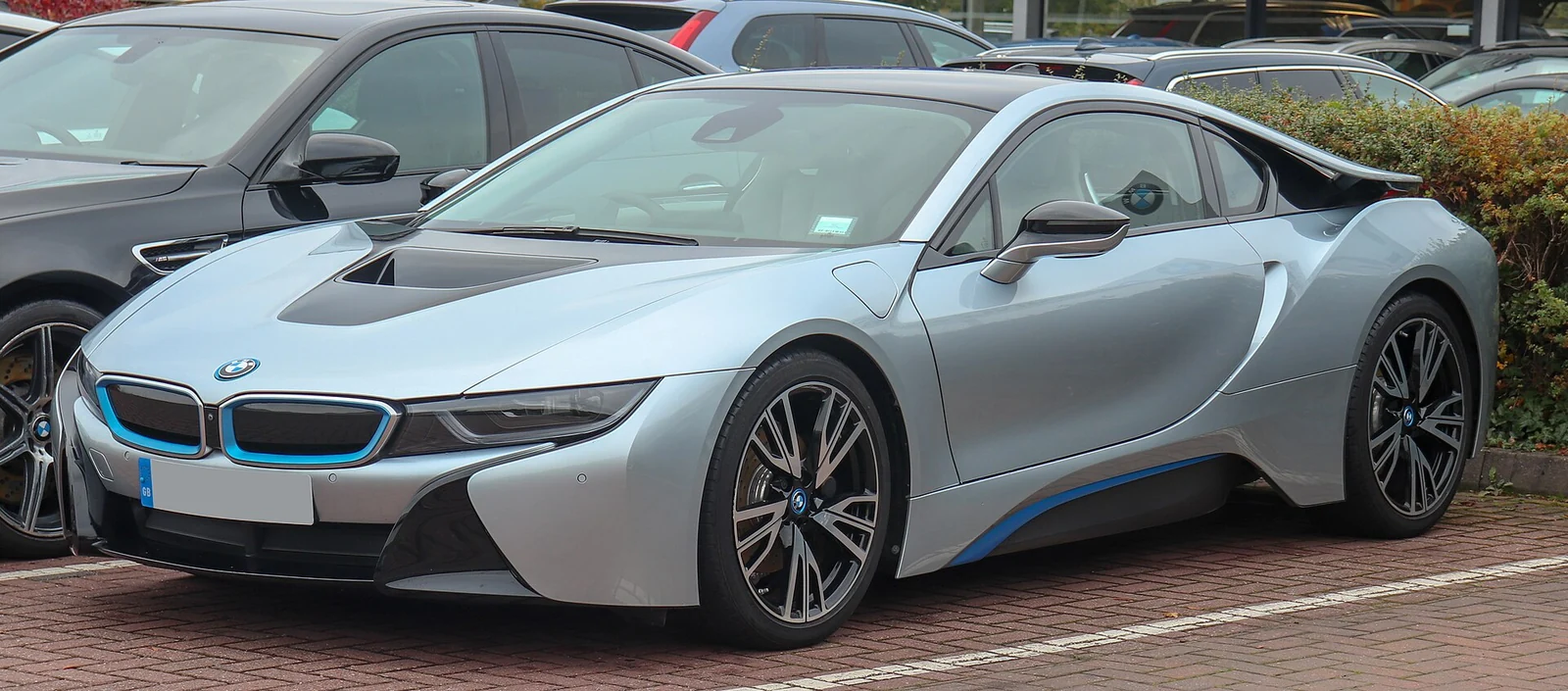
Silver BMW i8 photographed from the front three-quarter angle, showing its low, sculpted body and butterfly doors

Image credit

File
File:2016 BMW i8.jpg
Author (attribution required)
Vauxford
Test Drive this car

Unveiled at the 2013 Frankfurt Motor Show and built at BMW’s Leipzig plant alongside the i3, the i8 paired a turbocharged 1.5-litre three-cylinder engine (mounted transversely amidships, driving the rear wheels) with a separate electric motor on the front axle, for a genuine mechanical all-wheel-drive hybrid rather than a badge-engineering exercise.[1] A roadster joined the coupé in 2018, alongside a larger battery that raised NEDC electric range from 37 to 53-55 km depending on body style.

Unusually for a hybrid in this catalogue, BMW publishes a genuine combined system output for the i8: 369 hp (275 kW) and 570 N·m, rather than leaving a reader to add together an engine figure and a motor figure that were never meant to be summed. That published combined figure, not an inferred one, is what is recorded here.

Overview

Manufacturer
BMW
Produced
2014–2020
Model code
I12/I15
Designer
Benoit Jacob
Segment
S-segment (Europe) / Sports car (US)
Positioning
Premium
Assembly
BMW Group Plant Leipzig, Saxony, Germany

Dimensions

Length
4,689 mm

[1]

Width
1,942 mm

[1]

Height
1,298 mm

[1]

Wheelbase
2,800 mm

[1]

Kerb weight
1,485 kg

DIN kerb weight, as directly stated in the source; the infobox separately gives a US-spec 3,394 lb (1,539 kg) curb weight.

[1]

i8 Coupe

Trim · 2014–2018 · B38K15T0

Power
275 kW

369 hp combined system output, as published by BMW and stated directly in the infobox (already converted from hp: 369 x 0.745699872 kW). Unlike most hybrids in this catalogue, BMW publishes this as a genuine combined figure rather than leaving it to be inferred from the separate 231 hp (172 kW) petrol engine and 131 hp (98 kW) electric motor ratings, which do not sum to it.

[1]

Torque
570 N⋅m

Combined system torque at 3,700 rpm.

[1]

Kerb weight
1,485 kg

DIN kerb weight.

[1]

0–100 km/h
4.4 s

[1]

Top speed
250 km/h

Electronically limited.

[1]

Fuel economy
Not yet available
Electric consumption
Not yet available
Battery capacity
7.1 kWh

Gross capacity for 2014-2017 model years; increased to 11.6 kWh gross for 2018-2020.

[1]

Electric range
37 km

NEDC cycle, 2014-2017 model years. The US EPA cycle gave 15 mi (24 km) for the same cars; the two are not comparable and neither is converted into the other. The 2018-2020 cars with the larger battery were rated 53-55 km NEDC / 18 mi EPA.

[1]

CO₂
Not yet available
Drag coefficient
0.26

[1]

Frontal area
Not yet available
Displacement
1,499 cc

1.5 L.

[1]

Boot volume
Not yet available
Seats
4
Engine
inline-3, turbocharged, transverse mid-mounted, driving the rear wheels · B38K15T0
Drivetrain
All-wheel drive

Sources & confidence

Every figure above carries a status. Nothing on this page is estimated without saying so, and nothing missing has been filled in with a guess.

Last verified
2026-09-24
Review status
Compiled from cited sources

Photography on this page is credited on each image. Tap theion a photograph for its author, licence and source.

References

Every sourced figure and every cited claim on this page, numbered. Wikipedia articles record the revision they were read at, because the article will have changed by the time you check it.

  1. [1]

    BMW i8. Wikipedia · revision 1372261669 · read 2026-09-24

    WikipediaCC BY-SA 4.0