
White Russian
Vodka and coffee liqueur over ice, finished with a float of cream.

CC BY 4.0 · Cropped, white-balanced, graded and re-encoded to WebP by eXir.
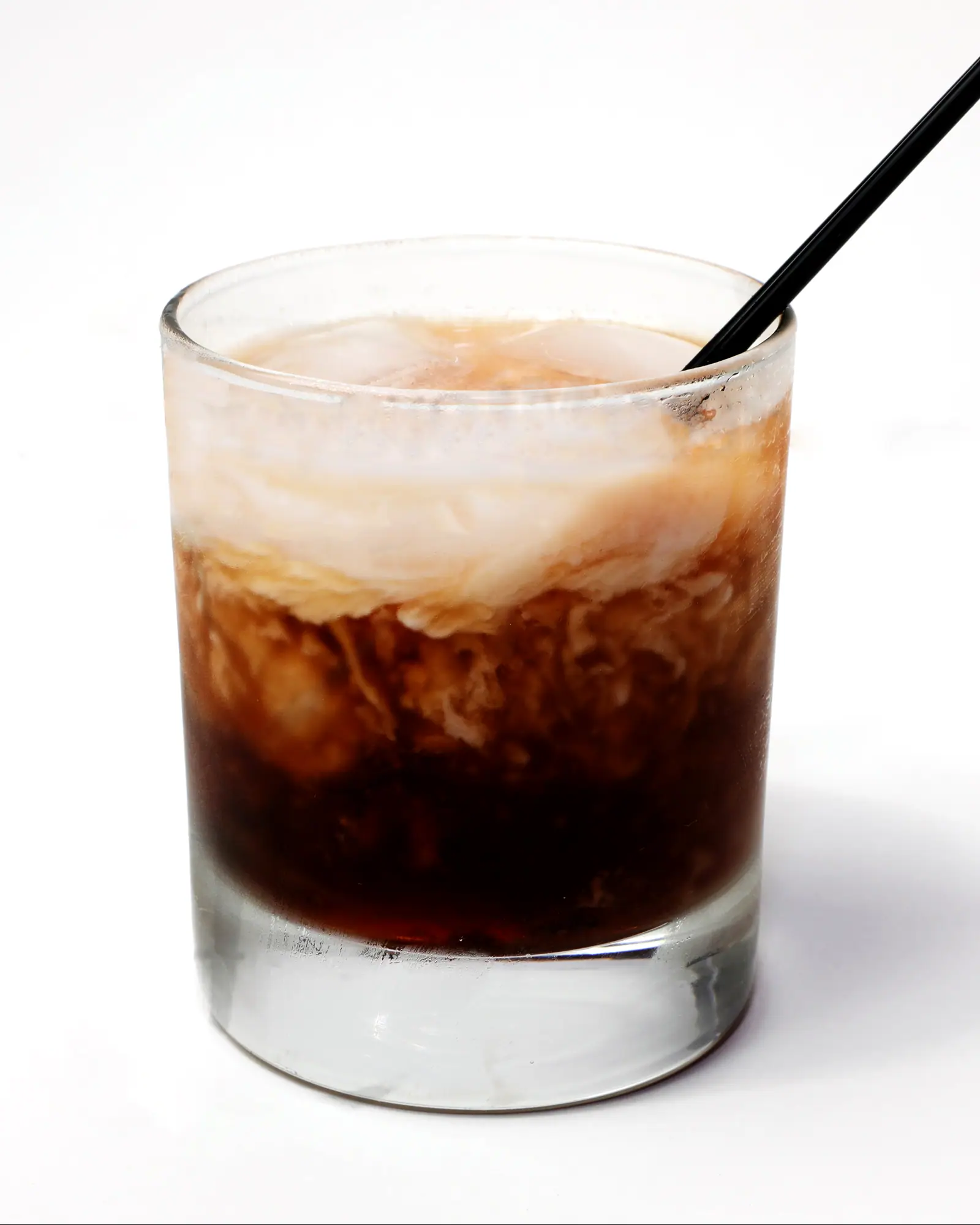
A White Russian in a rocks glass over ice, cream layered pale over the dark vodka and coffee liqueur beneath
Serving
Drink spec, per drink
Every figure above is per drink and does not move with the count, which is what makes the two service modes comparable. Sugar per litre, strength and standard drinks stay in the units their own authorities publish, because they are figures for comparing rather than for pouring. Dilution is modelled rather than measured, as a fraction of the poured volume before any ice; dotted figures descend from that estimate.
Diet and allergen labels are computed from the ingredients listed on this page and nothing else. They cannot account for cross-contamination or for the particular product you buy, and they are not medical or safety guidance.
Ingredients
 50 ml vodka
 25 ml coffee liqueur
 20 ml heavy cream
- 50 ml vodka
- 25 ml coffee liqueur
- 20 ml heavy cream
- ~24 ml water
Glass
Vessel
95 ml of liquid plus 130 ml of cubed ice occupies about 225 ml, inside the 300 ml the glass holds. The build fails if a recipe ever exceeds its stated vessel.
A batch needs a vessel that closes and fits a fridge shelf.
Method
2 steps · 30sFill the glass with ice and pour in the 50 ml vodka and 25 ml coffee liqueur.
Pour the 20 ml heavy cream over the back of a spoon held just above the surface, letting it settle as a pale layer on top.
The cream is poured gently over the back of a spoon rather than stirred in, which is what leaves the pale layer sitting distinctly on top rather than clouding the whole glass into one even colour.
Common pitfallCream stirred through rather than floated is not simply a different look. It also dilutes the top of the drink faster than the vodka and liqueur below it warm, so the first sip and the last taste noticeably unlike each other.
Keeping and make-ahead
Batched ahead, this keeps sealed and cold. The water line the engine adds is the dilution figure from the spec panel, not a rule of thumb.
About
Vodka and coffee liqueur floated with cream, a dairy-finished variant of the Black Russian first mixed in Brussels around 1949.
The drink descends from the Black Russian, credited to the bartender Gustave Tops at the Hotel Metropole in Brussels around 1949, mixed for Perle Mesta, an American socialite then serving as United States ambassador to Luxembourg 1. That original was only vodka and coffee liqueur, served over ice with nothing else added 1. Cream, the addition that makes a Black Russian white, followed later, in keeping with the taste for sweet, milky cocktails through the 1950s 2.
The name reaches print only some years afterward. The earliest documented use of "white Russian" for the cocktail is a recipe run in the Oakland Tribune on 21 November 1965, calling for equal parts vodka, cream and Coffee Southern, a coffee liqueur brand no longer made 2. Neither the black nor the white version has any real connection to Russia beyond vodka's association with it; the name describes the base spirit, not any place the drink was invented or served 2.
The drink's modern visibility owes more to cinema than to any bar. Its prominence in the 1998 film The Big Lebowski, whose protagonist orders one repeatedly and refers to it at one point as a "Caucasian," reintroduced the cocktail to a much wider audience than the bars still pouring it had reached on their own 2. The float of cream on top, unstirred, is the one technical detail that survives from the original Black Russian unchanged: everything below it is built exactly as Tops built it in Brussels.
- 1The History of the Black Russian Cocktailspiritshunters.com
- 2White Russian (cocktail)en.wikipedia.org