
Whiskey Sour
Bourbon, lemon and sugar in the proportion the whole sour family is built on.
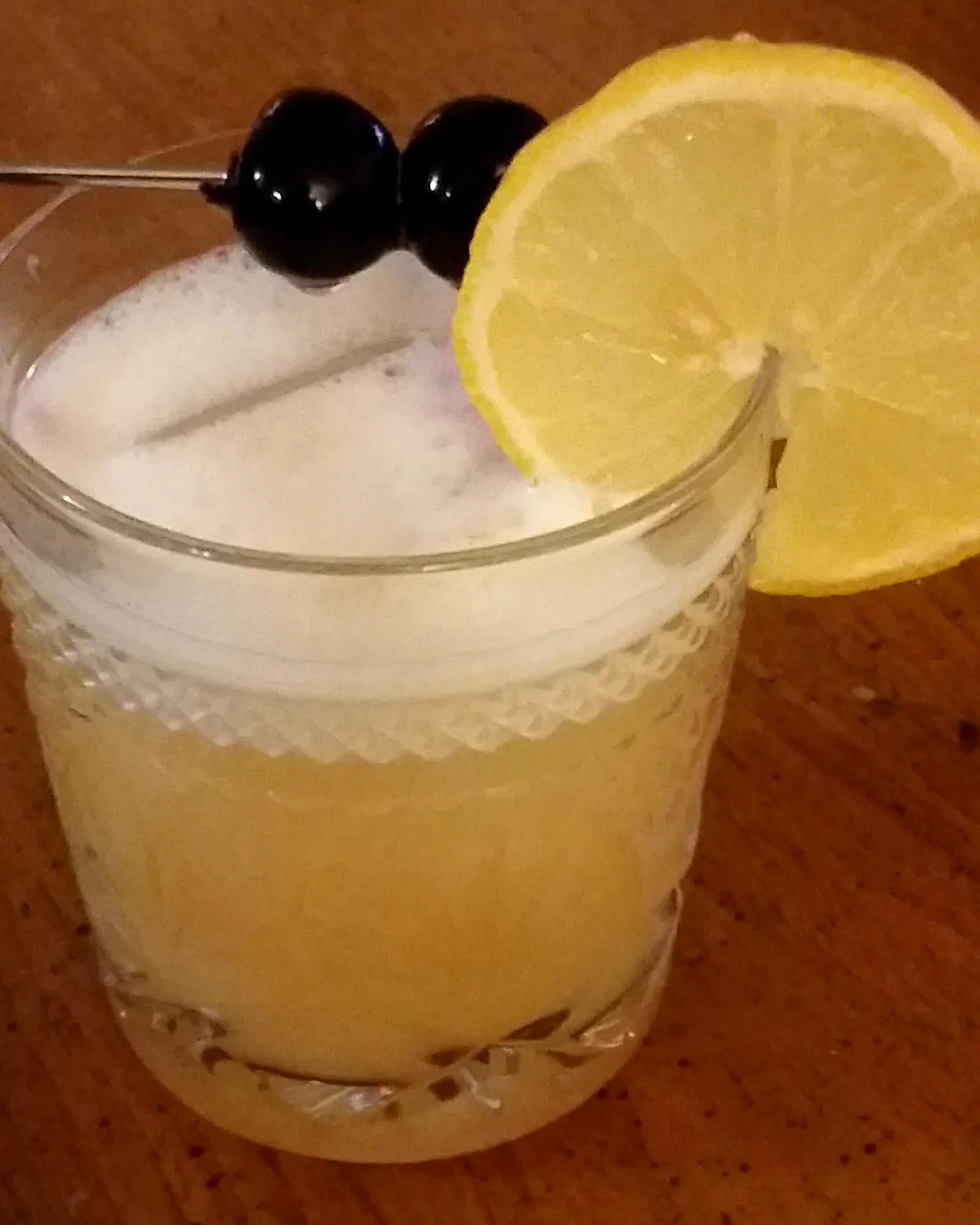
The same build with a white in it, shaken twice, for a drink with a head on it.

CC BY-SA 4.0 · Cropped, white-balanced, graded and re-encoded to WebP by eXir.
A Whiskey Sour in a heavy tumbler over ice, pale gold under a thin white head, with a lemon wheel and two cherries on a pick
Serving
Drink spec, per drink
Every figure above is per drink and does not move with the count, which is what makes the two service modes comparable. Sugar per litre, strength and standard drinks stay in the units their own authorities publish, because they are figures for comparing rather than for pouring. Dilution is modelled rather than measured, as a fraction of the poured volume before any ice; dotted figures descend from that estimate.
Diet and allergen labels are computed from the ingredients listed on this page and nothing else. They cannot account for cross-contamination or for the particular product you buy, and they are not medical or safety guidance.
Ingredients
 23 ml fresh lemon juice
 60 ml bourbon
 23 ml simple syrupInterchangeable by volume and almost identical in sugar, so the arithmetic barely moves. What changes is the molasses left on the crystals, which lands squarely on the bourbon's own caramel and makes a rounder, darker drink.flavour: moderate change · strength: no change · sweetness: minor change
- 23 ml fresh lemon juice
- 60 ml bourbon
- 23 ml simple syrup
- ~53 ml water
Glass
Vessel
158 ml of liquid plus 175 ml of cubed ice occupies about 333 ml, inside the 400 ml the glass holds. The build fails if a recipe ever exceeds its stated vessel.
A batch needs a vessel that closes and fits a fridge shelf.
Drink spec, per drink
Every figure above is per drink and does not move with the count, which is what makes the two service modes comparable. Sugar per litre, strength and standard drinks stay in the units their own authorities publish, because they are figures for comparing rather than for pouring. Dilution is modelled rather than measured, as a fraction of the poured volume before any ice; dotted figures descend from that estimate.
Diet and allergen labels are computed from the ingredients listed on this page and nothing else. They cannot account for cross-contamination or for the particular product you buy, and they are not medical or safety guidance.
Ingredients
- 23 ml fresh lemon juice
- 60 ml bourbon
- 23 ml simple syrup
 ½ white egg white (15 ml)
- 23 ml fresh lemon juice
- 60 ml bourbon
- 23 ml simple syrup
- ½ white egg white (15 ml)
- ~66 ml water
Glass
Vessel
186 ml of liquid plus 175 ml of cubed ice occupies about 361 ml, inside the 400 ml the glass holds. The build fails if a recipe ever exceeds its stated vessel.
A batch needs a vessel that closes and fits a fridge shelf.
Method
4 steps · 1m 52sSqueeze the 23 ml fresh lemon juice and strain out the pips and pulp. Juice that has been sitting since yesterday makes a duller drink than anything else you could get wrong here.
Combine the 60 ml bourbon, the 23 ml fresh lemon juice and the 23 ml simple syrup in a shaker and fill it with cubed ice.
Shake hard for 12s. Short and violent; the aim is to chill and aerate, not to melt the ice.
Shaken rather than stirred because there is juice in it. Stirring a drink with citrus leaves it heavy and flat; the shake aerates it, and the lightness that comes from that is half of why a sour reads as refreshing when it is mostly spirit.
Strain into a double old fashioned glass over fresh cubed ice. The ice in the shaker has done its work and is half water by now.
Common pitfallBottled lemon juice is the one substitution that ruins this drink outright. It is preserved, and what preserves it is cooked, dulled acid that reads as sour without reading as lemon. The juice has to be squeezed the same day.
Keeping and make-ahead
Batched ahead, this keeps sealed and cold. The water line the engine adds is the dilution figure from the spec panel, not a rule of thumb.
Method
5 steps · 2m 19sSqueeze the 23 ml fresh lemon juice and strain out the pips and pulp.
Combine the 60 ml bourbon, the 23 ml fresh lemon juice, the 23 ml simple syrup and the ½ white egg white (15 ml) in a shaker. Close it straight away; the white should not sit in the acid.
Shake with no ice at all for 20s, until the shaker feels heavier than it should and the sound goes soft.
The first shake has no ice in it on purpose. Protein unfolds and traps air far more readily warm than cold, so a shake without ice builds the foam and the shake with ice then chills it without knocking it back down. Doing it the other way round gives a thin, short-lived head.
Open it, fill it with cubed ice and shake again for 14s.
Double strain into a double old fashioned glass over fresh cubed ice, pouring slowly so the foam settles on top rather than folding into the drink.
Common pitfallA white that has been sitting in the lemon juice will not whip. Acid starts denaturing the protein straight away, so the white goes in with everything else and the shaker closes immediately.
Keeping and make-ahead
Batched ahead, this keeps sealed and cold. The water line the engine adds is the dilution figure from the spec panel, not a rule of thumb.
About
The reference example of the oldest and largest family of mixed drinks, and one whose own first appearance in print is two decades later than the family's.
The sour is a documented family rather than an inferred one. Jerry Thomas describes it in How to Mix Drinks in 1862 1, and the book's sours are made with brandy and with gin: spirit, lemon, sugar and water, in that order 2. A whiskey one is not among them.
Whiskey arrives late and arrives already established. The earliest known mention in print is in the Waukesha Plain Dealer, a Wisconsin newspaper, on 4 January 1870 3, and it appears there as something a man simply orders, with no explanation offered to the reader 2. A drink does not reach that state in a newspaper the year it is invented, so the printed date is a floor rather than a birthday.
A rival claim exists. A 1962 publication of the Universidad del Cuyo cites the Iquique newspaper El Comercio in attributing the drink to Elliott Stubb in 1872 3. The same claim, with the same man and the same port, is attached elsewhere to the Pisco Sour, which is a reason to hold it loosely rather than a reason to discount it.
The older story told about the family (sailors adding citrus to spirit against scurvy, and the ration that became grog) is a claim about where the shape came from, not about this drink 2. It is repeated widely enough to be worth naming and rests on inference rather than on any recipe.
What is not in doubt is the proportion. Two parts spirit to three quarters each of citrus and sugar produces a drink that is neither sweet nor sour, and the whole family is that ratio with one slot changed. The named variants change exactly one thing each: a white makes it a Boston Sour, a float of red wine makes it a New York Sour, and swapping the whiskey names it after the whiskey 3.
- 1Sour (cocktail)en.wikipedia.org
- 2Everything You Need To Know About The Whiskey Sourthewhiskeywash.com
- 3Whiskey souren.wikipedia.org