
Tinto de Verano
Young red wine and lemon soda, built over ice in equal parts.
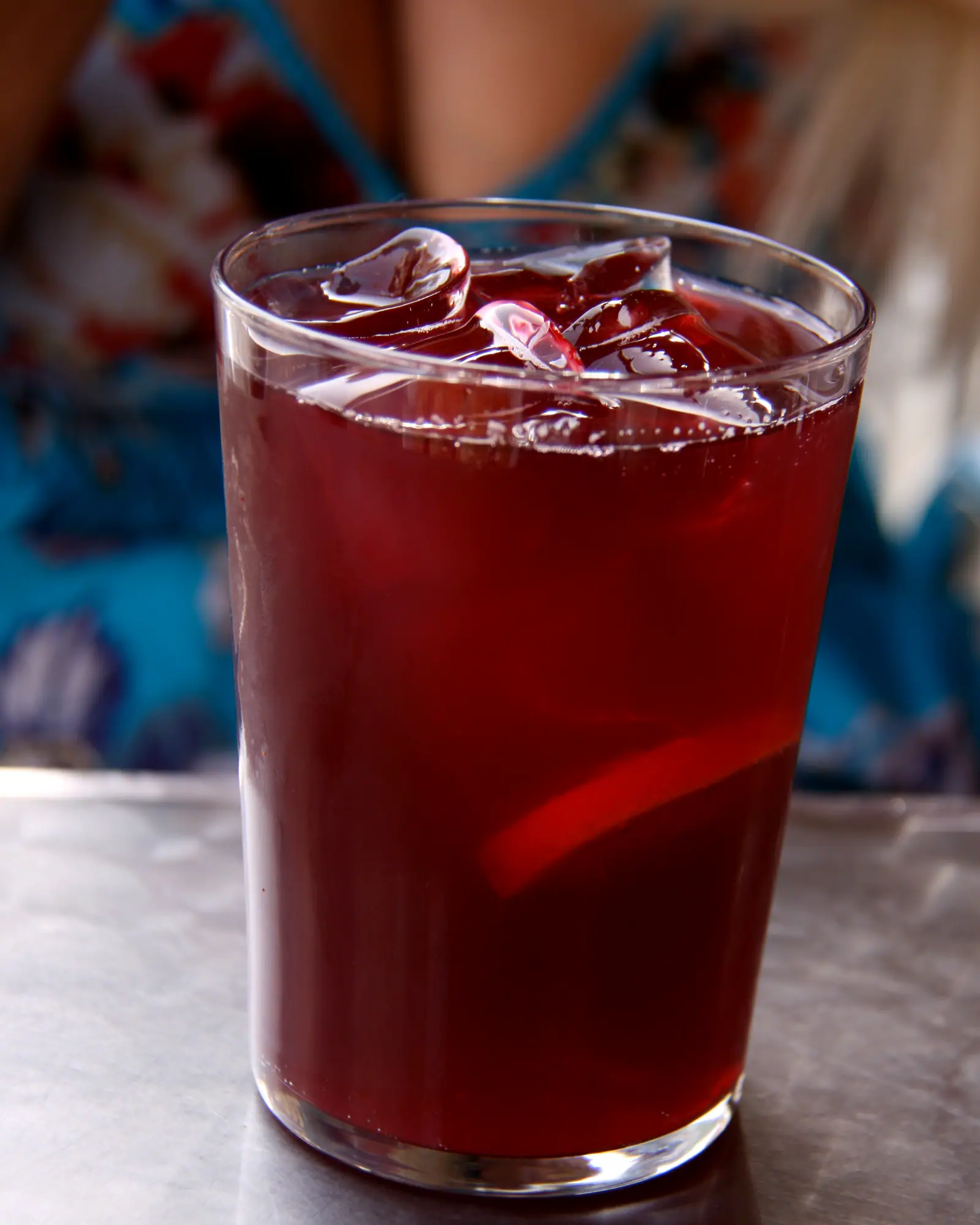

CC BY-SA 3.0 · Cropped, white-balanced, graded and re-encoded to WebP by eXir.
A glass of Tinto de Verano, deep red, over ice with a slice of lemon, on a metal table
Serving
Drink spec, per drink
Every figure above is per drink and does not move with the count, which is what makes the two service modes comparable. Sugar per litre, strength and standard drinks stay in the units their own authorities publish, because they are figures for comparing rather than for pouring. Dilution is modelled rather than measured, as a fraction of the poured volume before any ice; dotted figures descend from that estimate.
Many red wines are fined with isinglass, gelatine or egg white or casein; unfiltered or vegan-labelled bottles are not. The finished wine contains at most a trace of the fining agent, but the label is the only way to know which was used for a given bottle.
Diet and allergen labels are computed from the ingredients listed on this page and nothing else. They cannot account for cross-contamination or for the particular product you buy, and they are not medical or safety guidance.
Ingredients
 80 ml red wine
 80 ml lemon soda
 ½ lemon (10 g)
- 80 ml red wine
- 80 ml lemon soda
- ½ lemon (10 g)
Glass
Vessel
160 ml of liquid plus 230 ml of cubed ice occupies about 390 ml, inside the 400 ml the glass holds. The build fails if a recipe ever exceeds its stated vessel.
A batch needs a vessel that closes and fits a fridge shelf.
Method
4 steps · 1m 10sFill a Collins glass with cubed ice.
Pour in the 80 ml red wine.
The two go in equal parts rather than one topping up the other, which is what separates this from a wine spritzer built mostly of wine with a splash of soda on top.
Top with the 80 ml lemon soda.
Drop in a lemon slice.
Common pitfallA heavy, oaked wine reads as flat and muddy against the soda; the point of this drink is a young, unaged red diluted into something lighter, and an expensive bottle is wasted on it rather than improving it.
Keeping and make-ahead
Built to order in equal parts so the soda keeps its fizz; a pre-mixed batch goes flat before it is served.
About
Young red wine cut with lemon soda in equal parts, the everyday Spanish summer drink that sangria is often mistaken for abroad.
The drink is usually traced to Córdoba in the 1920s, where a wine seller named Federico Vargas is said to have cut his red wine with soda to make it lighter for his customers, with the mixture known at first simply as "un Vargas" 1 2. Wikipedia's own account flags the claim as under-sourced rather than settled fact, and no independent record of Vargas or his bar has been produced beyond the story itself 1.
Whatever its origin, the drink kept to one idea: young red wine and a lemon-flavoured carbonated soda, mixed in roughly equal parts and served over ice, with nothing else added 1. That plainness is the whole distinction from sangria, which layers in fruit, sugar and often a spirit and is left to macerate before it is served. A tinto de verano is built to order and drunk immediately, and in the south of Spain it is treated as the everyday choice precisely because the wine itself is still recognisable in the glass, where sangria's is not 2.
Outside Spain the two are frequently conflated, in part because sangria is the better-known export and tourist-facing venues serve it far more than locals do; within Spain, tinto de verano is understood as the more domestic, unfussy drink of the pair 1 2.
- 1Tinto de veranoen.wikipedia.org
- 2This summer know your Sangria from your Tinto de Veranoirishtimes.com