
Negroni
Equal parts gin, Campari and sweet vermouth, stirred over ice.
.jpg)
CC BY-SA 4.0 · Cropped, white-balanced, graded and re-encoded to WebP by eXir.
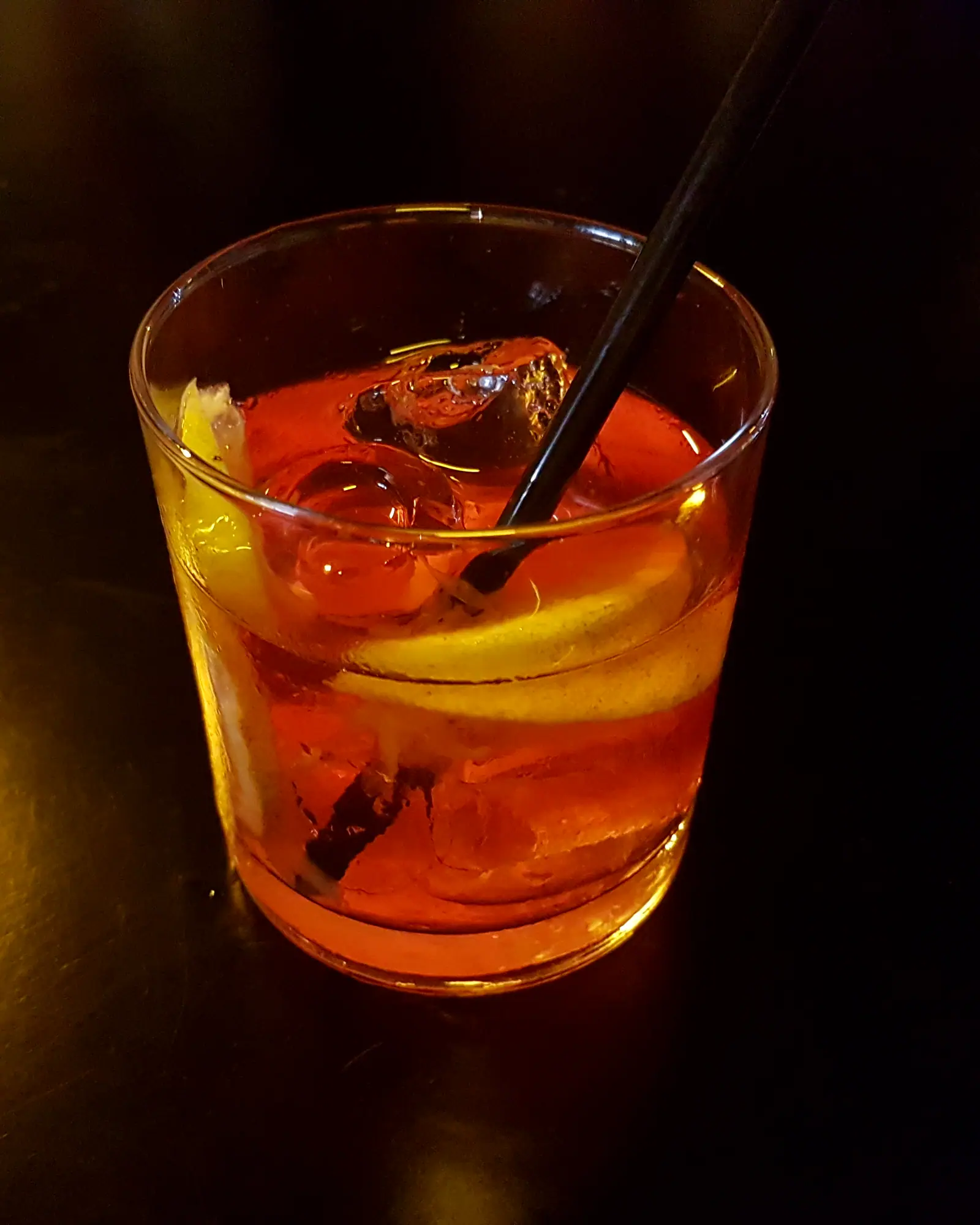
A Negroni in a rocks glass over ice, with a slice of orange and a stirrer, lit warmly against a dark bar
Serving
Drink spec, per drink
Every figure above is per drink and does not move with the count, which is what makes the two service modes comparable. Sugar per litre, strength and standard drinks stay in the units their own authorities publish, because they are figures for comparing rather than for pouring. Dilution is modelled rather than measured, as a fraction of the poured volume before any ice; dotted figures descend from that estimate.
The red was carmine, a colourant made from insects, until the producer moved to synthetic colourants in the mid-2000s. The European label cached here lists E122, E102 and E133 and no carmine, and the United States bottling uses Red 40; reporting on the change describes it as not having reached every market at once, so which colourant is in a given bottle depends on where it was made.
Vermouth is wine-based, and wine may be clarified with isinglass, made from fish, or with gelatine. Neither is a declarable allergen and neither has to appear on a label, so whether a particular bottle is vegan is a question about that producer rather than about vermouth.
Diet and allergen labels are computed from the ingredients listed on this page and nothing else. They cannot account for cross-contamination or for the particular product you buy, and they are not medical or safety guidance.
Ingredients
 30 ml London dry gin
 30 ml CampariProprietary
 30 ml sweet vermouth
 1 orange (140 g)
- 30 ml London dry gin
- 30 ml CampariProprietary
- 30 ml sweet vermouth
- 1 orange (140 g)
- ~36 ml water
Glass
Vessel
126 ml of liquid plus 130 ml of block ice occupies about 256 ml, inside the 300 ml the glass holds. The build fails if a recipe ever exceeds its stated vessel.
A batch needs a vessel that closes and fits a fridge shelf.
Method
4 steps · 1m 50sChill a rocks glass and set a single large cube in it. One large piece melts more slowly than the same mass broken into small ones, and the drink is meant to be drunk slowly.
Combine the 30 ml London dry gin, the 30 ml Campari and the 30 ml sweet vermouth in a mixing glass filled with cubed ice.
Stir for 25s, until the outside of the glass is frosted and the liquid has visibly gained volume. Strain over the waiting cube.
Everything in the glass is spirituous and nothing in it is cloudy, so the drink is stirred. Shaking would aerate it and leave it hazy for several minutes, and the weight and clarity are most of what the drink is.
Cut a 4 cm swathe of orange peel, hold it skin-outwards over the surface and squeeze so the oil lands on the drink. Rub it around the rim and drop it in.
Common pitfallVermouth is wine. An open bottle kept at room temperature oxidises within weeks, and the flat, faintly stewed drink that results is usually blamed on the gin or the Campari. Refrigerate it once it is open and buy it in the small size.
Keeping and make-ahead
Batched ahead, this keeps sealed and cold. The water line the engine adds is the dilution figure from the spec panel, not a rule of thumb.
About
An equal-parts Italian aperitivo whose formula is documented decades earlier than its name, and whose famous origin story rests on evidence far thinner than its retelling suggests.
The standard account is that Count Camillo Negroni asked a bartender at the Caffè Casoni in Florence to strengthen his Americano with gin, at some point around 1919 1. It is repeated everywhere, and the documentary basis for it is thin. The fullest investigation of it is by the Florentine bartender Luca Picchi, whose book on the subject works from civil records rather than from anything printed at the time 1, and the earliest support anyone has produced for the story itself is a private letter from 1920 2.
A rival claim exists and is worth stating because it is instructive rather than because it is likely. Descendants of General Pascal Olivier de Negroni, a Corsican-born French officer, have argued that he invented a vermouth-based drink while stationed in Senegal in the 1850s or 1860s 2. The dates are the problem: the Campari recipe was created in 1860 3, so a drink made in celebration of an 1857 marriage cannot have contained the ingredient that defines this one.
What is documented is stranger than either. The formula appears in print in 1929, in L'heure du Cocktail, as equal parts gin, Campari and Italian vermouth, under the name Campari Mixte, not Negroni. The drink is not recorded in print under this name until 1950, and recipes titled Negroni do not appear until 1955 1. Two decades separate the formula from the name, which is the opposite of how the origin story is usually told.
The structure explains the survival better than the story does. It is an Americano with the soda replaced by gin, which turns a long, low aperitivo into a short, strong one without adding an ingredient. Equal parts makes it memorable, and memorable is how a drink outlives the bar it was made in.
It is also weaker than its reputation. Equal thirds of gin, a twenty-five per cent bitter and a sixteen per cent fortified wine, watered by stirring, finish below a Manhattan and well below a Martini. What reads as strength is the bitterness.
- 1Negroni cocktail — historydiffordsguide.com
- 2The Negroni: Debated Origins, Enduring Tastewarontherocks.com
- 3Our Historycampari.com