
Moscow Mule
Vodka, lime and ginger beer, built over ice in a copper mug.

CC BY-SA 3.0 · Cropped, white-balanced, graded and re-encoded to WebP by eXir.
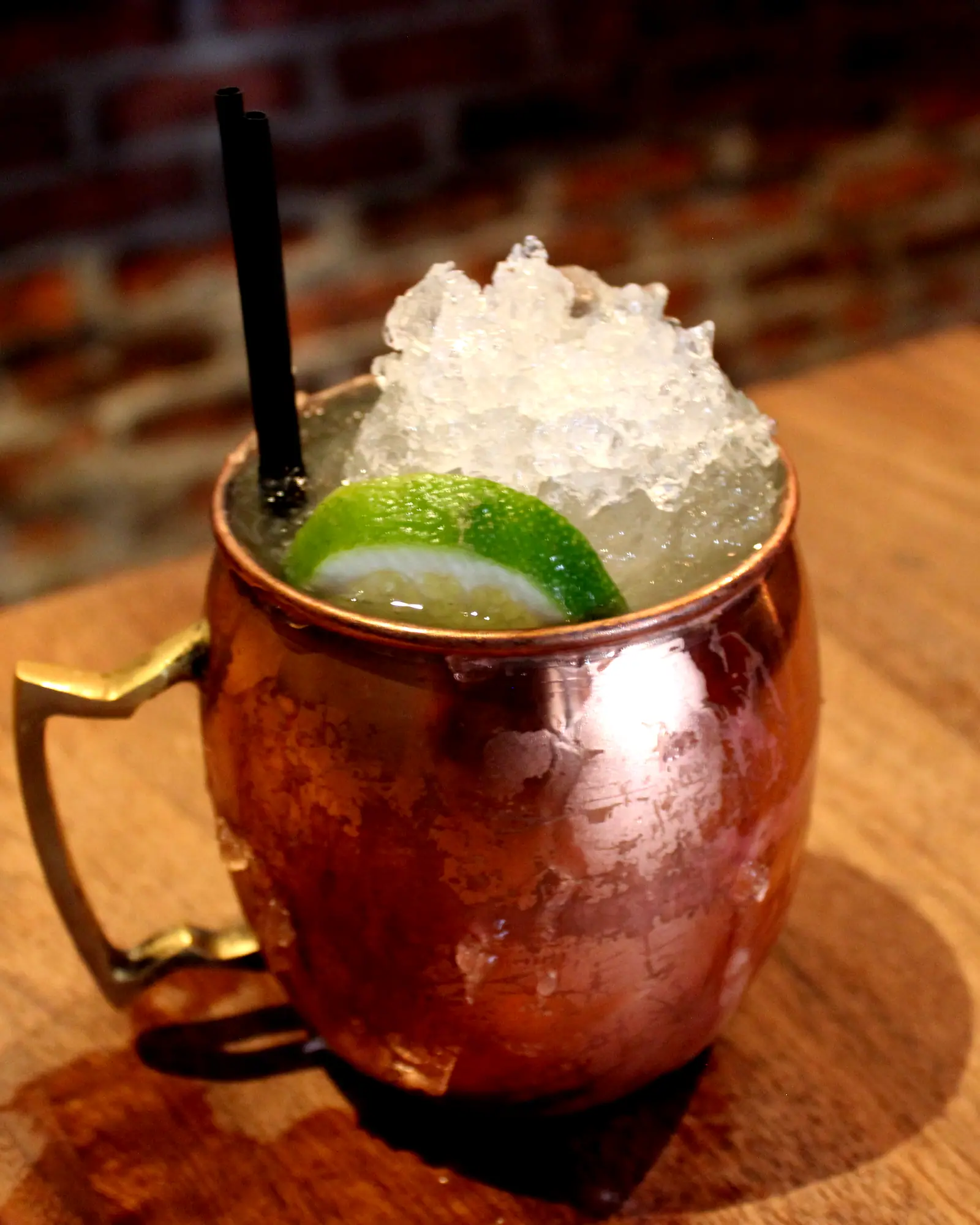
A Moscow Mule in a copper mug packed with crushed ice, garnished with a lime wheel and a black straw, on a wooden bar counter
Serving
Drink spec, per drink
Every figure above is per drink and does not move with the count, which is what makes the two service modes comparable. Sugar per litre, strength and standard drinks stay in the units their own authorities publish, because they are figures for comparing rather than for pouring. Dilution is modelled rather than measured, as a fraction of the poured volume before any ice; dotted figures descend from that estimate.
Diet and allergen labels are computed from the ingredients listed on this page and nothing else. They cannot account for cross-contamination or for the particular product you buy, and they are not medical or safety guidance.
Ingredients
 45 ml vodka
 15 ml fresh lime juice
 90 ml ginger beer
 ½ lime (8 g)
- 45 ml vodka
- 15 ml fresh lime juice
- 90 ml ginger beer
- ½ lime (8 g)
- ~38 ml water
Glass
Vessel
150 ml of liquid plus 230 ml of cubed ice occupies about 380 ml, inside the 400 ml the glass holds. The build fails if a recipe ever exceeds its stated vessel.
A batch needs a vessel that closes and fits a fridge shelf.
Method
4 steps · 1m 20sFill the copper mug with cubed ice.
The copper mug is not decoration: copper conducts heat far faster than glass, so the outside chills and beads with condensation almost as soon as the ice goes in, which is most of what this drink is known for beyond its build.
Pour in the 45 ml vodka and the 15 ml fresh lime juice.
Top with the 90 ml ginger beer, poured gently down the side of the mug rather than straight onto the ice.
Drop in a lime wheel.
Common pitfallGinger beer poured in hard, or stirred once it lands, throws off most of its carbonation before the first sip. It goes in gently, down the side of the mug, and the drink is not stirred afterwards.
Keeping and make-ahead
Batched ahead, this keeps sealed and cold. The water line the engine adds is the dilution figure from the spec panel, not a rule of thumb.
About
Vodka, ginger beer and lime built in a copper mug, credited with breaking vodka into the American market in the early 1940s.
The accounts agree on the people and disagree on almost everything else. A 1948 newspaper story credited three men (Jack Morgan, owner of Cock 'n Bull ginger beer, John G. Martin, who held the American rights to Smirnoff, and Rudolph Kunett, head of Smirnoff's vodka division) with combining the two products at Manhattan's Chatham Hotel in 1941 1. A later account, drawn from an interview with Cock 'n Bull bartender Wes Price, places the invention a year earlier at the restaurant's Los Angeles bar, with Price himself mixing the drink to use up unsold vodka and ginger beer 2. Both versions keep the same underlying problem: neither Smirnoff nor Cock 'n Bull ginger beer was selling, and someone poured them together to move the stock.
The copper mug is where the record thins out further. Martin's own account names Oseline Schmidt, said to have inherited a copper works, as its source; other tellings credit Sophie Berezinski, a Russian immigrant whose father ran the Moscow Copper Company. Neither claim is independently verified 2.
What is not disputed is how the drink was sold. Martin spent years travelling to bars across the United States, asking bartenders to pose with a mug and a Smirnoff bottle so he could photograph them with an instant camera. The photographs were proof, carried to the next bar, that the drink was already catching on elsewhere 1. The tactic worked well enough to help move American vodka from a marginal curiosity to the country's best-selling spirit within a generation 2.
- 1Moscow muleen.wikipedia.org
- 2The Cock 'n Bull Story — Inventing the Moscow Mulewesthollywoodhistory.org