
Mimosa
Equal parts orange juice and sparkling wine, built straight into the glass.

CC BY 4.0 · Cropped, white-balanced, graded and re-encoded to WebP by eXir.
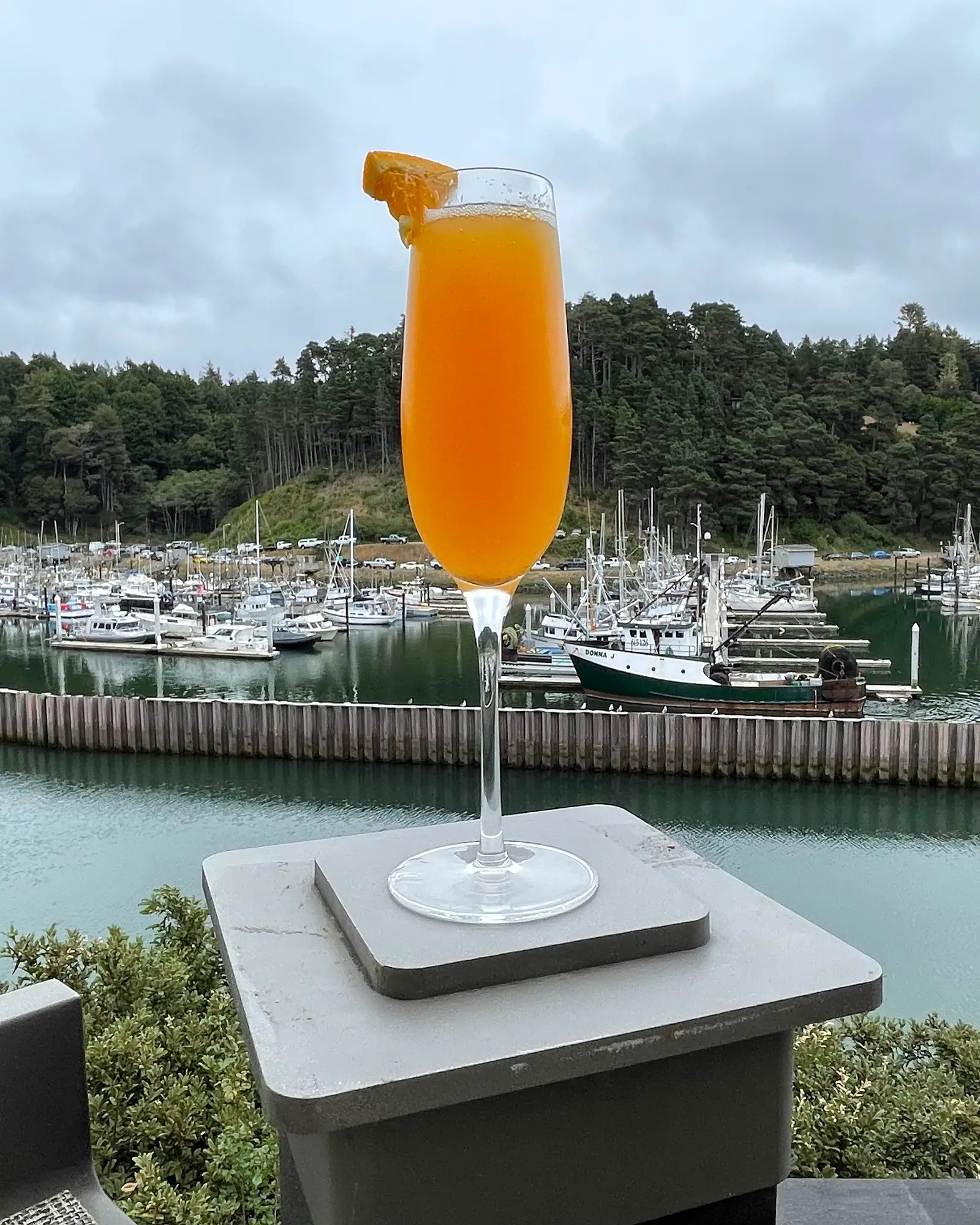
An orange Mimosa in a champagne flute, garnished with a curl of citrus peel, overlooking a harbour
Serving
Drink spec, per drink
Every figure above is per drink and does not move with the count, which is what makes the two service modes comparable. Sugar per litre, strength and standard drinks stay in the units their own authorities publish, because they are figures for comparing rather than for pouring.
Wine is routinely fined with isinglass, gelatine or casein, and a producer rarely states whether a given bottle was.
Diet and allergen labels are computed from the ingredients listed on this page and nothing else. They cannot account for cross-contamination or for the particular product you buy, and they are not medical or safety guidance.
Ingredients
 75 ml fresh orange juice
 75 ml brut sparkling wine
- 75 ml fresh orange juice
- 75 ml brut sparkling wine
Glass
Vessel
150 ml of liquid, served without ice, inside the 180 ml the glass holds. The build fails if a recipe ever exceeds its stated vessel.
A batch needs a vessel that closes and fits a fridge shelf.
Method
2 steps · 50sChill the flute. The drink carries no ice of its own, so the glass and both liquids have to already be cold.
Pour the 75 ml fresh orange juice into the glass, then top with the 75 ml brut sparkling wine.
Common pitfallOrange juice with any pulp settles and clouds the wine's own bead; a juice strained clean keeps the two layers from separating into a visibly striped glass.
Keeping and make-ahead
Sparkling wine is always poured to order for its bubbles; the orange juice can be squeezed ahead but the drink itself is never pre-mixed.
About
Equal parts orange juice and sparkling wine, credited to the Ritz Hotel in Paris and closely tied to London's earlier, less diluted Buck's Fizz.
The Mimosa is usually credited to Frank Meier, head bartender at the Ritz Hotel in Paris, and dated to the mid-1920s, though sources differ on the exact year, placing it anywhere from 1921 to 1925 1. The attribution itself is not solid: Meier's own 1936 cocktail book marked every recipe he claimed to have invented with a symbol, and the Mimosa carries no such mark, despite his willingness to claim credit for other drinks in the same book 2.
A near-identical drink, the Buck's Fizz, was already being served in London by 1921, made by bartender Malachi "Pat" McGarry at Buck's Club 1. The two are distinguished mainly by ratio: a Buck's Fizz is built two parts sparkling wine to one part orange juice and served without ice, while a Mimosa is built in equal parts and served over ice in some accounts 1. Given that the Buck's Fizz is the earlier of the two by several years, it is treated by some sources as the Mimosa's direct predecessor rather than a separate, coincidentally similar drink 1; other accounts stop short of stating a descent and note only that they are frequently confused with each other 2.
The name itself is unconnected to either origin story: it refers to the bright yellow flowers of Acacia dealbata, commonly called mimosa, which the drink's colour was thought to resemble 2. Less credible accounts crediting the film director Alfred Hitchcock with popularising the drink in 1940s San Francisco are not supported by the earlier Paris and London dates already on record 2.
- 1Buck's Fizz & Mimosa Cocktails — History & Recipesdiffordsguide.com
- 2Mimosa (cocktail)en.wikipedia.org