
Martini
Gin and a trace of dry vermouth, stirred and strained up.
A dry martini with olive brine stirred in and extra olives to garnish.
Gin with equal measures of dry and sweet vermouth.
Gin and dry vermouth in an older, more generous ratio.
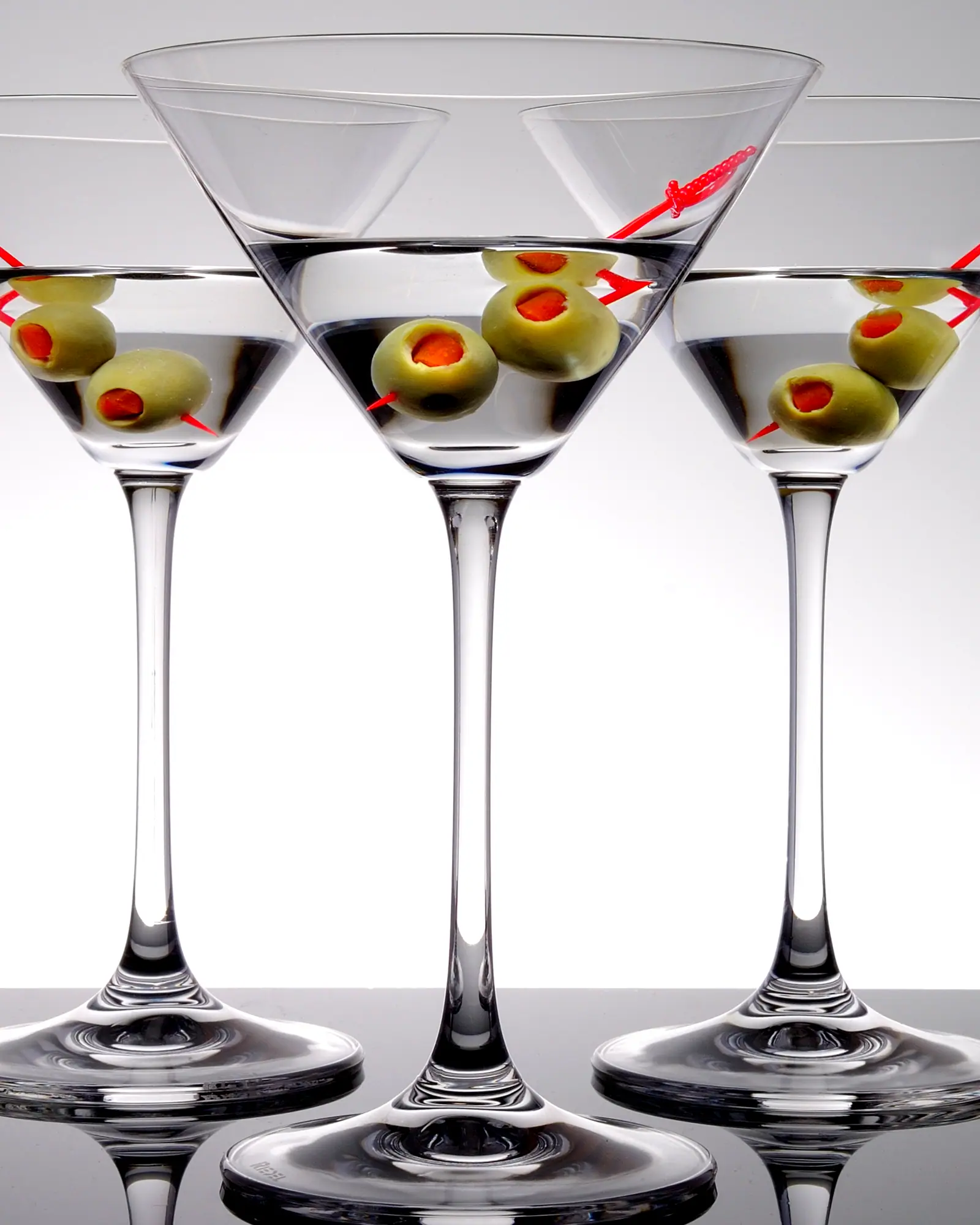

CC BY 2.0 · Cropped, white-balanced, graded and re-encoded to WebP by eXir.
Several martinis in stemmed cocktail glasses, each garnished with green olives on a pick, against a plain white background
Serving
Drink spec, per drink
Every figure above is per drink and does not move with the count, which is what makes the two service modes comparable. Sugar per litre, strength and standard drinks stay in the units their own authorities publish, because they are figures for comparing rather than for pouring. Dilution is modelled rather than measured, as a fraction of the poured volume before any ice; dotted figures descend from that estimate.
Vermouth is wine-based, and wine may be clarified with isinglass, made from fish, or with gelatine. Neither is a declarable allergen and neither has to appear on a label, so whether a particular bottle is vegan is a question about that producer rather than about vermouth.
Diet and allergen labels are computed from the ingredients listed on this page and nothing else. They cannot account for cross-contamination or for the particular product you buy, and they are not medical or safety guidance.
Ingredients
 60 ml London dry gin
 10 ml dry vermouth
 1 olive pickled green olive (4 g)
- 60 ml London dry gin
- 10 ml dry vermouth
- 1 olive pickled green olive (4 g)
- ~31 ml water
Glass
Vessel
101 ml of liquid, served without ice, inside the 180 ml the glass holds. The build fails if a recipe ever exceeds its stated vessel.
A batch needs a vessel that closes and fits a fridge shelf.
Drink spec, per drink
Every figure above is per drink and does not move with the count, which is what makes the two service modes comparable. Sugar per litre, strength and standard drinks stay in the units their own authorities publish, because they are figures for comparing rather than for pouring. Dilution is modelled rather than measured, as a fraction of the poured volume before any ice; dotted figures descend from that estimate.
Vermouth is wine-based, and wine may be clarified with isinglass, made from fish, or with gelatine. Neither is a declarable allergen and neither has to appear on a label, so whether a particular bottle is vegan is a question about that producer rather than about vermouth.
Diet and allergen labels are computed from the ingredients listed on this page and nothing else. They cannot account for cross-contamination or for the particular product you buy, and they are not medical or safety guidance.
Ingredients
- 60 ml London dry gin
- 10 ml dry vermouth
 15 ml olive brine
- 3 olives pickled green olive (12 g)
- 60 ml London dry gin
- 10 ml dry vermouth
- 15 ml olive brine
- 3 olives pickled green olive (12 g)
- ~35 ml water
Glass
Vessel
120 ml of liquid, served without ice, inside the 180 ml the glass holds. The build fails if a recipe ever exceeds its stated vessel.
A batch needs a vessel that closes and fits a fridge shelf.
Drink spec, per drink
Every figure above is per drink and does not move with the count, which is what makes the two service modes comparable. Sugar per litre, strength and standard drinks stay in the units their own authorities publish, because they are figures for comparing rather than for pouring. Dilution is modelled rather than measured, as a fraction of the poured volume before any ice; dotted figures descend from that estimate.
Vermouth is wine-based, and wine may be clarified with isinglass, made from fish, or with gelatine. Neither is a declarable allergen and neither has to appear on a label, so whether a particular bottle is vegan is a question about that producer rather than about vermouth.
Vermouth is wine-based, and wine may be clarified with isinglass, made from fish, or with gelatine. Neither is a declarable allergen and neither has to appear on a label, so whether a particular bottle is vegan is a question about that producer rather than about vermouth.
Diet and allergen labels are computed from the ingredients listed on this page and nothing else. They cannot account for cross-contamination or for the particular product you buy, and they are not medical or safety guidance.
Ingredients
- 60 ml London dry gin
- 15 ml dry vermouth
 15 ml sweet vermouth
- 1 olive pickled green olive (4 g)
- 60 ml London dry gin
- 15 ml dry vermouth
- 15 ml sweet vermouth
- 1 olive pickled green olive (4 g)
- ~38 ml water
Glass
Vessel
128 ml of liquid, served without ice, inside the 180 ml the glass holds. The build fails if a recipe ever exceeds its stated vessel.
A batch needs a vessel that closes and fits a fridge shelf.
Drink spec, per drink
Every figure above is per drink and does not move with the count, which is what makes the two service modes comparable. Sugar per litre, strength and standard drinks stay in the units their own authorities publish, because they are figures for comparing rather than for pouring. Dilution is modelled rather than measured, as a fraction of the poured volume before any ice; dotted figures descend from that estimate.
Vermouth is wine-based, and wine may be clarified with isinglass, made from fish, or with gelatine. Neither is a declarable allergen and neither has to appear on a label, so whether a particular bottle is vegan is a question about that producer rather than about vermouth.
Diet and allergen labels are computed from the ingredients listed on this page and nothing else. They cannot account for cross-contamination or for the particular product you buy, and they are not medical or safety guidance.
Ingredients
- 60 ml London dry gin
- 20 ml dry vermouth
- 1 olive pickled green olive (4 g)
- 60 ml London dry gin
- 20 ml dry vermouth
- 1 olive pickled green olive (4 g)
- ~35 ml water
Glass
Vessel
115 ml of liquid, served without ice, inside the 180 ml the glass holds. The build fails if a recipe ever exceeds its stated vessel.
A batch needs a vessel that closes and fits a fridge shelf.
Method
4 steps · 1m 30sChill a martini glass.
Combine the 60 ml London dry gin and the 10 ml dry vermouth in a mixing glass filled with cubed ice.
Stir for 25s, until the outside of the glass is frosted, and strain into the chilled glass.
Everything in the glass is spirituous and nothing needs aerating, so it is stirred rather than shaken. Shaking would also beat air into the drink and cloud it, which a gin this pale is meant never to be.
Skewer the 1 olive pickled green olive (4 g) on a pick and drop it in.
Common pitfallThis ratio leaves almost nowhere for the vermouth to hide, so a bottle kept warm and half-empty for months oxidises into something flat and papery that no amount of good gin then covers up.
Keeping and make-ahead
Batched ahead, this keeps sealed and cold. The water line the engine adds is the dilution figure from the spec panel, not a rule of thumb.
Method
4 steps · 1m 30sChill a martini glass.
Combine the 60 ml London dry gin, the 10 ml dry vermouth and the 15 ml olive brine in a mixing glass filled with cubed ice.
The brine is added at the same stage as the gin and vermouth and stirred with them, rather than dropped in afterwards, so it dilutes and chills alongside the rest of the drink instead of sitting cold and separate on top.
Stir for 25s, until the outside of the glass is frosted, and strain into the chilled glass.
Skewer the 3 olives pickled green olive (12 g) onto a pick and drop it in.
Common pitfallBrine is salted water rather than a spirit, so it does not just season the drink, it also measurably weakens and dilutes it, and a heavy hand with the jar gives a noticeably flatter pour than the same ratio of gin to dry vermouth alone.
Keeping and make-ahead
Batched ahead, this keeps sealed and cold. The water line the engine adds is the dilution figure from the spec panel, not a rule of thumb.
Method
4 steps · 1m 30sChill a martini glass.
Combine the 60 ml London dry gin, the 15 ml dry vermouth and the 15 ml sweet vermouth in a mixing glass filled with cubed ice.
"Perfect" is a term of art rather than a claim: it names any martini split evenly between the two vermouths rather than favouring one, which brings a little of the sweet style's colour and depth into the dry version without losing the drink's spirit-forward core.
Stir for 25s, until the outside of the glass is frosted, and strain into the chilled glass.
Skewer the 1 olive pickled green olive (4 g) on a pick and drop it in.
Common pitfallTwo open vermouth bottles age at the same rate as one, and a stale sweet vermouth is easier to miss here than in a Manhattan, since the dry vermouth alongside it still reads clean.
Keeping and make-ahead
Batched ahead, this keeps sealed and cold. The water line the engine adds is the dilution figure from the spec panel, not a rule of thumb.
Method
4 steps · 1m 30sChill a martini glass.
Combine the 60 ml London dry gin and the 20 ml dry vermouth in a mixing glass filled with cubed ice.
This is closer to how the drink was poured before the ratio drifted drier through the twentieth century, and the extra vermouth is enough to taste as wine rather than as a background note.
Stir for 25s, until the outside of the glass is frosted, and strain into the chilled glass.
Skewer the 1 olive pickled green olive (4 g) on a pick and drop it in.
Common pitfallWith this much vermouth in the glass, an oxidised bottle is more obvious than in the dry version rather than less, since there is more of it to have gone flat.
Keeping and make-ahead
Batched ahead, this keeps sealed and cold. The water line the engine adds is the dilution figure from the spec panel, not a rule of thumb.
About
A gin and dry vermouth cocktail whose ratio drifted steadily drier across the twentieth century, from a sweet Old Tom gin drink to one measured in parts of gin against a bare rinse of vermouth.
The earliest recipe printed under this name appears in Harry Johnson's 1888 Bartender's Manual, calling for Old Tom gin, sweet vermouth, curaçao and bitters 1. This was a sweeter, more heavily flavoured drink than the one now served under the same name, and close in shape to the Martinez already circulating under its own name a few years earlier. Its relationship to that drink is no more settled than the rest of its history: the near- identical Marguerite, Martine and Martinez recipes of the 1880s and 1890s read less like one drink simplifying into another than like several bars converging on the same gin-and-vermouth idea at once.
The move to a drier style is documented through named guides rather than a single moment. The Marguerite of 1898 is essentially an equal-parts version with an olive rather than a cherry, and by 1904 American bars were printing recipes specifically labelled "Dry Martini Cocktail," built on dry rather than sweet vermouth 1. From there the published ratio kept falling across the century: a widely cited 1922 version settles near two parts gin to one of vermouth, the 1930s moved toward three to one, the 1940s toward four, and by the later part of the century five or six to one was standard, with some published versions run far drier still 2. The dry, wet and perfect versions served today trace points along that same century-long drift rather than three unrelated recipes.
The naming is undocumented rather than settled, and the standard accounts contradict each other. One credits a bartender at San Francisco's Occidental Hotel serving a drink to travellers bound for the town of Martinez in the 1860s; a rival version credits a bartender in that town instead; a third derives the name from the Martini & Rossi vermouth brand rather than from any bartender at all 2. None of the three is documented closer to the event than decades after it, and no source resolves which, if any, is correct.
- 1Martini: Historydiffordsguide.com
- 2Martini (cocktail)en.wikipedia.org