
Martinez
Old Tom gin and sweet vermouth in equal measure, with maraschino and a dash of bitters.

CC BY-SA 3.0 · Cropped, white-balanced, graded and re-encoded to WebP by eXir.
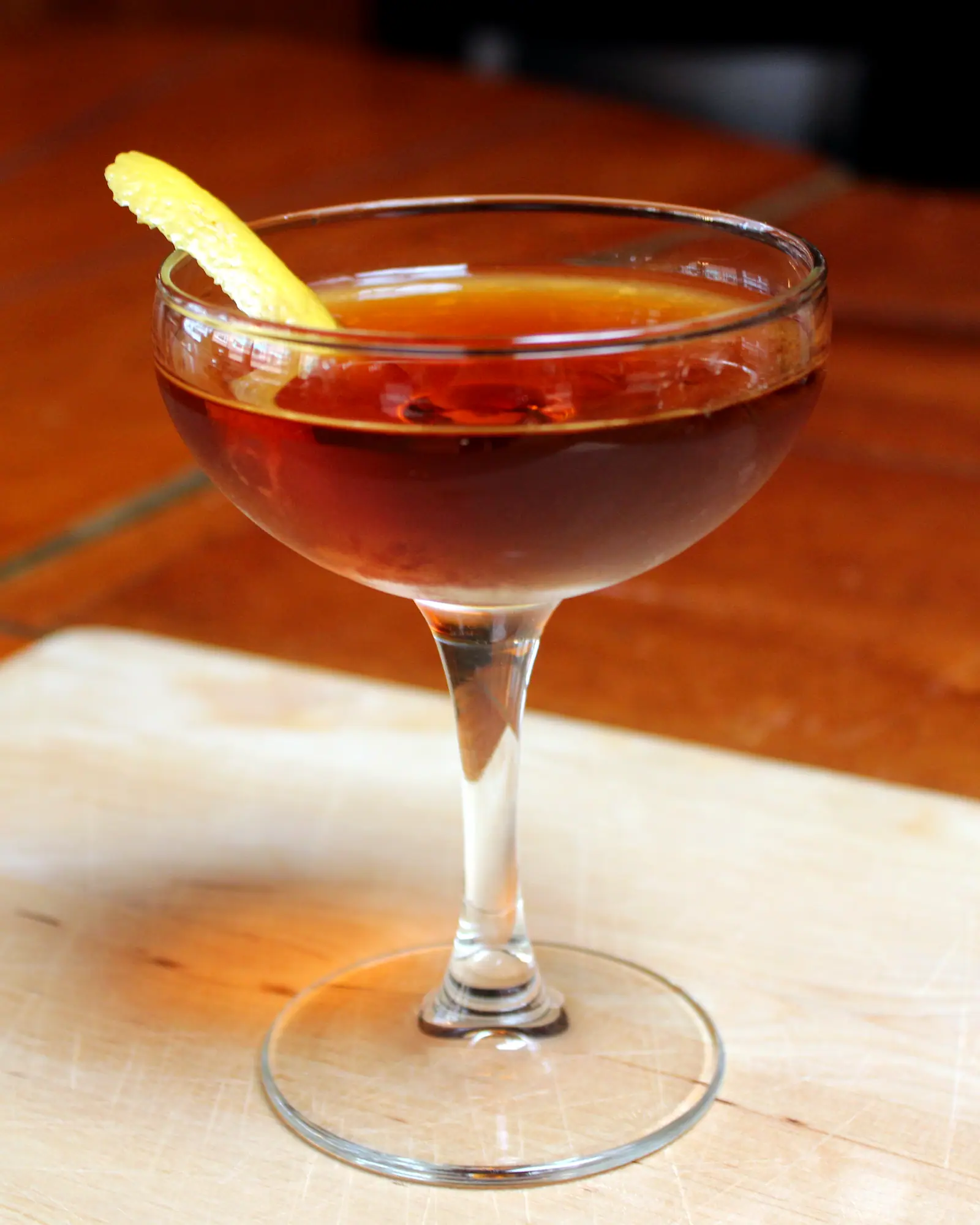
A Martinez served up in a coupe, deep amber-red, with a citrus twist resting on the rim.
Serving
Drink spec, per drink
Every figure above is per drink and does not move with the count, which is what makes the two service modes comparable. Sugar per litre, strength and standard drinks stay in the units their own authorities publish, because they are figures for comparing rather than for pouring. Dilution is modelled rather than measured, as a fraction of the poured volume before any ice; dotted figures descend from that estimate.
Vermouth is wine-based, and wine may be clarified with isinglass, made from fish, or with gelatine. Neither is a declarable allergen and neither has to appear on a label, so whether a particular bottle is vegan is a question about that producer rather than about vermouth.
The recipe is cherry distillate, sugar, alcohol and water; the leading producer states its products contain no animal-derived ingredients.
The producer's own product page states the bitters are 100% vegan and gluten-free.
Diet and allergen labels are computed from the ingredients listed on this page and nothing else. They cannot account for cross-contamination or for the particular product you buy, and they are not medical or safety guidance.
Ingredients
 45 ml Old Tom gin
 45 ml sweet vermouth
 5 ml maraschino liqueur
 2 dashes Angostura Aromatic Bitters (1.8 ml)Proprietary
 1 orange (140 g)
- 45 ml Old Tom gin
- 45 ml sweet vermouth
- 5 ml maraschino liqueur
- 2 dashes Angostura Aromatic Bitters (1.8 ml)Proprietary
- 1 orange (140 g)
- ~40 ml water
Glass
Vessel
136 ml of liquid, served without ice, inside the 180 ml the glass holds. The build fails if a recipe ever exceeds its stated vessel.
A batch needs a vessel that closes and fits a fridge shelf.
Method
4 steps · 1m 35sChill a coupe.
Combine the 45 ml Old Tom gin, the 45 ml sweet vermouth, the 5 ml maraschino liqueur and the 2 dashes Angostura Aromatic Bitters (1.8 ml) in a mixing glass filled with cubed ice.
Stir for 25s, until the outside of the glass is frosted, and strain into the chilled coupe.
Every ingredient here is spirituous or a liqueur and nothing needs aerating, so it is stirred rather than shaken, the same as the rest of this family.
Cut a 4 cm swathe of orange peel, hold it skin-outwards over the surface and squeeze so the oil lands on the drink. Rub it around the rim and drop it in.
Common pitfallOld Tom gin carries its own sweetness, and a bottle of London dry gin used in its place removes that as well as swapping the botanicals, so the drink reads noticeably drier and sharper than intended.
Keeping and make-ahead
Batched ahead, this keeps sealed and cold. The water line the engine adds is the dilution figure from the spec panel, not a rule of thumb.
About
A gin cocktail whose earliest printed recipe describes it only in terms of the Manhattan, and whose supposed relationship to the Martini is closer to a shared grandparent than to one drink simplifying into the other.
The earliest printed recipe does not introduce the drink on its own terms. O. H. Byron's 1884 guide defines it in five words, as the same as the Manhattan with gin substituted for whisky 1. That the Manhattan needed no further explanation by then suggests it was already the better known of the two, though the record does not settle which came first.
Two rival invention stories exist, and neither survives close reading. One credits Jerry Thomas, working at San Francisco's Occidental Hotel; the other credits an unnamed bartender in the town of Martinez, California, mixing a drink for a traveller headed there. Thomas's own guide is the problem for the first story: the recipe appears only in the 1887 edition, printed two years after his death, so it cannot be evidence of what he served in his lifetime 2.
That 1887 text calls for a pony of Old Tom gin, a full glass of vermouth, two dashes of maraschino and a dash of Boker's bitters 2. This is a sweeter, more heavily bittered drink than most modern pours. The base spirit is less settled than the name suggests, too: through the middle of the nineteenth century the port of New York was clearing hundreds of times more Dutch genever than English gin, so an early bartender's "gin" more plausibly meant genever than the London dry style the name calls up now 3.
Whether the Martini is a simplified descendant of this drink is itself contested rather than settled. Genealogies drawn from the period's guides describe a family of near-identical drinks (Martine, Martineau, Martigny among them) circulating under slightly different names in different cities, which reads less like one drink evolving into another and more like the same sweet-gin-and-sweet-vermouth idea passed from bar to bar and relabelled each time it changed hands 4. The Martini most likely shares a grandparent with this drink rather than descending from it directly, which is closer to the truth than either one's usual telling admits.
- 1Year Manhattan and Martinez Cocktails are First Citedbeeretseq.com
- 2Martinez (cocktail)en.wikipedia.org
- 3Martinez (Difford's Recipe)diffordsguide.com
- 4The Martini Part II: The History of the Martin[x] Familyherzogcocktailschool.com