
Makgeolli
Steamed glutinous rice fermented a week with nuruk into a cloudy, faintly sweet, low-alcohol rice wine.
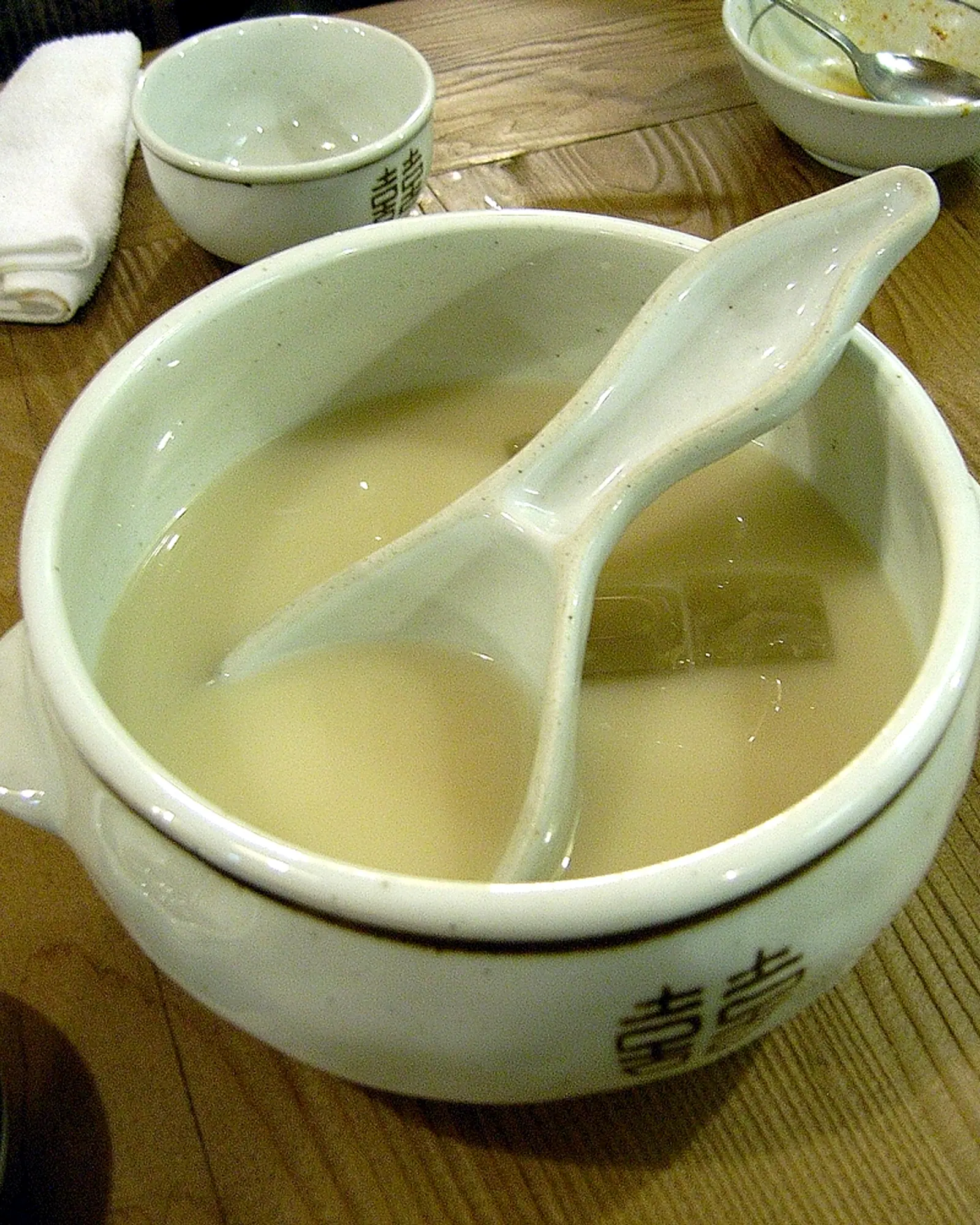

CC BY-SA 2.5 · Cropped, white-balanced, graded and re-encoded to WebP by eXir.
Milky white makgeolli in a traditional ceramic bowl with a ladle, small cups beside it
Serving
Drink spec, per drink
Every figure above is per drink and does not move with the count, which is what makes the two service modes comparable. Sugar per litre, strength and standard drinks stay in the units their own authorities publish, because they are figures for comparing rather than for pouring.
Diet and allergen labels are computed from the ingredients listed on this page and nothing else. They cannot account for cross-contamination or for the particular product you buy, and they are not medical or safety guidance.
Ingredients
 500 g steamed glutinous rice
 50 g nuruk
 1 000 ml water
- 500 g steamed glutinous rice
- 50 g nuruk
- 1 000 ml water
Glass
Vessel
250 ml of liquid, served without ice, inside the 300 ml the glass holds. The build fails if a recipe ever exceeds its stated vessel.
A batch needs a vessel that closes and fits a fridge shelf.
Method
5 steps · 7d 1hSteam the 500 g steamed glutinous rice until fully tender.
Spread the rice out and let it cool fully to room temperature.
Crumble the 50 g nuruk over the cooled rice and mix in the 600 ml water, working it through evenly.
Cover the crock loosely and leave it at room temperature for 7d, stirring once a day for the first few days, until it smells sweet and yeasty and rises with visible bubbles.
Nuruk carries mould, wild yeast and bacteria together, so it converts the rice's starch to sugar and ferments that sugar to alcohol in the same vessel, unlike a two-step process using a single cultured mould and a separately pitched yeast.
Mash the ferment against a coarse cloth to press out the liquid, then stir in the 400 ml water to loosen it to drinking strength, and refrigerate until cold. Shake the bottle before pouring to bring the settled rice back into suspension.
Common pitfallStraining too finely, or too hard, strips out the fine rice sediment that gives makgeolli its characteristic milky, cloudy body; a coarse press through cloth is meant to leave some behind rather than clarify the drink.
SafetyThe crock is covered loosely rather than sealed, since the ferment produces real carbon dioxide as it works. A batch that smells sharply of solvent, or shows pink, orange or fuzzy growth on the surface rather than a clean white cap, has gone wrong and should be discarded rather than pressed and served.
Keeping and make-ahead
Batched ahead, this keeps sealed and cold. The water line the engine adds is the dilution figure from the spec panel, not a rule of thumb.
About
Korea's oldest rice wine, made with rice, water and a wheat culture called nuruk, and a farmer's drink for most of its history before a colonial-era ban very nearly ended it.
Rice wine brewing in Korea is traced back to the Three Kingdoms period, and during the Goryeo dynasty a version was known as ihwa-ju, "pear blossom wine," for the time of year it was traditionally made 1. The name makgeolli itself is far younger: it first appears in an encyclopedia believed to date to the nineteenth century 2. What has stayed constant across that span is the method, using rice, water and nuruk, a dried cake of grain carrying wild mould, yeast and bacteria together, which both breaks the rice's starch down to sugar and ferments it to alcohol in the same vessel 1. Cloudy, low in alcohol next to distilled soju, and cheap to make at home, it became known as a farmer's drink, brewed in the countryside rather than bought 1.
That home-brewing tradition was deliberately broken twice in the twentieth century. Under Japanese colonial rule, a licensing and tax system was imposed on home production, and by 1934 brewing makgeolli at home had been outlawed outright 12. Decades later, in 1965, the South Korean government banned brewing with rice again, this time over rice shortages, and producers switched to wheat and barley for a generation 1. Rice brewing was permitted again around 1990, though ordinary home brewing did not become fully legal again until years after that 1.
The drink's recent revival among younger, urban drinkers has come largely through small breweries returning to traditional nuruk rather than the laboratory yeast and additives that filled the gap during the ban years, a shift Boksoondoga, a brewery founded in 2009 on a family recipe, is often credited with helping to popularise 2. By the late 2010s South Korea counted several hundred small-scale makgeolli producers, a scale of production the drink had not seen since before the colonial ban 1.
- 1Makgeollien.wikipedia.org
- 2Makgeolli: How Korean rice wine is stepping out of soju's shadowkoreanprep.com