
Kvass
Toasted rye bread steeped, sweetened and fermented for a day into a tangy, faintly fizzy drink.
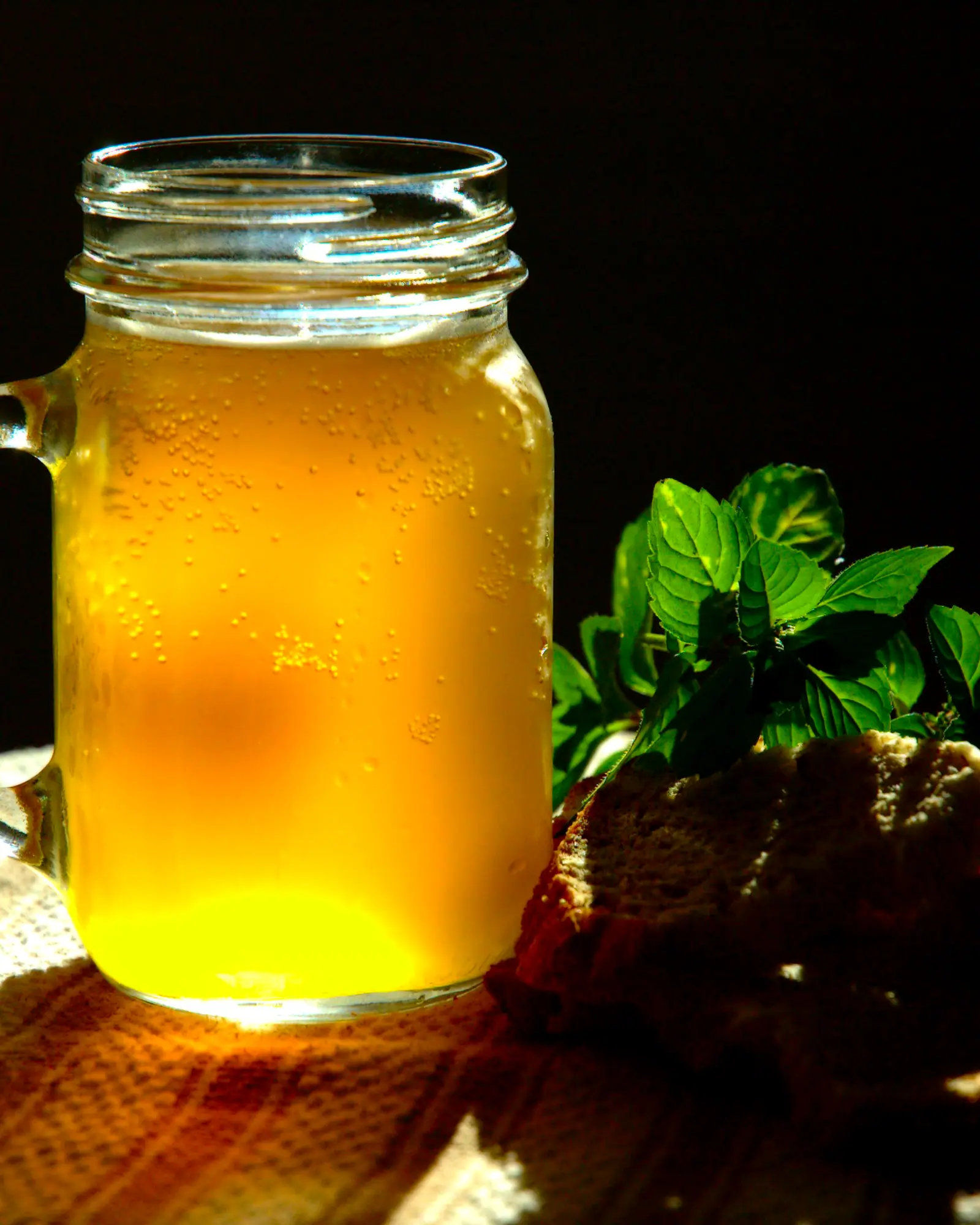

CC BY-SA 3.0 · Cropped, white-balanced, graded and re-encoded to WebP by eXir.
Amber kvass in a mason jar mug, lit warmly, with a sprig of fresh mint beside it
Serving
Drink spec, per drink
Every figure above is per drink and does not move with the count, which is what makes the two service modes comparable. Sugar per litre, strength and standard drinks stay in the units their own authorities publish, because they are figures for comparing rather than for pouring.
Diet and allergen labels are computed from the ingredients listed on this page and nothing else. They cannot account for cross-contamination or for the particular product you buy, and they are not medical or safety guidance.
Ingredients
 300 g rye bread
 2 000 ml water
 150 g granulated sugar
 3 g yeast
 15 g raisins
- 300 g rye bread
- 2 000 ml water
- 150 g granulated sugar
- 3 g yeast
- 15 g raisins
Glass
Vessel
419 ml of liquid, served without ice, inside the 500 ml the glass holds. The build fails if a recipe ever exceeds its stated vessel.
A batch needs a vessel that closes and fits a fridge shelf.
Method
5 steps · 28h 13mToast the 300 g rye bread in a low oven until it is dark and dry almost to the point of burning.
Toasting the bread hard, right to the edge of burnt, is what gives kvass its dark colour and roasted flavour; bread merely stale gives a much paler, blander drink.
Pour the boiling 2 000 ml water over the toasted bread and leave it to steep as it cools to room temperature.
Strain out the bread, then stir the 150 g granulated sugar and the 3 g yeast into the dark, toasty liquid until dissolved, and drop in the 15 g raisins.
Cover loosely and leave at room temperature for 24h, away from direct light, until the raisins have risen to the top and the liquid tastes tangy and faintly fizzy.
Strain into bottles, cap, and refrigerate until cold before serving.
Common pitfallLeft fermenting for much longer than a day, kvass turns sharply sour and noticeably more alcoholic, which is a real ferment behaving normally rather than a fault, but it is no longer the mild drink this recipe is timed for.
SafetyThe jar is covered loosely rather than sealed, since the ferment produces real carbon dioxide as it works. A batch that smells of solvent, or shows fuzzy or coloured growth on the surface rather than a clean layer of raisins and bread, has gone wrong and should be discarded rather than bottled.
Keeping and make-ahead
Batched ahead, this keeps sealed and cold. The water line the engine adds is the dilution figure from the spec panel, not a rule of thumb.
About
A lightly fermented rye bread drink recorded in Kievan Rus over a thousand years ago, and marketed by the Soviet state as a home-grown answer to Coca-Cola.
Kvass appears in the Primary Chronicle, the earliest surviving history of the Kievan state, in an account of Prince Vladimir's baptism in 988 or 989, where kvass is distributed to the people of Kiev alongside honey and food 12. It is drunk almost purely as a household ferment for most of its history: rye bread or rye flour and malt steeped in hot water, then fermented for about half a day with bread yeast and sugar, a process simple and forgiving enough that nearly any household could keep it going 1. Its low alcohol content and the fermentation's antibacterial effect also made it a safer everyday drink than untreated water in a medieval city, which is part of why monastic communities favoured it 2.
The drink stayed largely a home and tavern product until the nineteenth century, when commercial and eventually industrial production turned it into an ordinary consumer good rather than something made in every kitchen 1. The Soviet state later gave it a second, openly political life: in 1964, Premier Nikita Khrushchev announced plans to sell kvass internationally as a native alternative to Western sodas, and the following decades saw it sold from tanker trucks and distinctive yellow street barrels across Soviet cities 2. Sales fell after the Soviet Union's collapse as Western brands entered the market, then recovered sharply in the 2000s as producers marketed kvass explicitly as a patriotic, natural alternative to imported cola. This was the same contrast the Soviet campaign had drawn decades earlier, now aimed at a different audience 2.
- 1Kvassen.wikipedia.org
- 2Russia's Patriotic Alternative to Coca-Cola Is Made Out of Breadatlasobscura.com