
Irish Coffee
Sweetened whiskey coffee under a floated, unstirred layer of cream.

CC BY 2.0 · Cropped, white-balanced, graded and re-encoded to WebP by eXir.
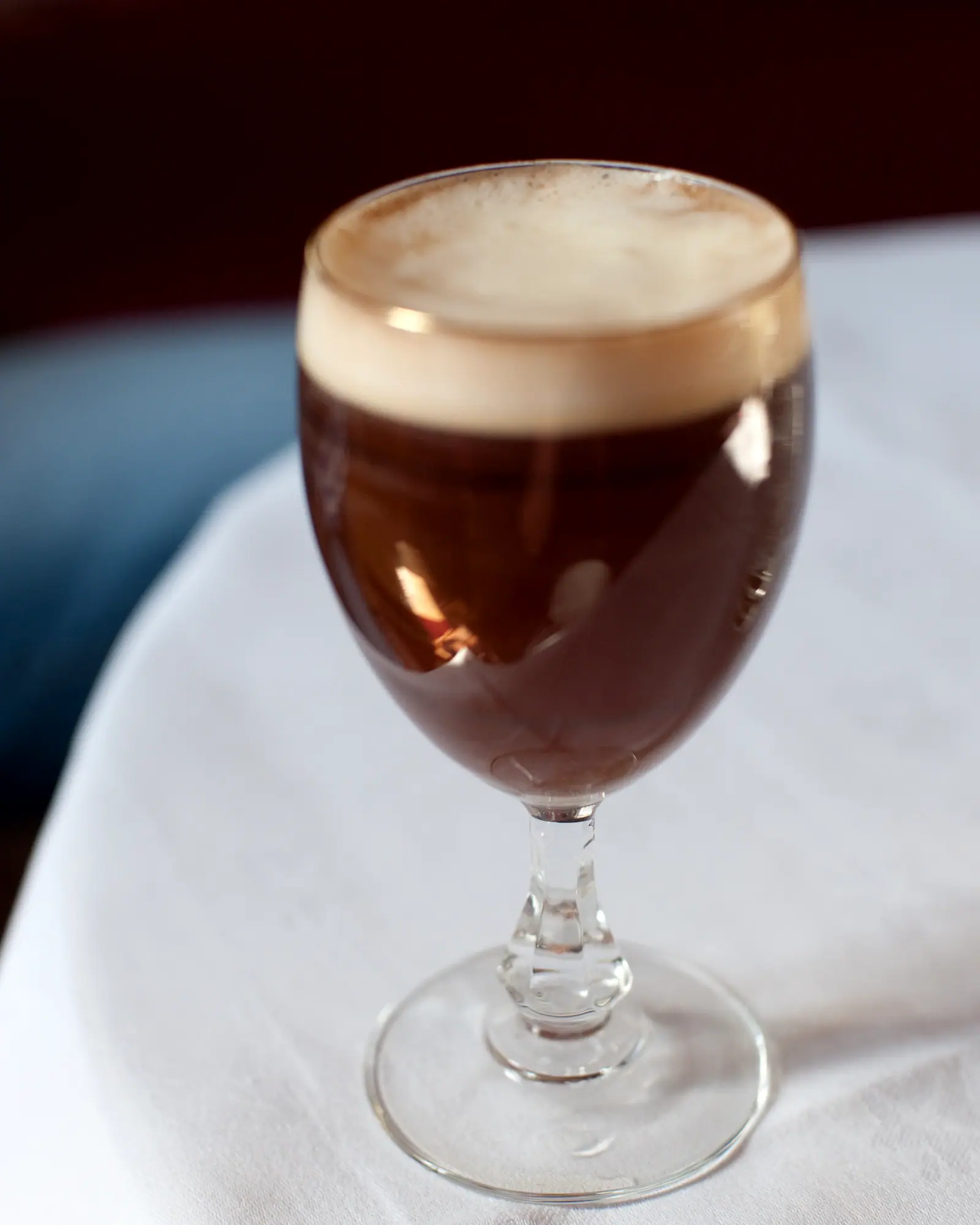
An Irish Coffee in a footed glass, dark coffee under a layer of pale cream
Serving
Drink spec, per drink
Every figure above is per drink and does not move with the count, which is what makes the two service modes comparable. Sugar per litre, strength and standard drinks stay in the units their own authorities publish, because they are figures for comparing rather than for pouring.
Diet and allergen labels are computed from the ingredients listed on this page and nothing else. They cannot account for cross-contamination or for the particular product you buy, and they are not medical or safety guidance.
Extraction
This brew works out at 100.0 g of coffee per litre of water, against the 49.5 to 60.5 g/L the standard allows, so it is stronger than it. The comparison is made in grams per litre and not on the ratio, because a ratio is the reciprocal of a strength and a symmetric band on one is an asymmetric band on the other. Source: Golden Cup Standard, Specialty Coffee Association.
No extraction yield is shown. It needs a measured dissolved-solids figure from the finished cup, nothing on a bag of coffee supplies one, and estimating it from the method would be inventing the single number the calculation exists to establish.
Ingredients
 15 g coffee
 150 ml water
 5 g granulated sugar
 50 ml Irish whiskey
 50 ml heavy cream
- 15 g coffee
- 150 ml water
- 5 g granulated sugar
- 50 ml Irish whiskey
- 50 ml heavy cream
Glass
Vessel
223 ml of liquid, served without ice, inside the 240 ml the glass holds. The build fails if a recipe ever exceeds its stated vessel.
A batch needs a vessel that closes and fits a fridge shelf.
Method
5 steps · 5mGrind the 15 g coffee to a medium texture for a drip brew.
Brew the 150 ml water through the grounds at 95 °C for 3m 30s, straight into the warmed serving glass.
Stir the 5 g granulated sugar into the hot coffee until fully dissolved, then stir in the 50 ml Irish whiskey.
Whip the 50 ml heavy cream for 30s, just enough to thicken it to a pourable, self-supporting consistency.
Pour the cream over the back of a spoon held just above the surface, so it spreads out and sits as a distinct layer on top.
The cream is poured gently over the back of a warm spoon held just above the surface, which breaks its fall enough to let it sit as a distinct layer rather than plunge through and mix into the coffee below.
Common pitfallCream whipped too far turns solid rather than pourable and will not spread into an even float; it wants only enough air worked in to thicken and hold its own weight, not the stiff peaks a dessert cream needs.
Keeping and make-ahead
Brewed and built to order. The cream is floated at the very end and would sink into a drink that had already begun to cool.
About
Sweetened whiskey coffee under a floated layer of cream, invented at a Limerick flying-boat terminal in the 1940s and carried to America by a travel writer in 1952.
The drink is credited to Joe Sheridan, a chef at the Foynes flying-boat terminal in County Limerick, sometime around 1943, when a transatlantic flight turned back in bad weather and a cabin of cold, tired passengers returned to the terminal for the night 1. Sheridan is said to have warmed coffee with Irish whiskey and sugar and finished it with cream, and when a passenger asked whether it was Brazilian coffee, to have answered that it was Irish coffee instead 2.
The drink reached the United States by a more documented route. Stanton Delaplane, a travel writer for the San Francisco Chronicle, drank it at Shannon and brought the idea to Jack Koeppler at San Francisco's Buena Vista Cafe, and the two spent time trying to reproduce it before Koeppler travelled to Foynes to learn the method directly from Sheridan 2. The Buena Vista began serving it on 10 November 1952, using cream aged briefly to thicken it enough to float, and the recipe is reported to have been essentially unchanged there since 2. San Francisco is sometimes credited as the drink's birthplace outright; the more accurate claim, and the one both sources support, is that it was introduced to America there rather than invented there 2.
The recipe was formal enough by 1988 that Ireland's own National Standards Authority published a specification for it, I.S. 417, since cancelled but evidence of how codified the proportions had become 1. The float itself is the drink's defining technique: cream poured gently enough to sit on the surface rather than stirred through, so the coffee stays hot and dark under a cold, unmixed layer, drunk through rather than after it.
- 1Irish coffeeen.wikipedia.org
- 2The True History of Irish Coffee and Its San Francisco Originskqed.org