
Hot Chocolate
Real chocolate melted into milk, dense enough to leave a coat on the back of a spoon.
Cocoa powder and sugar whisked into hot milk, thinner and quicker than melted chocolate.

CC BY 2.0 · Cropped, white-balanced, graded and re-encoded to WebP by eXir.
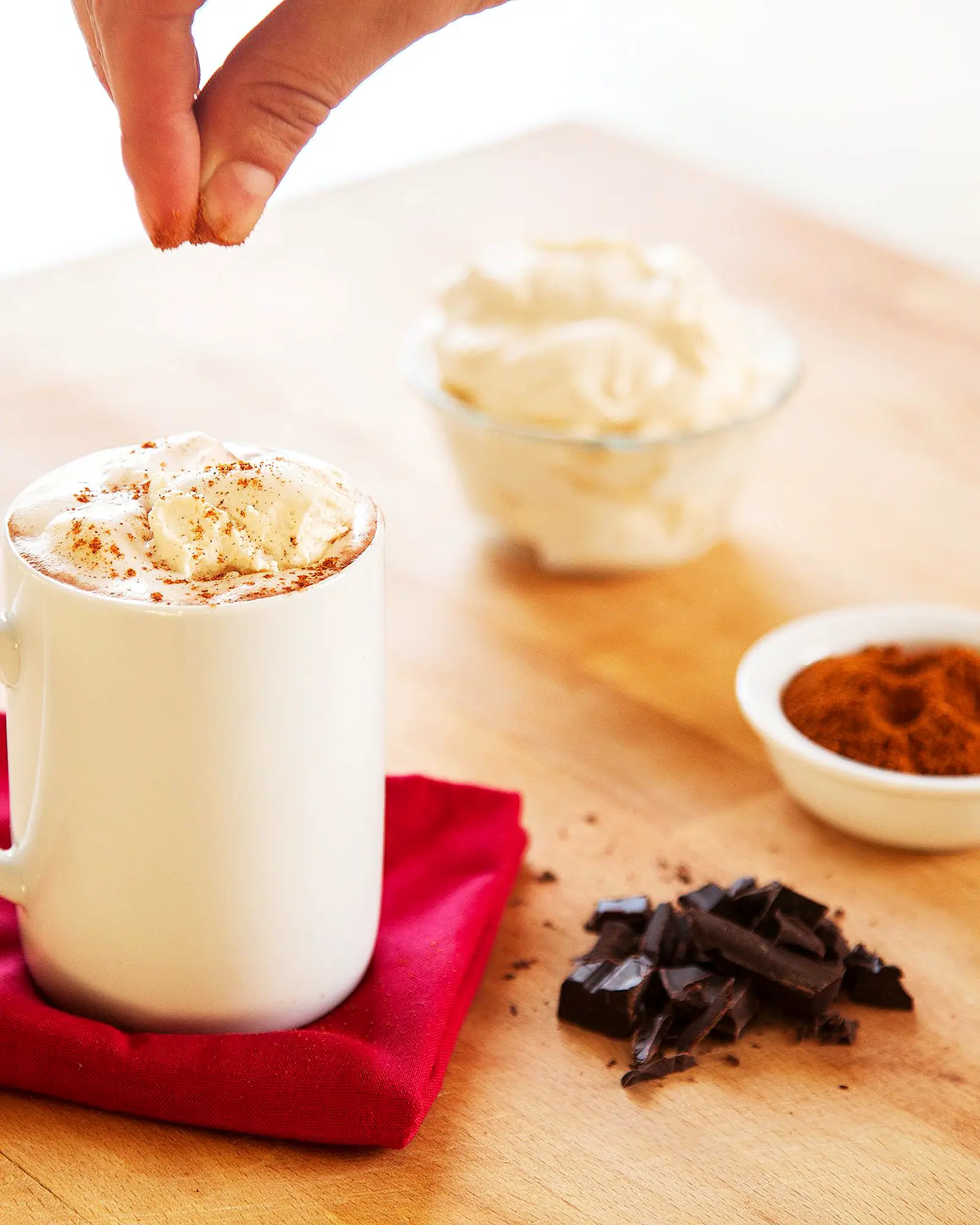
A white mug of hot chocolate topped with whipped cream, being dusted with spice, chocolate chunks and a bowl of cream beside it
Serving
Drink spec, per drink
Every figure above is per drink and does not move with the count, which is what makes the two service modes comparable. Sugar per litre, strength and standard drinks stay in the units their own authorities publish, because they are figures for comparing rather than for pouring.
Many dark chocolate bars carry milk fat or milk solids even when not labelled milk chocolate, and some are made without dairy at all; check the bar.
Diet and allergen labels are computed from the ingredients listed on this page and nothing else. They cannot account for cross-contamination or for the particular product you buy, and they are not medical or safety guidance.
Ingredients
 220 ml whole milk
 45 g dark chocolate
 10 g granulated sugar
- 220 ml whole milk
- 45 g dark chocolate
- 10 g granulated sugar
Glass
Vessel
262 ml of liquid, served without ice, inside the 350 ml the glass holds. The build fails if a recipe ever exceeds its stated vessel.
A batch needs a vessel that closes and fits a fridge shelf.
Drink spec, per drink
Every figure above is per drink and does not move with the count, which is what makes the two service modes comparable. Sugar per litre, strength and standard drinks stay in the units their own authorities publish, because they are figures for comparing rather than for pouring.
Diet and allergen labels are computed from the ingredients listed on this page and nothing else. They cannot account for cross-contamination or for the particular product you buy, and they are not medical or safety guidance.
Ingredients
 12 g cocoa powder
- 18 g granulated sugar
- 240 ml whole milk
- 12 g cocoa powder
- 18 g granulated sugar
- 240 ml whole milk
Glass
Vessel
263 ml of liquid, served without ice, inside the 350 ml the glass holds. The build fails if a recipe ever exceeds its stated vessel.
A batch needs a vessel that closes and fits a fridge shelf.
Method
2 steps · 4m 30sWarm the 220 ml whole milk in a pan over 3m, without letting it boil.
Add the chopped 45 g dark chocolate and the 10 g granulated sugar and whisk over low heat for 1m 30s, until melted and thickened to a consistency that coats the back of a spoon.
The chocolate goes in chopped rather than whole, because small pieces melt evenly into the hot milk as they are whisked; a single block needs so long to melt through that the milk scorches before the centre is gone.
Common pitfallMilk brought to a hard boil rather than a bare simmer scorches on the base of the pan the moment the chocolate is added to catch, and that burnt-milk note carries through the whole cup.
Keeping and make-ahead
Heated and melted to order. Chocolate this dense keeps thickening as it cools and is much harder to loosen back up than it was to make.
Method
2 steps · 2m 50sWhisk the 12 g cocoa powder and 18 g granulated sugar with a small spoonful of the cold 240 ml whole milk to a smooth paste.
The cocoa and sugar are worked into a small splash of cold milk first, because cocoa powder clumps the instant it meets a large volume of hot liquid, and a smooth paste avoids ever needing to strain the cup.
Warm the rest of the milk over 2m 30s, without letting it boil, then whisk in the paste until fully dissolved.
Common pitfallCocoa whisked straight into the full pan of hot milk leaves floating specks that never fully wet out, since there is no concentrated liquid for the powder to dissolve into first.
Keeping and make-ahead
Heated and whisked to order; there is nothing here that benefits from standing once it is off the heat.
About
A Mesoamerican ceremonial drink remade in Spain with sugar and spice, carried through Europe's chocolate houses, and split since into a thick melted-chocolate style and a thinner cocoa-powder one.
Cacao was drunk in Mesoamerica for centuries before Europe encountered it. The Maya were preparing cacao drinks by roughly 2,500 to 3,000 years ago, and the Aztecs later treated the drink as a marker of status, holding that it was a bad omen for anyone of low standing to drink it 1. What reached Spain from the conquest was bitter and unsweetened, seasoned with chilli rather than sugar, and Spanish drinkers reworked it with sugar and spices such as cinnamon to suit their own taste 1. Chocolate's spread through the rest of Europe is credited in part to royal marriage, with Spain's monopoly on the trade said to have loosened as the drink travelled to the French court 2.
England came to it later, through fashionable chocolate houses that opened from the late 1650s, serving a drink still made with water and spice rather than milk 2. Milk chocolate as a drink predates its most famous name: the physician and collector Hans Sloane is popularly credited with adding milk to chocolate after time spent in Jamaica in the 1680s, though Henry Stubbe had already described chocolate served with milk in London by 1662, before Sloane's association with the drink took hold 2. By the eighteenth century hot chocolate was established as a luxury drunk by the European nobility, distinct from the coffee served alongside it in the same houses 1.
The two versions on this page reflect a real difference in kind rather than a matter of proportion. One is made from solid chocolate, melted directly into milk and carrying the cocoa butter that chocolate contains; the other is made from cocoa powder, which has had most of that fat pressed out of it and gives a thinner, quicker drink usually called cocoa rather than chocolate in English 1. Both descend from the same Mesoamerican drink; they diverge only at the point where the cacao itself is processed.
- 1Hot chocolateen.wikipedia.org
- 2Sir Hans Sloane and Chocolatemexicolore.co.uk