
Chicha Morada
Purple corn boiled with pineapple and spice, strained and sweetened cold.
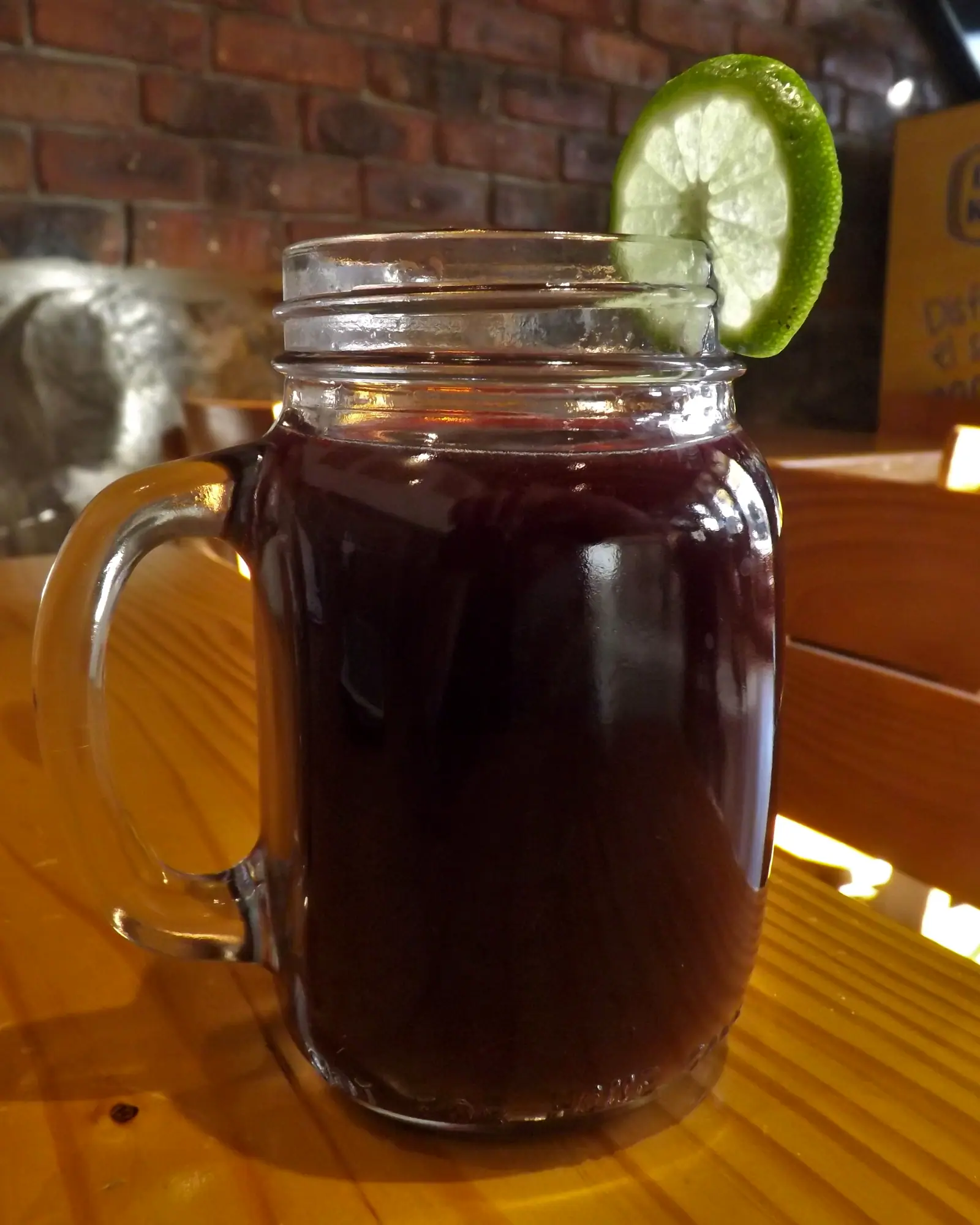

CC BY 2.0 · Cropped, white-balanced, graded and re-encoded to WebP by eXir.
Deep purple chicha morada in a mason-jar mug, garnished with a lime wheel
Serving
Drink spec, per drink
Every figure above is per drink and does not move with the count, which is what makes the two service modes comparable. Sugar per litre, strength and standard drinks stay in the units their own authorities publish, because they are figures for comparing rather than for pouring.
Diet and allergen labels are computed from the ingredients listed on this page and nothing else. They cannot account for cross-contamination or for the particular product you buy, and they are not medical or safety guidance.
Extraction
This brew works out at 100.0 g of coffee per litre of water, against the 49.5 to 60.5 g/L the standard allows, so it is stronger than it. The comparison is made in grams per litre and not on the ratio, because a ratio is the reciprocal of a strength and a symmetric band on one is an asymmetric band on the other. The water temperature also sits outside the standard. Source: Golden Cup Standard, Specialty Coffee Association.
No extraction yield is shown. It needs a measured dissolved-solids figure from the finished cup, nothing on a bag of coffee supplies one, and estimating it from the method would be inventing the single number the calculation exists to establish.
Ingredients
 20 g dried purple corn
 1 pineapple (60 g)
 3 g cinnamon bark
 1 g cloves
 200 ml water
 15 g granulated sugar
 8 ml fresh lime juice
- 20 g dried purple corn
- 1 pineapple (60 g)
- 3 g cinnamon bark
- 1 g cloves
- 200 ml water
- 15 g granulated sugar
- 8 ml fresh lime juice
Glass
Vessel
167 ml of liquid plus 230 ml of cubed ice occupies about 397 ml, inside the 400 ml the glass holds. The build fails if a recipe ever exceeds its stated vessel.
A batch needs a vessel that closes and fits a fridge shelf.
Method
4 steps · 1h 16mCombine the 20 g dried purple corn, 1 pineapple (60 g), 3 g cinnamon bark and 1 g cloves with the 200 ml water and boil at 100 °C for 45m, until the liquid turns a deep purple.
The corn is boiled whole rather than ground, which draws out its deep purple colour slowly over the better part of an hour rather than the few minutes a steep would take.
Strain out the corn, pineapple and spices and discard them.
Stir the 15 g granulated sugar into the hot strained liquid until dissolved.
Cool for 30m, then stir in the 8 ml fresh lime juice and pour over ice.
Common pitfallAdding the lime juice while the liquid is still hot dulls the purple towards brown; it goes in only once the strained liquid has cooled.
Keeping and make-ahead
Made a pot at a time in practice, but authored here as one boil to order.
About
Purple corn boiled with pineapple, cinnamon and cloves, the unfermented, non-alcoholic descendant of a much older Andean corn beverage.
Something close to chicha morada was already being drunk in the Andes before the Inca Empire existed, and colonial chroniclers recorded it being used medicinally, in religious ritual, and as an offering to the dead. This is evidence of a drink woven into Andean life well beyond refreshment 1. No source names an inventor, and none claims one exists; the drink's age is documented through what colonial writers described rather than through any single origin.
That older drink was, by most accounts, fermented rather than boiled. Chicha in its broader sense covers a family of corn beverages across the Andes, and the traditional method for activating fermentation involved chewing the corn, since enzymes in human saliva convert its starches into fermentable sugars 1. Chicha morada specifically is the branch of that family that colonial chroniclers describe being made by boiling instead of fermenting, which is what makes it, unlike chicha in general, reliably non-alcoholic 2. Neither source gives an exact date for that shift, only that it had already taken place by the time it was being written about.
The written record for the drink much resembling today's version becomes clearer in the nineteenth century, with detailed descriptions appearing in the writing of the French author Camille Pradier-Fodéré in the 1870s and earlier references in the work of Juan de Arona and Carlos Prince 2. The method those sources describe (purple corn boiled with pineapple peel, quince, cinnamon and cloves, then strained, cooled and sweetened) is essentially the one still followed, purple corn's colour and mild sweetness serving as the base for whatever fruit and spice a household has on hand 2.
- 1The Hazy Origins Of Peru's Purple Drink, Chicha Moradamashed.com
- 2Chicha moradaen.wikipedia.org