
Cafe de Olla
Coffee simmered with piloncillo and cinnamon in an unglazed clay pot.

CC BY 2.0 · Cropped, white-balanced, graded and re-encoded to WebP by eXir.
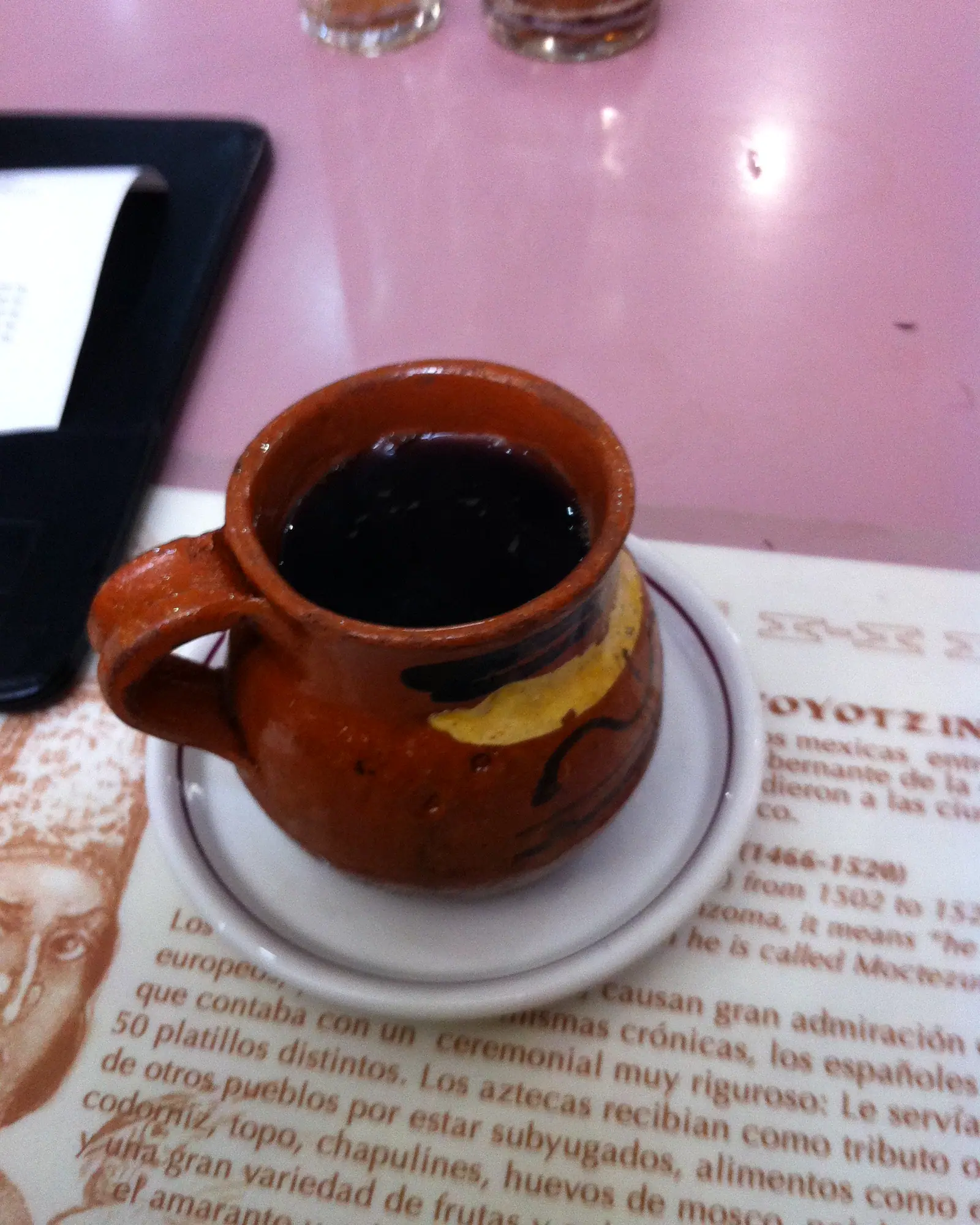
Dark cinnamon-spiced coffee in a traditional clay mug, a lemon wedge on the saucer
Serving
Drink spec, per drink
Every figure above is per drink and does not move with the count, which is what makes the two service modes comparable. Sugar per litre, strength and standard drinks stay in the units their own authorities publish, because they are figures for comparing rather than for pouring.
Diet and allergen labels are computed from the ingredients listed on this page and nothing else. They cannot account for cross-contamination or for the particular product you buy, and they are not medical or safety guidance.
Extraction
This brew works out at 66.7 g of coffee per litre of water, against the 49.5 to 60.5 g/L the standard allows, so it is stronger than it. The comparison is made in grams per litre and not on the ratio, because a ratio is the reciprocal of a strength and a symmetric band on one is an asymmetric band on the other. The water temperature also sits outside the standard. Source: Golden Cup Standard, Specialty Coffee Association.
No extraction yield is shown. It needs a measured dissolved-solids figure from the finished cup, nothing on a bag of coffee supplies one, and estimating it from the method would be inventing the single number the calculation exists to establish.
Ingredients
 300 ml water
 30 g piloncillo
 3 g cinnamon bark
 20 g coffee
- 300 ml water
- 30 g piloncillo
- 3 g cinnamon bark
- 20 g coffee
Glass
Vessel
289 ml of liquid, served without ice, inside the 300 ml the glass holds. The build fails if a recipe ever exceeds its stated vessel.
A batch needs a vessel that closes and fits a fridge shelf.
Method
4 steps · 11mSimmer the 300 ml water with the 30 g piloncillo and 3 g cinnamon bark in a clay or heavy pot for 5m, until the piloncillo is fully dissolved.
The piloncillo and cinnamon go into the water before the coffee does, simmered together long enough to dissolve fully and infuse the water, so the grounds meet already-spiced, already-sweetened water rather than plain water that is sweetened afterward.
Grind the 20 g coffee coarse, close to sea-salt texture.
Stir in the ground coffee, take the pot off the heat and let it steep for 5m.
Strain into the serving mug, leaving the grounds and the spent cinnamon behind in the pot.
Common pitfallAdding the coffee before the piloncillo has fully dissolved leaves undissolved crystals settled in with the grounds, and straining then pulls out sweetness along with the spent coffee.
Keeping and make-ahead
Simmered a pot at a time and strained straight into the cup. Held hot on the stove, the coffee keeps extracting past the point the recipe intends.
About
Coffee simmered with piloncillo and cinnamon in an unglazed clay pot, a Mexican Revolution-era answer to coffee too bitter and too poor to drink plain.
The drink's association with the Mexican Revolution of 1910 to 1920 is specific rather than general: it is credited to the soldaderas, the women who travelled with revolutionary troops as cooks, medics and combatants and are remembered locally as adelitas 1. Coffee in a military camp was routinely reheated and overworked until it turned harshly bitter, and the adelitas' response was to sweeten and spice it rather than brew it better with what they had; piloncillo and cinnamon went in to mask what repeated reheating had done, and the result outlasted the war it was improvised for 1.
The clay pot is not incidental to that story; it is where the drink gets its name. Olla de barro is unglazed earthenware, and both the method and most sources treat the pot as essential rather than traditional-but-optional: clay distributes heat more gently than metal and is credited with giving the coffee an earthy character a saucepan does not reproduce 2 1. The base recipe is coffee, cinnamon and piloncillo, with orange peel, aniseed or cloves added in regional and family versions 2, a spread of variation consistent with a drink that spread by household rather than by recipe card.
It remains most associated with cold weather and rural households rather than city cafes 2, closer to a drink passed down within families than to a commercially standardised one, which is also why versions of it disagree on exactly which spices belong in the pot.
- 1The History of Café de Ollaojo.chapala.com
- 2Café de ollaen.wikipedia.org