
Cafe con Leche
Strong espresso stretched with hot milk, poured over rather than steamed into it.
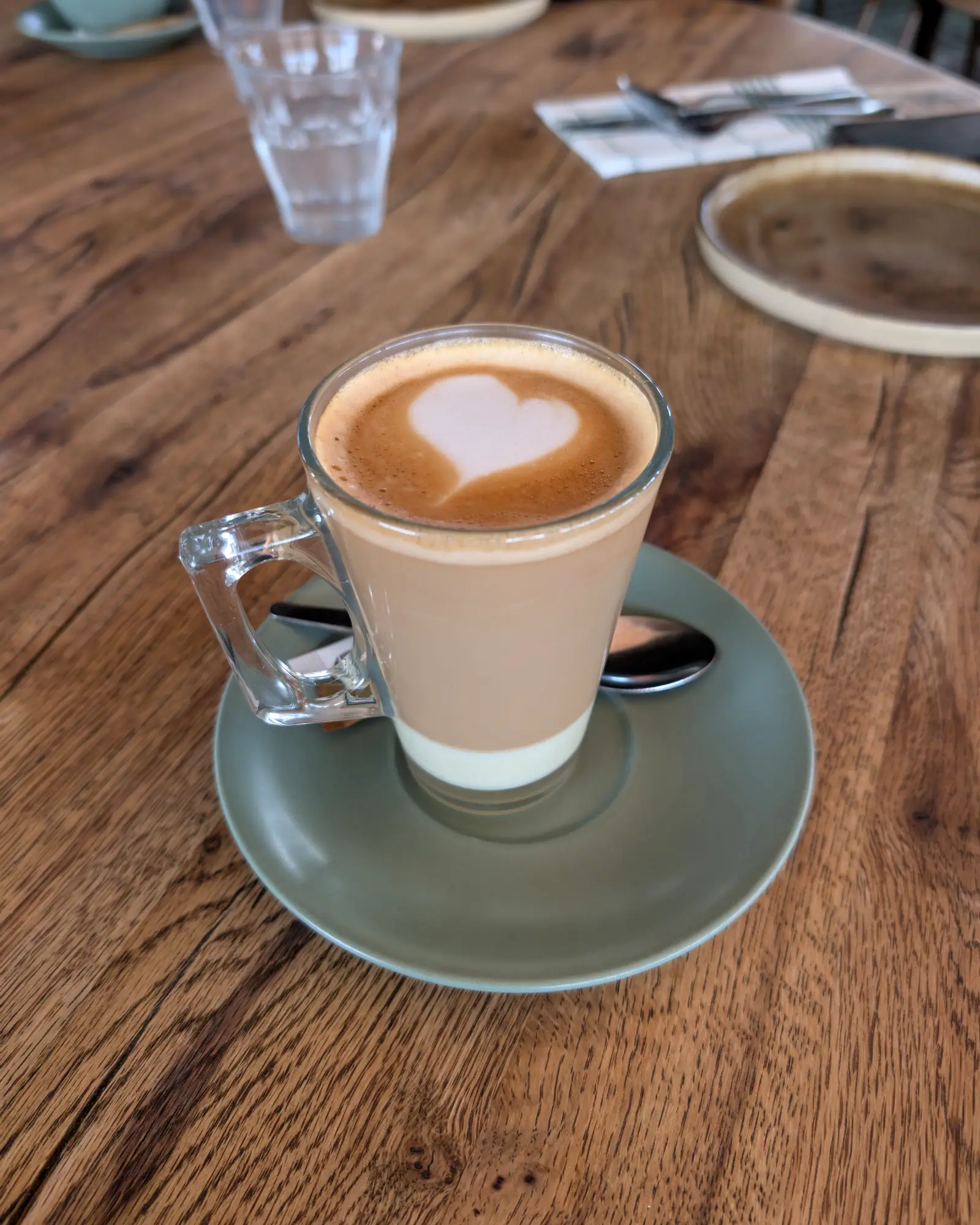

CC0 · Cropped, white-balanced, graded and re-encoded to WebP by eXir.
Café con leche with a heart of latte art, in a glass mug on a saucer
Serving
Drink spec, per drink
Every figure above is per drink and does not move with the count, which is what makes the two service modes comparable. Sugar per litre, strength and standard drinks stay in the units their own authorities publish, because they are figures for comparing rather than for pouring.
Diet and allergen labels are computed from the ingredients listed on this page and nothing else. They cannot account for cross-contamination or for the particular product you buy, and they are not medical or safety guidance.
Extraction
No extraction yield is shown. It needs a measured dissolved-solids figure from the finished cup, nothing on a bag of coffee supplies one, and estimating it from the method would be inventing the single number the calculation exists to establish.
Ingredients
 18 g coffee
 90 ml whole milk
 50 ml water
- 18 g coffee
- 90 ml whole milk
- 50 ml water
Glass
Vessel
126 ml of liquid, served without ice, inside the 350 ml the glass holds. The build fails if a recipe ever exceeds its stated vessel.
A batch needs a vessel that closes and fits a fridge shelf.
Method
4 steps · 2m 28sGrind the 18 g coffee fine for the espresso machine.
Heat the 90 ml whole milk in a small pan or with the steam wand until hot but not boiling.
Pump the 50 ml water through the grounds at 93 °C for 28s to pull the shot.
Pour the hot milk into the cup, then add the shot on top.
The hot milk is poured into the cup first and the shot added on top, rather than the other way round, so the crema stays visible on the surface instead of getting folded under a stream of milk.
Keeping and make-ahead
Pulled and heated to order. A shot held for the milk to catch up loses its crema before the two ever meet.
About
Strong coffee stretched with hot milk in roughly equal parts, a Spanish breakfast habit that became a fuel for Tampa's cigar factories after it travelled through Cuba.
Café con leche's origin in Spain is placed in the nineteenth century, when milk began to be added to coffee as an everyday improvement rather than a special preparation 1. It travelled from there through Spanish-speaking communities, and its clearest documented outpost outside Spain and Cuba is Tampa, where Cuban immigrants working in the cigar industry brought it in the 1880s 2.
What happened in Tampa is unusually well recorded for a drink this ordinary. Cigar factories there employed workers rolling cigars entirely by hand, in shifts long enough that keeping them at the bench mattered to the owners as much as keeping them awake did, and factory owners arranged for professional cafeteros to deliver café con leche (brewed with a pinch of salt, finished with steamed milk and sugar) directly to the rollers rather than let them leave for a break 2. Beans roasted in the Cuban style, supplied locally by mills such as Naviera Coffee, gave the coffee a bolder flavour and a longer shelf life than a lighter roast would have kept 2. The drink spread from the factory floor to streetcar conductors and to restaurants across the city, with the Columbia becoming particularly associated with serving it.
The Spanish and the Cuban-Tampan versions have since drifted apart in sweetness and technique (the Spanish original left closer to plain milk and coffee, the Cuban-influenced version built on sweetened, sometimes sugar-whipped coffee), but both keep the same basic structure of strong coffee lengthened with hot milk in something close to equal measure 1.
- 1What is Cafe Con Leche?787coffee.com
- 2Café con Leche — The drink that powered the cigar industrytampahistorical.org