
Cafe au Lait
Strong drip coffee and scalded milk, poured together in equal measure.
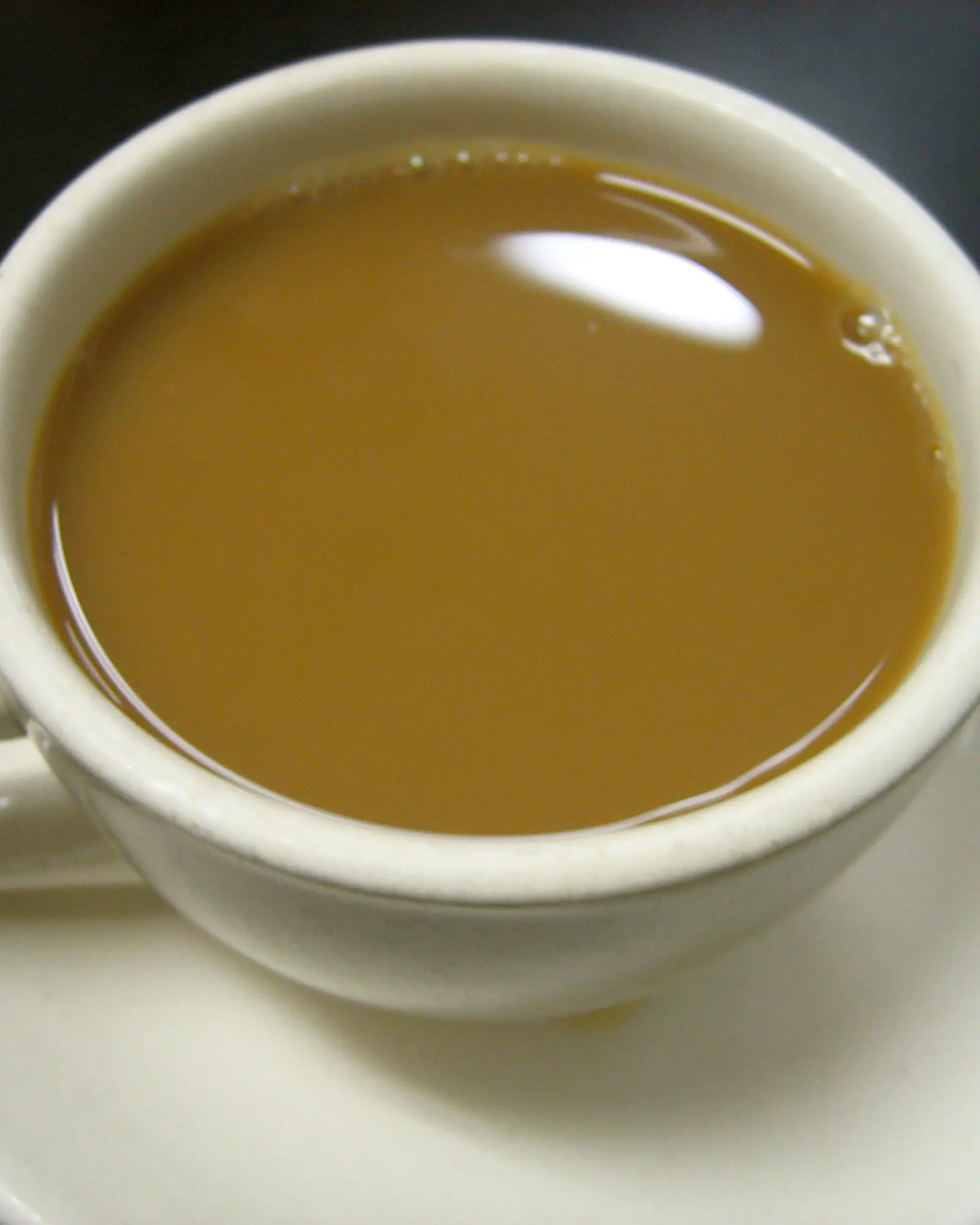

CC BY 2.0 · Cropped, white-balanced, graded and re-encoded to WebP by eXir.
Milky coffee filling a wide white cup, viewed from above
Serving
Drink spec, per drink
Every figure above is per drink and does not move with the count, which is what makes the two service modes comparable. Sugar per litre, strength and standard drinks stay in the units their own authorities publish, because they are figures for comparing rather than for pouring.
Diet and allergen labels are computed from the ingredients listed on this page and nothing else. They cannot account for cross-contamination or for the particular product you buy, and they are not medical or safety guidance.
Extraction
This brew works out at 88.9 g of coffee per litre of water, against the 49.5 to 60.5 g/L the standard allows, so it is stronger than it. The comparison is made in grams per litre and not on the ratio, because a ratio is the reciprocal of a strength and a symmetric band on one is an asymmetric band on the other. Source: Golden Cup Standard, Specialty Coffee Association.
No extraction yield is shown. It needs a measured dissolved-solids figure from the finished cup, nothing on a bag of coffee supplies one, and estimating it from the method would be inventing the single number the calculation exists to establish.
Ingredients
 16 g coffee
 180 ml water
 150 ml whole milk
- 16 g coffee
- 180 ml water
- 150 ml whole milk
Glass
Vessel
300 ml of liquid, served without ice, inside the 350 ml the glass holds. The build fails if a recipe ever exceeds its stated vessel.
A batch needs a vessel that closes and fits a fridge shelf.
Method
4 steps · 4mGrind the 16 g coffee to a medium texture for a drip brew.
Brew the 16 g coffee with the 180 ml water at 94 °C over 3m to give a strong, dark cup.
While the coffee brews, heat the 150 ml whole milk in a small pan just to the point of steaming, without letting it boil.
Pour the hot coffee and the scalded milk into a wide bowl or mug together, in two streams at once.
Coffee and milk are poured into the bowl from two jugs at once, in roughly equal streams, rather than one added to the other; it is the simultaneous pour that keeps the drink an even pale brown rather than a dark coffee lightened at the last moment.
Keeping and make-ahead
Brewed and scalded to order. Milk held hot for later develops a skin and a flat, cooked taste well before the coffee would need it.
About
Strong drip coffee and scalded milk poured together in equal measure, a French breakfast habit old enough to survive in a seventeenth-century letter.
Coffee mixed with milk is documented in France earlier than most of the drinks this site covers: the Marquise de Sévigné, a French aristocrat whose letters are a standard source for the period, referred to it in her correspondence in the seventeenth century 1. That makes café au lait one of the oldest named milk-coffee preparations rather than a later refinement of espresso-bar culture, and it predates the espresso machine by more than two centuries.
The traditional composition has stayed close to that early habit: strong coffee and hot milk combined in roughly equal parts, poured into an oversized, handleless bowl rather than a cup, so that bread or a croissant can be dunked directly into it at breakfast 1 2. That is the detail that most separates it from a caffè latte, which is built on espresso rather than on drip- or press-brewed coffee 2: café au lait's coffee is brewed the way an ordinary pot of coffee is, then lightened with milk at roughly its own strength, not concentrated into a shot first.
The drink's best-known regional variant is not French. New Orleans café au lait is built on coffee cut with chicory, a substitution that dates to the American Civil War, when a Union naval blockade of the port cut off the city's coffee supply and chicory root was roasted and ground in to stretch what remained 1 2. The chicory addition outlived the shortage that caused it and is now treated as the New Orleans style in its own right, poured the same equal-parts way as the French original.
- 1What is a café au lait? Origins and historynescafe.com
- 2Café au laiten.wikipedia.org