
Boza
Millet cooked to a porridge, sweetened and fermented for a day into a thick, faintly tart drink.
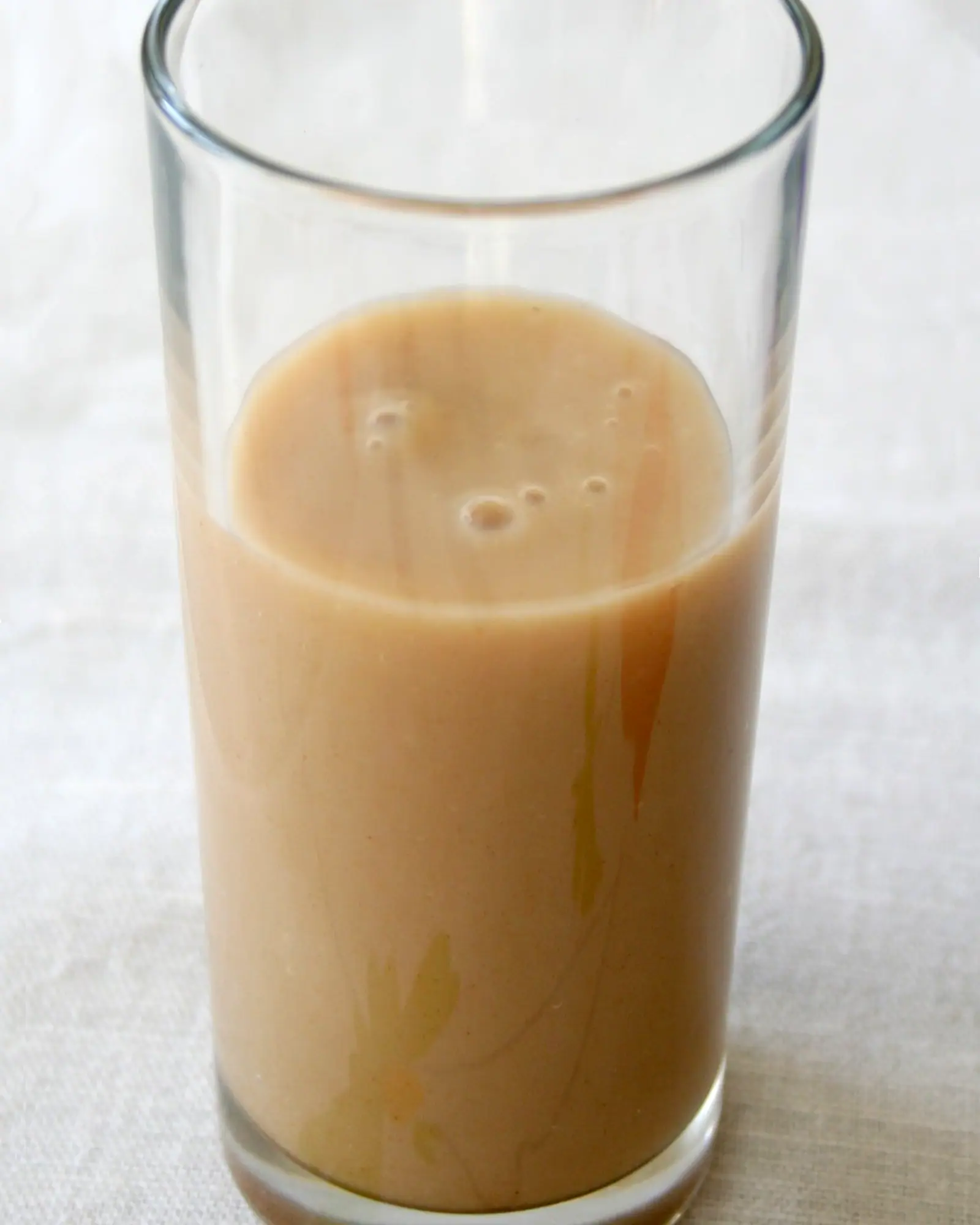

CC BY-SA 3.0 · Cropped, white-balanced, graded and re-encoded to WebP by eXir.
Tan, thick boza filling a tall glass
Serving
Drink spec, per drink
Every figure above is per drink and does not move with the count, which is what makes the two service modes comparable. Sugar per litre, strength and standard drinks stay in the units their own authorities publish, because they are figures for comparing rather than for pouring.
Diet and allergen labels are computed from the ingredients listed on this page and nothing else. They cannot account for cross-contamination or for the particular product you buy, and they are not medical or safety guidance.
Ingredients
 150 g millet
 900 ml water
 100 g granulated sugar
 2 g yeast
 2 g cinnamon bark
- 150 g millet
- 900 ml water
- 100 g granulated sugar
- 2 g yeast
- 2 g cinnamon bark
Glass
Vessel
321 ml of liquid, served without ice, inside the 400 ml the glass holds. The build fails if a recipe ever exceeds its stated vessel.
A batch needs a vessel that closes and fits a fridge shelf.
Method
5 steps · 25h 33mSimmer the 150 g millet in the 900 ml water, stirring occasionally, until it collapses into a soft, thick porridge.
Take it off the heat and let it cool fully to room temperature before anything else goes in, or the next step's yeast will not survive it.
Stir the 100 g granulated sugar and the 2 g yeast through the cooled porridge until both are evenly distributed.
Cover the jar loosely and leave it at room temperature for 24h, away from direct light, until it smells mildly tart rather than sharply alcoholic.
A day at room temperature is enough to turn the sweetened porridge faintly tart without pushing it toward real sourness; historically boza sold this mild was the everyday, non-alcoholic style, while a longer, hotter ferment produced a sharper, more intoxicating drink sold separately.
Strain out the settled grain, pressing to get the last of the liquid through, and refrigerate until cold. Finish each glass with the 2 g cinnamon bark, grated straight over the top.
Common pitfallMillet settles hard once cooked, so the porridge needs a stir on its way into the fermenting jar and again before straining, or the bottom of the batch turns out far thicker than the top.
SafetyThe jar is covered loosely rather than sealed, since the yeast produces real carbon dioxide as it works and a tight lid traps that pressure. A batch that smells sharply of alcohol or solvent, rather than mildly tart, has fermented too far or gone wrong, and either way it should be discarded rather than pushed further.
Keeping and make-ahead
Batched ahead, this keeps sealed and cold. The water line the engine adds is the dilution figure from the spec panel, not a rule of thumb.
About
A thick, faintly tart fermented millet drink carried across Central Asia and the Caucasus into the Ottoman world, historically sold in two distinct strengths under one name.
Fermented cereal drinks of this general kind are documented in Anatolia and Mesopotamia many thousands of years before Boza is recorded as a name, and the word itself is attested among Central Asian Turkic peoples by the tenth century, spreading from there into the Caucasus and the Balkans as Turkic and later Ottoman rule expanded 1. The seventeenth-century Ottoman traveller Evliya Çelebi recorded that it was popular with the Janissaries, who valued it as a low-alcohol drink they could carry on campaign, and that Istanbul alone held some three hundred boza shops 1.
What Evliya's account makes clear is that "boza" was never one drink. He distinguished a sweet, mild, largely non-alcoholic style he considered fit for pious and learned people from a sour, longer-fermented "Tatar" boza sold in port taverns to sailors and labourers, a distinction the food historian Mary Işın has also drawn 2. Ottoman authorities periodically restricted or banned the drink over the centuries, largely because of that stronger, more intoxicating version rather than the sweet one 1. By the nineteenth century the mild, low-alcohol style had become the dominant one at the Ottoman court, and it is the style that survived into ordinary retail sale 2.
Istanbul's Vefa Bozacısı, founded in 1876 and still trading from the same shop today, is the best-documented survivor of that retail trade 2. Its thick, tart style, served cold and traditionally topped with cinnamon and roasted chickpeas, is close to what a modern reader now expects the drink to mean, even though it was originally just one of several regional styles sold under the same name.
- 1Bozaen.wikipedia.org
- 2Bring on the Bozacornucopia.net