
Boulevardier
Bourbon, Campari and sweet vermouth, stirred and strained up.

CC BY-SA 2.0 · Cropped, white-balanced, graded and re-encoded to WebP by eXir.
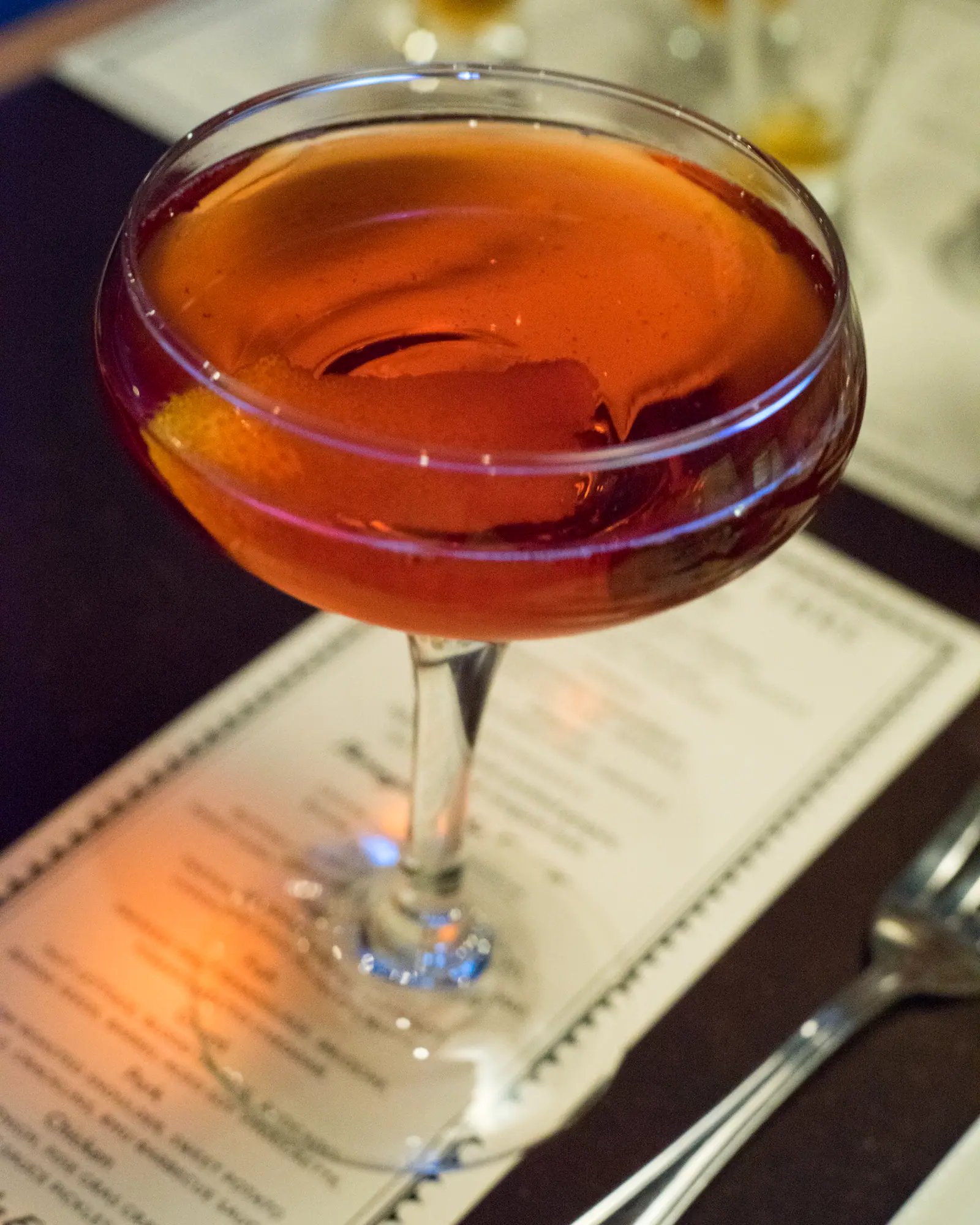
A Boulevardier served up in a coupe, deep amber-red, with an orange twist resting against the rim.
Serving
Drink spec, per drink
Every figure above is per drink and does not move with the count, which is what makes the two service modes comparable. Sugar per litre, strength and standard drinks stay in the units their own authorities publish, because they are figures for comparing rather than for pouring. Dilution is modelled rather than measured, as a fraction of the poured volume before any ice; dotted figures descend from that estimate.
The red was carmine, a colourant made from insects, until the producer moved to synthetic colourants in the mid-2000s. The European label cached here lists E122, E102 and E133 and no carmine, and the United States bottling uses Red 40; reporting on the change describes it as not having reached every market at once, so which colourant is in a given bottle depends on where it was made.
Vermouth is wine-based, and wine may be clarified with isinglass, made from fish, or with gelatine. Neither is a declarable allergen and neither has to appear on a label, so whether a particular bottle is vegan is a question about that producer rather than about vermouth.
Diet and allergen labels are computed from the ingredients listed on this page and nothing else. They cannot account for cross-contamination or for the particular product you buy, and they are not medical or safety guidance.
Ingredients
 45 ml bourbon
 30 ml CampariProprietary
 30 ml sweet vermouth
 1 orange (140 g)
- 45 ml bourbon
- 30 ml CampariProprietary
- 30 ml sweet vermouth
- 1 orange (140 g)
- ~44 ml water
Glass
Vessel
149 ml of liquid, served without ice, inside the 180 ml the glass holds. The build fails if a recipe ever exceeds its stated vessel.
A batch needs a vessel that closes and fits a fridge shelf.
Method
4 steps · 1m 35sChill a coupe.
Combine the 45 ml bourbon, the 30 ml Campari and the 30 ml sweet vermouth in a mixing glass filled with cubed ice.
Stir for 25s, until the outside of the glass is frosted, and strain into the chilled coupe.
Nothing in the glass is cloudy and nothing needs aerating, so it is stirred exactly as its gin-based relative is: shaking would leave it hazy for no gain.
Cut a 4 cm swathe of orange peel, hold it skin-outwards over the surface and squeeze so the oil lands on the drink. Rub it around the rim and drop it in.
Common pitfallBourbon's proof varies far more than gin's does, and a cask-strength bottle used in place of a standard one pours meaningfully more alcohol into the same measure, moving the balance without changing anything else in the method.
Keeping and make-ahead
Batched ahead, this keeps sealed and cold. The water line the engine adds is the dilution figure from the spec panel, not a rule of thumb.
About
A drink published in Paris in 1927, credited to an American writer and named for the well-dressed men-about-town he ran a magazine for, then left undocumented for roughly eighty years before its ratio was revised into the one most bars now pour.
The drink is credited to Erskine Gwynne, an American writer living in 1920s Paris and a co-founder of a magazine named for the well-dressed men-about-town the word describes 1. The recipe appears in Harry MacElhone's 1927 Barflies and Cocktails, inside an essay on the bar culture of the city's American expatriates, and names Gwynne as its author 2. The original proportions are equal parts bourbon, Campari and Italian vermouth 2.
Almost nothing is recorded about the drink between that appearance and its rediscovery during the cocktail revival of the 2000s: a gap of roughly eighty years with no documented reference in between 2. Ted Haigh's 2007 republication of the recipe adjusted the ratio to one and a half parts bourbon against one part each of Campari and vermouth, and it is that heavier-on-the-whiskey version, rather than Gwynne's original equal thirds, that most published recipes and the modern trade now call a Boulevardier 3.
The shape is close enough to its gin-based relative that most modern accounts describe it outright as a whiskey version of that drink rather than as a separate invention 3. What changes is more than the base spirit: with a rounder, sweeter spirit standing where the gin's botanicals were, the Campari reads as less sharply bitter and the whole drink sits fuller and softer on the palate, even with the Campari and vermouth carried over unchanged. Both drinks are stirred rather than shaken for the same reason (everything in the glass is clear and spirituous, and shaking would only cloud it), which is closer to why the two are still described as siblings than any question of who copied whom.
- 1Boulevardier Cocktaildiffordsguide.com
- 2Boulevardier (cocktail)en.wikipedia.org
- 3Boulevardier Cocktail Recipepunchdrink.com