
Bee's Knees
Gin softened with lemon and honey rather than plain sugar.

CC BY-SA 3.0 · Cropped, white-balanced, graded and re-encoded to WebP by eXir.
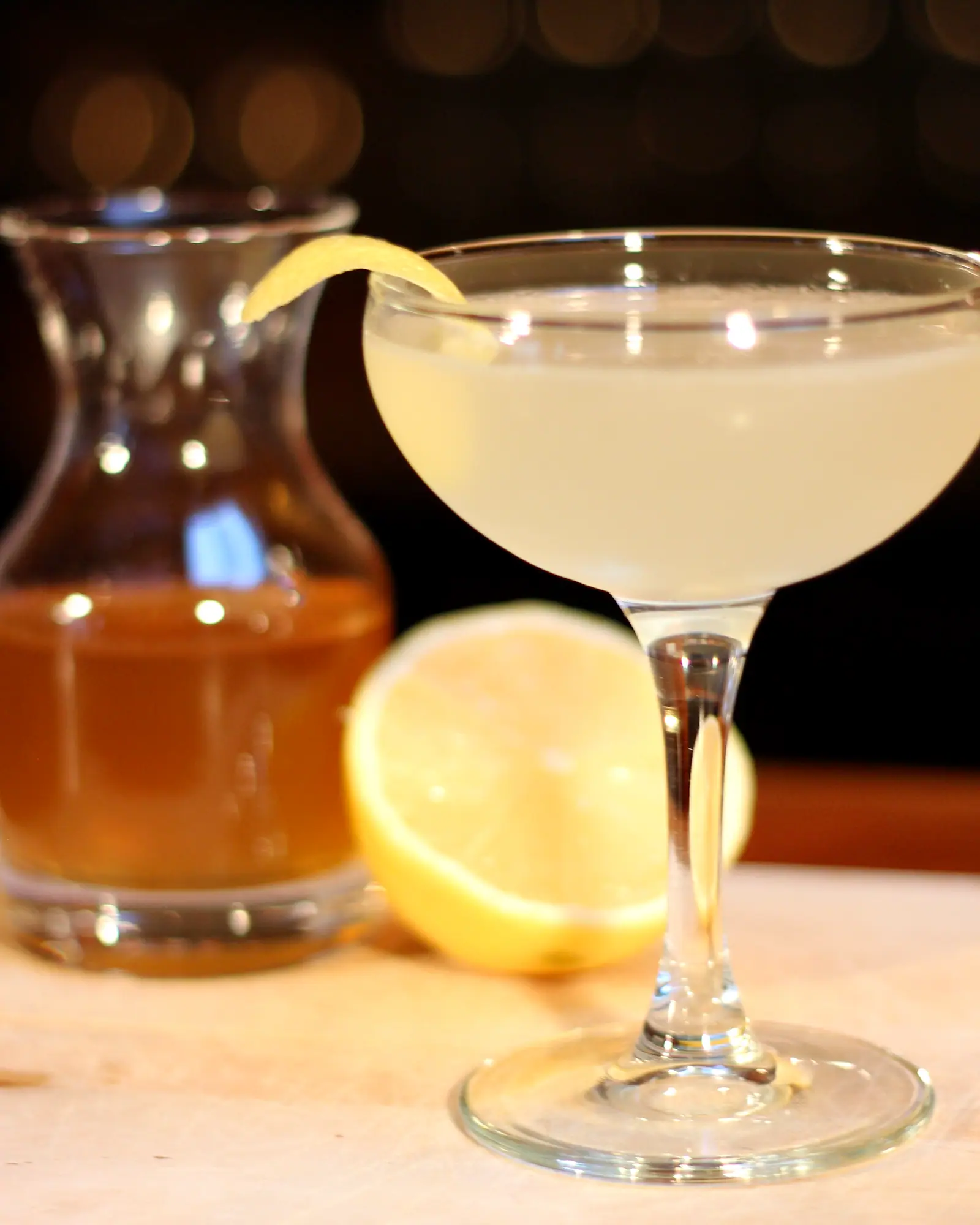
A Bee's Knees cocktail in a coupe glass with a lemon twist, pale golden-yellow, with lemon halves and a carafe of amber liquid in the background
Serving
Drink spec, per drink
Every figure above is per drink and does not move with the count, which is what makes the two service modes comparable. Sugar per litre, strength and standard drinks stay in the units their own authorities publish, because they are figures for comparing rather than for pouring. Dilution is modelled rather than measured, as a fraction of the poured volume before any ice; dotted figures descend from that estimate.
Diet and allergen labels are computed from the ingredients listed on this page and nothing else. They cannot account for cross-contamination or for the particular product you buy, and they are not medical or safety guidance.
Ingredients
 23 ml fresh lemon juice
 60 ml London dry gin
- 23 ml honey syrupInterchangeable by volume and close in sugar, so the arithmetic barely moves. What is lost is the honey's own floral note, which is most of the reason this drink is named separately from a plain gin sour rather than folded into it.flavour: significant change · strength: no change · sweetness: no change
Glass
Vessel
158 ml of liquid, served without ice, inside the 180 ml the glass holds. The build fails if a recipe ever exceeds its stated vessel.
A batch needs a vessel that closes and fits a fridge shelf.
Method
4 steps · 1m 52sSqueeze the 23 ml fresh lemon juice and strain out the pips and pulp.
Combine the 60 ml London dry gin, the 23 ml fresh lemon juice and the 23 ml honey syrup in a shaker and fill it with cubed ice.
Honey syrup rather than honey straight from the jar. Honey on its own is too viscous to combine evenly in a cold shake and sinks to the bottom of the glass; let down with water first, it pours and measures the same as any other sweetener in the family.
Shake hard for 12s. Short and violent; the aim is to chill and aerate, not to melt the ice.
Double strain into a chilled coupe, catching the ice shards the shake has broken off.
Common pitfallA cheap blended honey reads as sweetness with almost no aroma of its own, which leaves this drink barely different from a plain gin sour. A single-varietal honey with real character is most of what distinguishes the two.
Keeping and make-ahead
Batched ahead, this keeps sealed and cold. The water line the engine adds is the dilution figure from the spec panel, not a rule of thumb.
About
A Prohibition-era gin sour sweetened with honey instead of sugar, whose own origin is one of the family's least settled.
The Bee's Knees has no single documented inventor, and the two names most often attached to it point in different directions. One account credits Frank Meier, an Austrian-born bartender who became the first head bartender at the Ritz Hotel in Paris when its Café Parisien opened in 1921 1. A second, from a 1929 newspaper item, attributes it instead to Margaret Brown, the American socialite later known for surviving the sinking of the Titanic 1. Neither claim is corroborated by a recipe in print at the time, which is why the drink is usually described as being of unclear origin rather than assigned to either name outright.
What is not in dispute is the period. The name is Prohibition-era slang for "the best," and the drink belongs to American Prohibition, when gin was the spirit most readily available to make at home and lemon and honey were ordinary kitchen goods rather than a bar's stock 1.
The drink has also had a documented modern revival. Barr Hill, a Vermont gin distillery, began an annual "Bee's Knees Week" in 2017 built around pollinator conservation, and a 2023 New York Times article credited that promotion with part of the cocktail's renewed popularity 1. The honey syrup that gives the drink its name is the one part of the recipe that has never been in question, whatever the disagreement about who first poured it.
- 1Bee's Kneesen.wikipedia.org