
Banana Smoothie
Frozen banana blended with milk and honey until smooth and thick enough to hold a straw upright.

CC BY 2.0 · Cropped, white-balanced, graded and re-encoded to WebP by eXir.
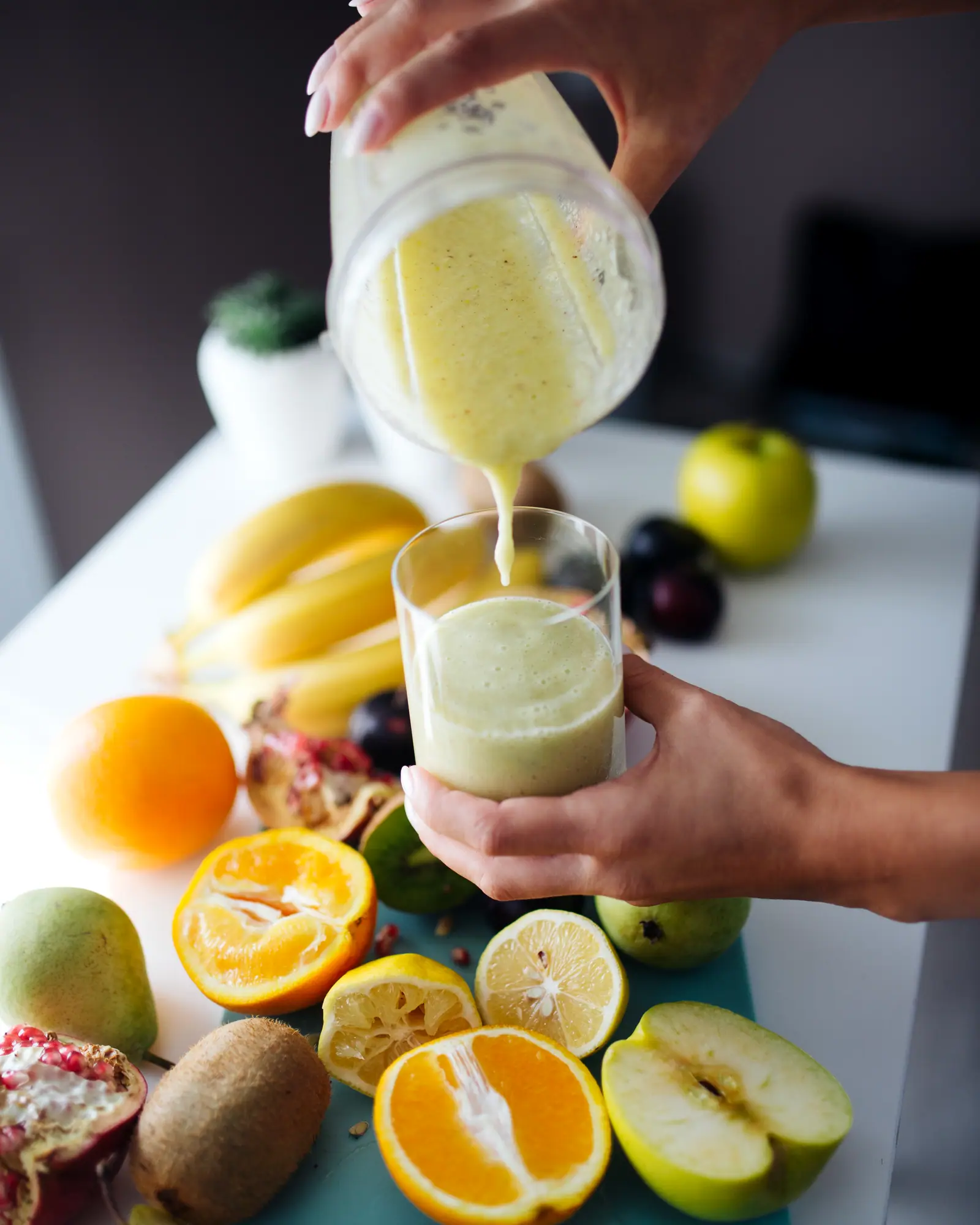
A pale yellow fruit smoothie being poured into a glass, surrounded by fresh fruit
Serving
Drink spec, per drink
Every figure above is per drink and does not move with the count, which is what makes the two service modes comparable. Sugar per litre, strength and standard drinks stay in the units their own authorities publish, because they are figures for comparing rather than for pouring.
Diet and allergen labels are computed from the ingredients listed on this page and nothing else. They cannot account for cross-contamination or for the particular product you buy, and they are not medical or safety guidance.
Ingredients
 90 ml whole milk
 150 g peeled banana
 15 ml honey
- 90 ml whole milk
- 150 g peeled banana
- 15 ml honey
Glass
Vessel
248 ml of liquid, served without ice, inside the 450 ml the glass holds. The build fails if a recipe ever exceeds its stated vessel.
A batch needs a vessel that closes and fits a fridge shelf.
Method
3 steps · 1m 5sAdd the 90 ml whole milk to the blender jug first, then the frozen 150 g peeled banana and the 15 ml honey.
The banana is peeled, sliced and frozen solid before it goes anywhere near the jug. It is the drink's whole frozen solid slot, doing the work ice does in a frozen cocktail, and a fresh banana blended with ice cubes instead comes back thinner and waterier for it.
Blend for 30s, until the banana has broken down completely and the mixture is uniform, thick and pourable rather than churning as loose chunks.
Pour into a chilled smoothie glass.
Common pitfallFrozen banana on its own is thick enough to stall a blender that never built the vortex the milk is there for. Adding the milk first and the fruit after gives the blade something to move through from the start.
Keeping and make-ahead
This drink is made to order.
About
A health food store staple built on a 1930s blender, that only turned into a branded, mainstream drink once Steve Kuhnau opened Smoothie King in 1973.
Blending fruit into a thick, drinkable purée needed a machine that did not exist commercially before the 1930s. Fred Waring and Fred Osius spent that decade developing a blender powerful enough to purée whole fruit, released as the Waring Blendor 1. Health food stores on the US west coast took it up soon after, and by the 1960s smoothies were an established part of a wider health food movement built around vegetarianism, whole foods and a turn away from processed ones 2 1.
The drink stayed a health food store item rather than a mainstream one until Steve Kuhnau opened the first Smoothie King in 1973, after several years of blending his own fruit and juice combinations as a lactose-intolerant teenager looking for something closer to a milkshake he could actually drink 1. Smoothie King's franchising turned a homemade fix into a category, and other chains followed, eventually pulling the smoothie away from its health food origins with sweeter, less austere recipes aimed at a wider market 2.
The banana smoothie itself was never a single invention. It sits at the plainest end of what the blender and the health food movement made possible: fruit, a liquid and no more engineering than the two required, which is likely why it carries no origin story of its own the way the branded and flavoured versions that followed it do.
- 1The Smoothie Revolutionthedailymeal.com
- 2Smoothieen.wikipedia.org