
Amazake
Rice and koji kept warm until the grain's own starch turns sweet, with no added sugar and no alcohol.
Sake lees dissolved into hot sweetened water, carrying a little of the alcohol left over from brewing.
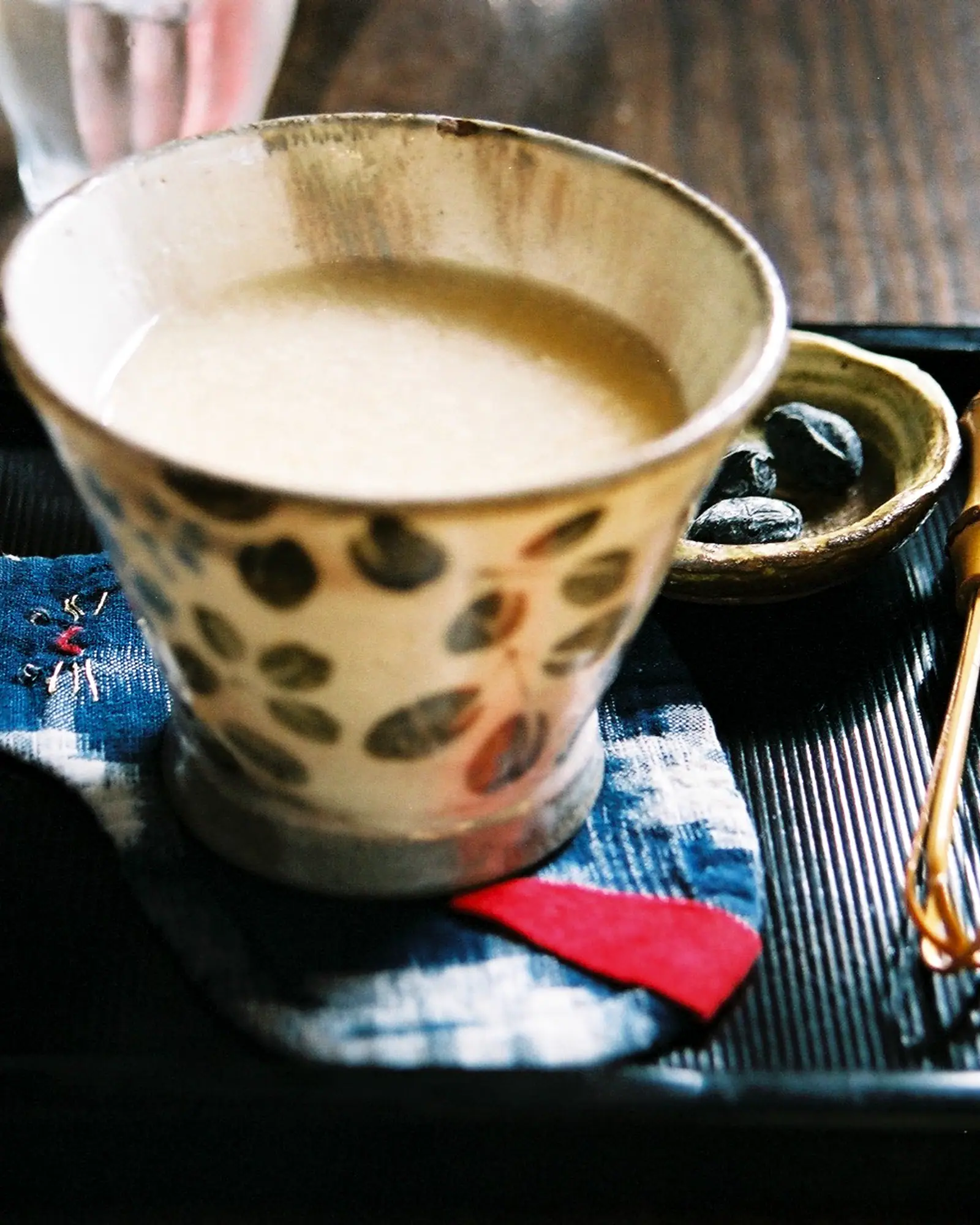

CC BY 2.0 · Cropped, white-balanced, graded and re-encoded to WebP by eXir.
Pale beige amazake served warm in a hand-painted ceramic cup on a tray, with a small dish and red accent cloth beside it
Serving
Drink spec, per drink
Every figure above is per drink and does not move with the count, which is what makes the two service modes comparable. Sugar per litre, strength and standard drinks stay in the units their own authorities publish, because they are figures for comparing rather than for pouring.
Diet and allergen labels are computed from the ingredients listed on this page and nothing else. They cannot account for cross-contamination or for the particular product you buy, and they are not medical or safety guidance.
Ingredients
 150 g rice koji
 150 g cooked rice
 450 ml water
- 150 g rice koji
- 150 g cooked rice
- 450 ml water
Glass
Vessel
225 ml of liquid, served without ice, inside the 350 ml the glass holds. The build fails if a recipe ever exceeds its stated vessel.
A batch needs a vessel that closes and fits a fridge shelf.
Drink spec, per drink
Every figure above is per drink and does not move with the count, which is what makes the two service modes comparable. Sugar per litre, strength and standard drinks stay in the units their own authorities publish, because they are figures for comparing rather than for pouring.
Diet and allergen labels are computed from the ingredients listed on this page and nothing else. They cannot account for cross-contamination or for the particular product you buy, and they are not medical or safety guidance.
Ingredients
 150 g sake kasu
- 450 ml water
 45 g granulated sugar
 5 g fresh ginger
- 150 g sake kasu
- 450 ml water
- 45 g granulated sugar
- 5 g fresh ginger
Glass
Vessel
311 ml of liquid, served without ice, inside the 350 ml the glass holds. The build fails if a recipe ever exceeds its stated vessel.
A batch needs a vessel that closes and fits a fridge shelf.
Method
3 steps · 8h 2mStir the 150 g rice koji into the still-warm 150 g cooked rice along with the 300 ml water, breaking up any clumps of koji as it goes in.
Hold the mash at 55 °C to 60 °C for 8h, covered but not sealed, stirring it once or twice. It is ready when it tastes distinctly sweet and the grains have mostly broken down.
A rice cooker on its keep-warm setting, a yoghurt maker or a thermos flask all hold the mash in the range the koji's enzymes need; well above it the enzymes are destroyed before they finish their work, and well below it the conversion barely happens in the time given.
Stir in the 150 ml water, warmed through, to loosen the mash to a drinkable consistency, and ladle it into cups while it is still warm.
Common pitfallStirring the koji into water that is still too hot from the rice scalds the culture before it starts working, and the mash never sweetens; let the rice cool to the ferment's own range before the koji goes in.
Keeping and make-ahead
Batched ahead, this keeps sealed and cold. The water line the engine adds is the dilution figure from the spec panel, not a rule of thumb.
Method
3 steps · 6mTear the 150 g sake kasu into pieces and whisk it into the 450 ml water over medium heat until it has fully broken down into a smooth, cloudy liquid.
The lees come as a dense, sticky sheet rather than a powder, so they are torn into pieces and whisked into the hot water over heat rather than simply stirred in cold, or they take far too long to break down.
Stir in the 45 g granulated sugar and hold the pot at a bare simmer until it dissolves.
Ladle into cups and finish each with a little of the 5 g fresh ginger, grated straight over the top.
Common pitfallBoiling the mixture hard drives off both the alcohol and the aroma that make sake kasu amazake taste like what it is; it wants a steady simmer, not a rolling one.
Keeping and make-ahead
Batched ahead, this keeps sealed and cold. The water line the engine adds is the dilution figure from the spec panel, not a rule of thumb.
About
A sweet fermented rice drink recorded in Japan since antiquity, made either from rice and koji with no alcohol at all, or from the pressed lees of sake with a little of the brewing left in it.
Amazake is old enough to appear in the Nihon Shoki, Japan's earliest official chronicle, compiled in 720 1. The chronicle records an offering of rice-and-koji liquor to Emperor Ojin around the late third century, and a separate ceremonial drink tied to a mythological birth, either of which is sometimes pointed to as the drink's origin 2. A Nara-period poem by Yamanoue no Okura describes ordinary people warming themselves with lees dissolved in hot water, which is the earliest clear trace of the sake-kasu version rather than the koji one 2.
Peddlers were already selling amazake in the streets by the Muromachi period, and by the Edo period the drink was made much as it is today and sold widely enough that the shogunate set a maximum price for it 21. It was drunk hot through the winter and, counterintuitively to a modern reader, cold in summer as well, valued as a quick source of sugar and vitamins during the hottest months before refrigeration made other drinks easy to keep cool.
The two methods on this page are genuinely different processes rather than a stylistic choice. Koji amazake steeps steamed rice with rice-koji at a temperature the koji's own enzymes need to convert starch into glucose, and it develops no alcohol at all. Sake-kasu amazake instead starts from the solid lees pressed out of sake during brewing, which already carry a small amount of alcohol and sake yeast; dissolved in hot water and sweetened rather than left to ferment further, it keeps that alcohol rather than being sweetened by any enzyme of its own 1. A drink sold simply as amazake could historically be either, and the two are not interchangeable for anyone avoiding alcohol.
- 1Ingredients, Functionality, and Safety of the Japanese Traditional Sweet Drink Amazakepmc.ncbi.nlm.nih.gov
- 2Tracing the History of the Fermented Beverage, Amazakeshun-gate.com