American · Bread
Sourdough Bread
A naturally leavened loaf raised entirely by a mature flour-and-water starter, its long fermentation done mostly overnight in the refrigerator. One serving is one slice.
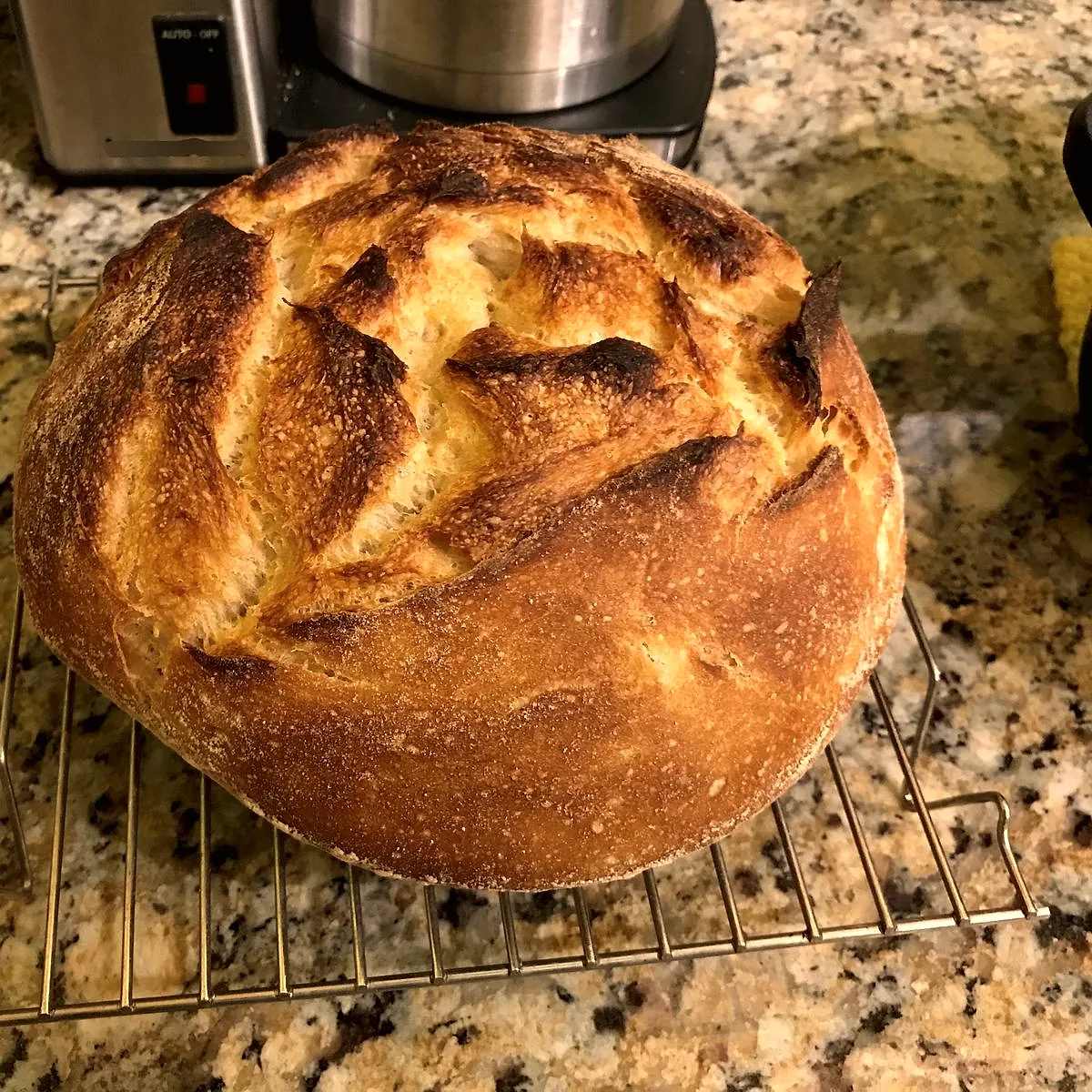

CC0. Cropped and colour-adjusted for this site.
Method
The evening or morning before baking, feed the starter with fresh flour and water and leave it at room temperature for 8h, until it has visibly doubled and looks domed and bubbled across the top.
Stir the 500 g bread flour and the 350 ml water together into a shaggy, floury dough, with no dry patches left. Cover and leave it to rest for 1h, which lets the flour hydrate fully before any mixing begins.
Add the 100 g active sourdough starter and the 10 g fine sea salt to the rested dough and work them in by hand, pinching and folding the dough over itself for 8m, until both are fully incorporated and the dough feels smooth enough to hold together.
Common pitfallStarter added before it has risen to its peak leavens the dough too slowly and gives it too little time to develop structure. It should float when a small spoonful is dropped in water; if it sinks, it needs longer to feed.
Cover the dough and leave it to rise at room temperature for 4h, until it looks noticeably fuller and slightly domed.
During the bulk rise, reach into the bowl, stretch one side of the dough up and fold it over onto itself, turn the bowl a quarter turn and repeat around all sides. Do this a few times at evenly spaced intervals across the rise, spending 10m in total; each round of folding tightens the dough's structure without ever needing to knead it.
Turn the dough out onto a lightly floured surface and shape it into a tight round by dragging it against the surface with cupped hands, over 6m. Set it seam-side up in a floured proving basket.
Cover the basket and refrigerate the shaped dough for 12h, ideally overnight, so it finishes proving slowly in the cold.
A long, cold overnight rise develops flavour that a fast, warm rise cannot: the yeast slows down while the bacteria that produce sourdough's characteristic acidity keep working, and the cold dough is also far easier to score cleanly.
Heat a covered heavy pot in the oven to 240 °C. Turn the cold dough out onto a sheet of baking paper, score the top with a sharp blade, and lower it into the hot pot using the paper as a sling. Bake covered for most of 45m, then uncover for the final stretch to let the crust brown and turn deep golden.
Naturally leavened bread is ancient, and nobody claims San Francisco invented it: wild-yeast fermentation was in use in Egypt millennia before California existed as a place name. What San Francisco supplied was the story that made sourdough an American identity rather than just a method.
When the Gold Rush of 1848–49 drew tens of thousands of prospectors west, sourdough starter travelled with them because it was durable, self-renewing and did not require a fresh supply of commercial yeast in a mining camp [1]. A small amount of starter let a miner stretch a little flour into bread indefinitely, and the culture became valuable enough that miners reportedly kept it close to their bodies, even sleeping with the pot on cold nights so the yeast and bacteria did not die [1]. The word "sourdough" became slang for a long-term prospector himself, a sign of how closely the two were associated.
French and Italian immigrant bakers opened shop in San Francisco during the same population boom, among them Isidore Boudin, whose bakery, founded in 1849 and still trading today, is generally credited as the origin of the continuously maintained "mother dough" culture the city's bakeries still use [2]. The particular tang associated with San Francisco sourdough is usually attributed to local wild yeast and bacteria strains, though the extent to which any given loaf still depends on a genuinely local culture, after a century and a half of shipping starters in and out of the city, is harder to verify than the marketing suggests.
Sources
- Gold Miners Kept Their Sourdough Starters Alive By Cuddling Them, Smithsonian MagazineOn miners' reliance on portable sourdough starters during the California Gold Rush.
- San Francisco Sourdough History, Food52Traces San Francisco's sourdough bakeries back to the Gold Rush-era immigrant bakers.