Brazilian · Dessert
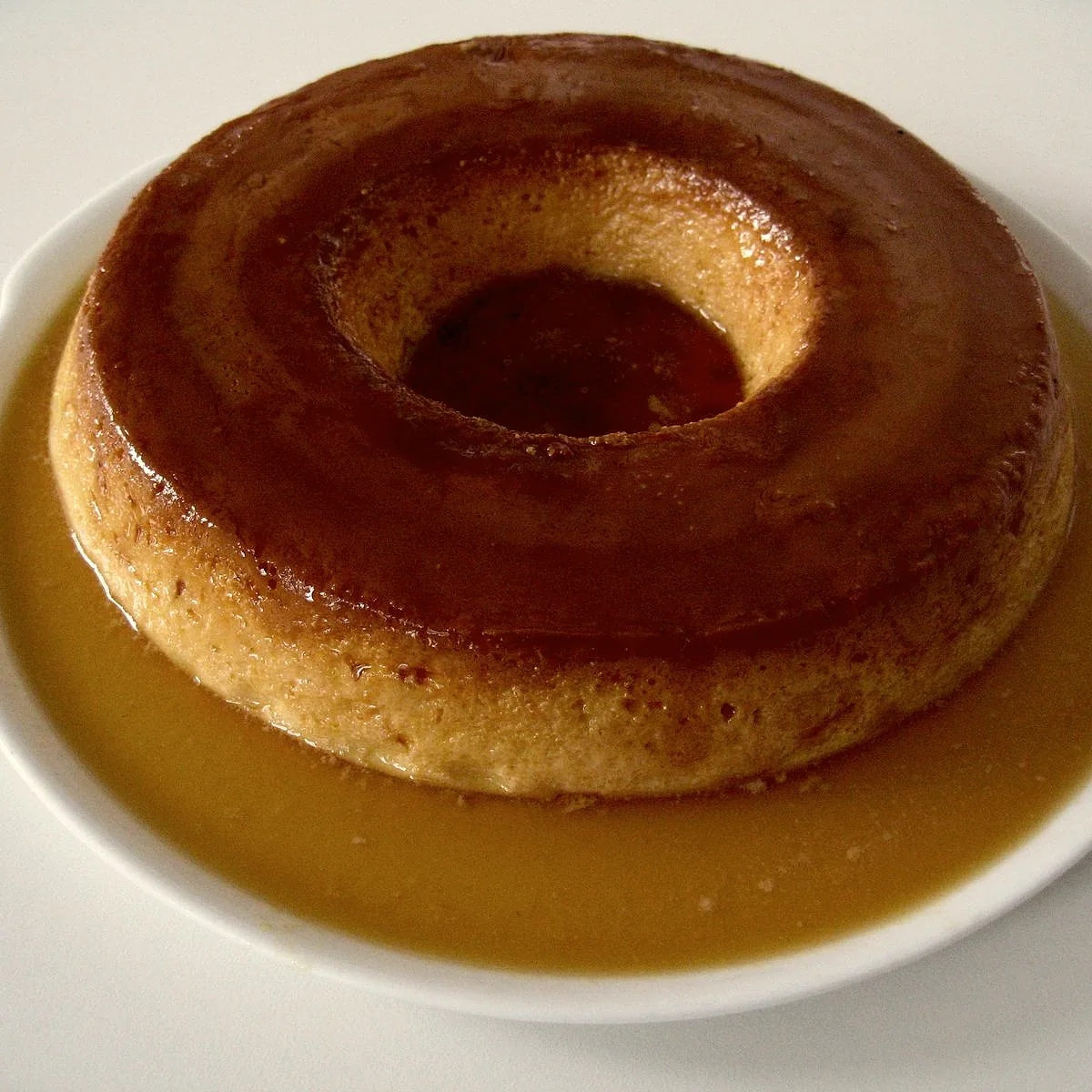
Pudim de Leite Condensado
A dense, egg-set caramel custard made with condensed milk in place of most of the sugar and cream a French crème caramel would use.
Not the same asCrème caramel (The French dessert it descends from is set with milk or cream, egg and a smaller amount of sugar; pudim's defining ingredient, condensed milk, makes it denser, sweeter and richer than its European relative.)
.jpg)
CC BY-SA 2.0. Cropped and colour-adjusted for this site.
Method
Melt the 150 g caster sugar with the 45 ml water in a saucepan over a medium heat, swirling occasionally, until it turns a deep amber. Immediately pour it into a metal ring mould, tilting to coat the base and lower sides, then set aside to harden.
Blend the 395 g condensed milk, 300 ml milk and 3 eggs (150 g) together until smooth, then pour over the set caramel in the mould.
Set the mould in a deep tray and pour in hot water to come halfway up its sides. Bake at 180 °C for 1h, until the custard is set at the edges but still holds a gentle wobble at the centre.
Baking the custard standing in a tray of hot water insulates it from the oven's direct heat, so it sets gently and evenly. Baked without the water bath, the outside overcooks and turns rubbery and pitted long before the centre sets.
Lift the mould from the water bath, cool to room temperature, then refrigerate for 4h, until completely cold and firm.
Common pitfallUnmoulding before the custard is fully cold makes it collapse rather than hold its shape, and the caramel does not release cleanly from the mould while still warm. It wants the full chill before it is turned out.
Run a knife around the edge, invert a serving plate over the mould and turn out in one motion, letting the liquid caramel run down over the custard.
Pudim de leite condensado belongs to the same family as the French crème caramel: an egg custard baked over a layer of caramelised sugar and turned out so the caramel runs down over the top, a technique Brazilian culinary teaching places squarely within the same wider custard family as flan and crème caramel [2]. What separates the Brazilian version from its European relatives is a single ingredient, sweetened condensed milk, which replaces most of the sugar and some of the milk in the base recipe and gives the finished custard its particular density and sweetness.
That ingredient's dominance in Brazilian kitchens is not incidental. Nestlé opened its first Brazilian condensed-milk factory in Araras, São Paulo, in 1921, and the product took its enduring name (Leite Moça, "the young woman's milk") from the maid pictured on the tin, after customers began asking for it by that description rather than by its formal name [1]. Condensed milk became popular as a dessert ingredient through the 1940s, and Nestlé's own advertising for pudim and similar recipes ran continuously from the 1950s into the 1980s [2], distributed through packaging, pamphlets and a dedicated home-economics service that systematically rebuilt traditional Brazilian sweets around condensed milk in place of more laborious techniques; a former head of that service later acknowledged the company had formulated its own version of recipes that were already established [1]. Pudim, along with brigadeiro and beijinho, was among the sweets reshaped this way.
The result is a case where a company's commercial interest and a country's culinary habit became difficult to separate: pudim made with condensed milk is now treated in Brazil as the traditional recipe in its own right, rather than as one branded version of an older French dessert.
Sources
- Como a Nestlé se apropriou das receitas brasileiras (ou de como viramos o país do leite condensado), O Joio e O TrigoInvestigative piece on Nestlé's Brazilian condensed-milk operation, including the 1921 Araras factory, the "Leite Moça" brand name, and the company's own home economics department admitting to reformulating traditional sweets around the product.
- Pudim de leite condensado, Cozinha TécnicaBrazilian culinary-education site placing pudim in the wider custard family and dating condensed milk's popularisation as a dessert ingredient to the 1940s, with Nestlé's own advertising for the recipe running from the 1950s into the 1980s.